

Best Drone for Video Quality in 2026: The Ultimate Filmmaker’s Guide
What if the most expensive drone on your wishlist is actually the wrong choice for your specific production needs? You've likely spent hours squinting at spec sheets trying to decode the difference between 10-bit D-Log M and HLG. It's frustrating to feel like you need an engineering degree just to find the best drone for video quality that won't be obsolete by next season. We understand the stress of wanting that crisp 6K/60fps HDR footage while worrying if the December 23, 2025, FCC "Covered List" updates might ground your new investment.
At Drone Doctor LLC, we're the leaders in sales and service, and we believe you deserve a reliable tool that works as hard as you do. This guide promises to clear the confusion by highlighting drones with the highest resolution, best color science, and smoothest stabilization available in May 2026. We'll preview top performers like the 100MP DJI Mavic 4 Pro and the accessible Potensic Atom 2; ensuring you find a cinematic powerhouse backed by expert support. Act now to elevate your production value with gear you can trust and fly with total confidence.
Key Takeaways
- Learn why sensor size and bitrates above 200Mbps are more critical for professional color grading than simple resolution stats.
- Compare the top 2026 contenders to identify the best drone for video quality based on your specific production budget.
- Master essential cinematic techniques, including using ND filters for motion blur and O5 transmission to eliminate dropped frames.
- Follow our video-first buying framework to choose the right gear for your output, from social media to high-end client delivery.
- Discover how expert curation and fast repair services ensure your professional power stays in the air and on schedule.
What Defines the Best Drone for Video Quality in 2026?
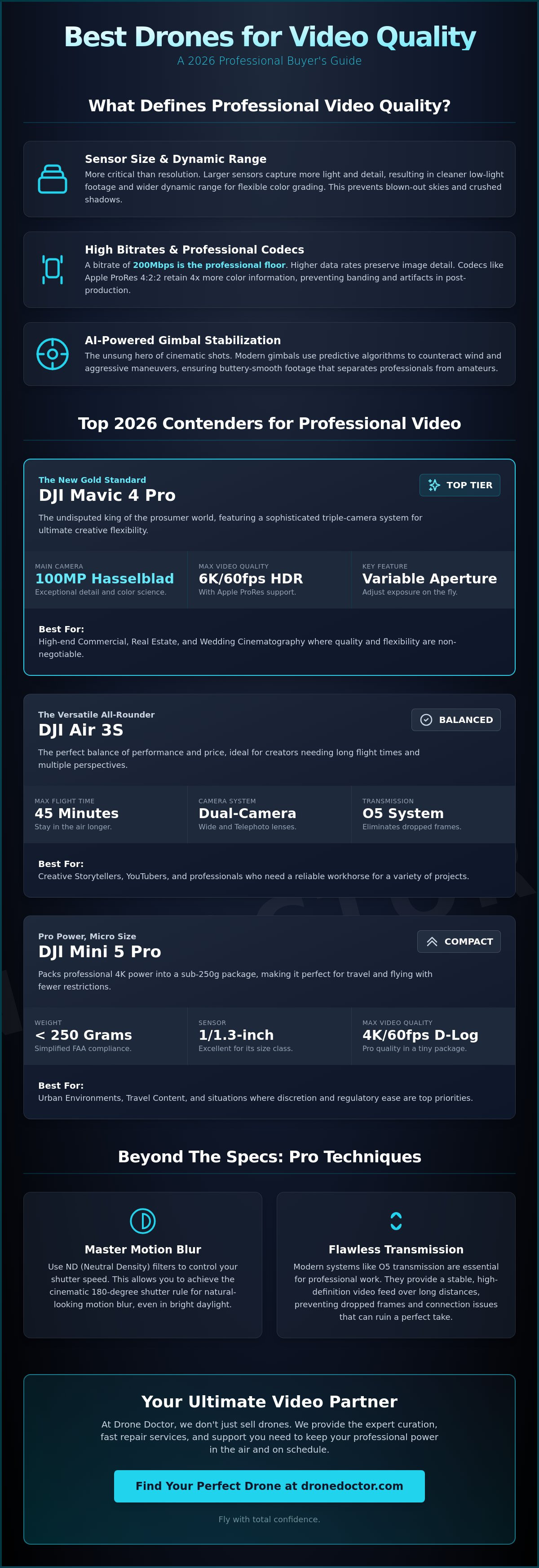
Don't get distracted by flashy megapixel counts on a retail box. While 8K resolution sounds impressive, the real secret to the best drone for video quality lies in the hardware's ability to capture light and raw data. Since the early history of aerial videography, professionals have understood that sensor surface area and color depth dictate the final cinematic look. In 2026, we prioritize sensor size over raw resolution because larger sensors deliver the dynamic range needed for high-end client work.
Professional grading requires massive amounts of data. If your drone records at a measly 100Mbps, your footage will likely fall apart the moment you push the shadows or highlights in post-production. We consider a bitrate of 200Mbps the absolute floor for professional work. This ensures that every frame retains the detail necessary for broadcast standards. Additionally, your gimbal is the unsung hero of the shot. Modern 2026 gimbals use AI-driven predictive algorithms to maintain a level horizon even when fighting 30mph gusts, providing that buttery smooth motion that separates hobbyists from the pros. Act now to secure a rig from Drone Doctor LLC that handles the elements without sacrificing your vision.
Sensor Size and Low-Light Performance
The 1/1.3-inch sensor on the DJI Mini 5 Pro is a marvel of portability, but it cannot compete with the 100MP Hasselblad system found on the Mavic 4 Pro. Larger physical pixels allow the sensor to soak up more light with significantly less electronic noise. This results in cleaner 6K files during blue hour or in dimly lit urban environments. Larger sensors provide a wider latitude between the brightest highlights and the deepest shadows, preventing blown out skies while maintaining rich detail in the foreground. This dynamic range is the hallmark of professional power in the air.
The Science of the Shot: Codecs and Color Profiles
Choosing your color profile is about balancing your workflow with final output quality. D-Log M offers a flat image with 1,024 shades of color per channel, perfect for editors who want total creative control during the grade. HLG (Hybrid Log-Gamma) is your go-to for instant HDR delivery without a heavy post-production lift. For high-budget projects, Apple ProRes support is a must-have; it utilizes 4:2:2 chroma subsampling to preserve four times the color information compared to standard 4:2:0 compression. This prevents ugly pixelation or "banding" in the sky during heavy grading. Shop with confidence knowing our experts at Drone Doctor LLC only stock the best drone for video quality options that meet these rigorous 2026 standards.
Top 2026 Contenders for Professional Video Quality
Selecting the right tool for your specific mission is the difference between a shaky hobbyist clip and a cinematic masterpiece. In May 2026, the market offers incredible variety, yet only a few models truly earn the title of the best drone for video quality. Whether you're shooting a high-budget commercial or a fast-paced social media reel, these contenders deliver the professional power you need to stand out. Act NOW to secure these top-tier machines before your next big shoot.
DJI Mavic 4 Pro: The New Gold Standard
The DJI Mavic 4 Pro is the undisputed king of the prosumer world. It features a sophisticated triple-camera system led by a 100MP Hasselblad wide-angle lens capable of 6K/60fps HDR video. The variable aperture is a game changer for commercial work; it allows you to adjust exposure instantly without landing to change filters. This flexibility makes it a must-have for real estate and high-end wedding cinematography. Because these high-value sensors are a significant investment, we recommend our professional drone repair services to keep your gear in peak condition. Shop with confidence knowing Drone Doctor LLC can handle any technical hiccups on the fly.
For creators who need a balance of performance and price, the DJI Air 3S is a versatile all-rounder. It offers a 45-minute flight time and dual-camera versatility for creative storytelling. If you need to stay under the 250-gram weight limit to simplify compliance with certain FAA regulations for commercial drone pilots, the DJI Mini 5 Pro is your best bet. It packs professional 4K power into a sub-240g package, making it perfect for urban environments where discretion is key. Don't wait for your competition to outpace you; secure your new drone today from Drone Doctor LLC and start capturing breathtaking footage.
Specialized Video: FPV and Cinema Drones
Sometimes the mission requires a specialized perspective that standard GPS drones don't provide. The DJI Avata 2 is the leader for capturing immersive, high-quality 4K FPV footage that places your audience directly in the action. However, when a project demands the absolute highest fidelity for the silver screen, the DJI Inspire 3 remains the cinema standard. It supports full-frame 8K ProRes RAW and interchangeable lenses, giving directors the ultimate creative palette. Matching the drone to the mission ensures you deliver exactly what your client expects every single time.
- DJI Mavic 4 Pro: Best for commercial and real estate work.
- DJI Air 3S: Best for travel and dual-focal length storytelling.
- DJI Mini 5 Pro: Best for weight-restricted zones and portability.
- DJI Inspire 3: The only choice for high-end Hollywood production.
Beyond the Resolution: Overcoming Common Video Obstacles
Even the best drone for video quality produces amateur results if you ignore the fundamentals of light and motion. High resolution is just the starting point. To achieve that coveted cinematic look, you must master the technical hurdles that occur between the lens and your microSD card. Don't let your 6K footage look like a shaky home movie. Act NOW to upgrade your toolkit with the accessories that make professional power possible.
Cinematic Motion and ND Filters
Cinematic video relies on the 180-degree shutter rule. This rule dictates that your shutter speed should be double your frame rate to create natural-looking motion blur. If you're shooting at 24fps, your shutter should stay at 1/50th of a second. In bright daylight, this setting will completely overexpose your image without Neutral Density (ND) filters. These filters act as sunglasses for your camera, cutting down light without shifting colors. Drones with a fixed aperture require ND filters to manage exposure because they lack the ability to narrow the physical iris to reduce incoming light. We recommend a versatile set ranging from ND8 for golden hour to ND64 for high-noon desert shoots.
Your storage choice is equally vital. With 2026 bitrates frequently exceeding 200Mbps, a standard card will cause your recording to stutter or fail. You must use V30 or V60 rated microSD cards to handle the sustained write speeds required for 4K and 8K ProRes files. Shop with confidence knowing that using the right glass and storage keeps your production on schedule.
Transmission and Safety: Keeping the Feed Clean
A dropped signal during a complex orbit can ruin a perfect take. Modern O4 and O5 transmission systems are designed to punch through the heavy radio interference found in urban environments. This ensures a stutter-free 1080p/60fps live feed so you can frame your shots with surgical precision. To see these systems in action, check out our drones for sale featuring the latest O5-equipped models. Reliable signal integrity is the backbone of safe, creative flight.
Finally, let's address the elephant in the room. On December 23, 2025, the FCC added specific foreign-made drones to its "Covered List," preventing *new* models from receiving authorization. However, existing drones that already have FCC approval remain completely legal to buy, sell, and fly. This means your current Mavic or Air series remains a viable, high-performance tool. Many of the models featured in Forbes' top drones for 2026 continue to dominate the market because their video quality is simply unmatched. Secure your fleet today and maintain your gear with the leaders in service to ensure your investment stays in the air for years to come.
Choosing Your Fleet: A Video-First Buying Framework
Building a professional fleet isn't just about picking the most expensive box on the shelf. You need a strategy that ensures your gear matches your specific delivery requirements. Finding the best drone for video quality depends entirely on whether your final file ends up on a smartphone screen or a 70-inch IMAX display. Act NOW to streamline your workflow and avoid overspending on features you might not actually use. Shop with confidence knowing you've picked the right tool for the job.
Step 1 is identifying your primary output. If you produce vertical content for social platforms, the 1/1.3-inch sensor on the DJI Mini series is often sufficient. However, for TV or high-end client delivery, you'll need the 10-bit color depth and higher bitrates found in the Mavic or Inspire lines. Step 2 involves portability. A drone that stays in a hard case in your garage because it's too heavy to hike with is a wasted investment. Determine if you need a backpack-ready setup for remote locations or a heavy-duty cinema rig.
Don't ignore the legalities in Step 3. As of March 16, 2024, all drones requiring FAA registration must broadcast Remote ID data. If your drone weighs over 0.55 lbs (250 grams), you must pay the $5 registration fee and hold a Part 107 certificate for commercial work. Finally, Step 4 is the 'Crash Fund.' Even the most advanced obstacle avoidance can't prevent every accident. Smart pilots budget for replacement propellers and professional sensor calibrations from the start. Secure yours today and fly with the peace of mind that comes from being fully prepared.
Matching Drone to Project Type
For YouTube and vlogging, the DJI Mini 5 Pro is the convenience king. Its sub-249g weight means you can fly recreational missions without FAA registration, yet it still delivers professional 4K power. For real estate and commercial projects, the Mavic 4 Pro hits the sweet spot with its 100MP triple-camera system and 51-minute flight time. When the project demands the absolute peak of cinema technology, the Inspire 3 provides full-frame 8K ProRes RAW capabilities that bridge the gap between aerial and ground-based enterprise cameras.
The Total Cost of Ownership in 2026
Your relationship with your gear shouldn't end at the checkout counter. Buying from the leader in Sales, Repair, and Service ensures you have a partner when things go wrong. At Drone Doctor, we provide expert support to keep your fleet operational. Whether you need a gimbal replacement or a complex sensor calibration, our team is here to help. Se habla Español! Our bilingual staff is ready to assist you in selecting the perfect rig for your needs today. Shop our professional drone inventory with total confidence and elevate your capabilities.
Why Drone Doctor is Your Ultimate Video Partner
Securing the best drone for video quality is a massive win for your production value, but your journey shouldn't end at the unboxing. Professional filmmaking involves unpredictable environments, tight deadlines, and the constant need for technical precision. We position ourselves as your primary ally in this fast-paced industry. As the leader in Sales, Repair, and Service, we provide more than just a box; we provide a lifetime of support for your creative vision. Shop with confidence knowing your satisfaction is our top priority.
Our expert curation means we only stock the 'must-haves' that meet the rigorous demands of 2026 workflows. We don't clutter our shelves with mediocre tech. Instead, we focus on drones delivering the highest resolution and best color science available today. Whether you are navigating the complexities of the December 23, 2025, FCC updates or looking for the latest O5 transmission systems, our team ensures you walk away with a reliable tool. Act NOW to join a community of pros who depend on us to keep their high-end optics in factory-perfect condition.
Professional Support for Professional Pilots
High-end 8K sensors and triple-camera systems are significant investments that require specialized care. Our repair services are designed to protect that investment. We understand that being grounded means losing money, so we prioritize fast repairs to get you back on set immediately. We maintain an extensive inventory of genuine parts for DJI and enterprise models, including those hard-to-find components that other shops simply can't access. From gimbal recalibrations to complex internal fixes, we handle the technical heavy lifting so you can focus on the shot. Subscribe to get notified about our latest service bundles and parts availability!
Ready to Elevate Your Capabilities?
The 2026 drone market is moving faster than ever, and having a knowledgeable partner makes all the difference. Visit our showroom or explore our online store to find the most competitive deals on professional power. If you feel confused by log profiles or sensor tiers, speak with our experts like Liz and Jose. They provide personalized gear recommendations based on your specific project needs. Se habla Español! Our bilingual team is ready to help you navigate the technical jargon and find the best drone for video quality for your fleet. Shop the Best Video Drones Now and secure your equipment before the next big production cycle begins. 🚨🛍️💳🔥
Take Command of Your Cinematic Future
Professional filmmaking in 2026 requires more than just high resolution; it demands a synergy of 10-bit color science, bitrates exceeding 200Mbps, and reliable signal integrity. You've learned how to navigate the FCC updates from December 23, 2025, and why a "crash fund" for professional maintenance is a non-negotiable part of your budget. Finding the best drone for video quality is about matching your gear to your mission, whether that's a sub-250g social media powerhouse or a full-frame 8K cinema rig.
Shop with confidence at Drone Doctor, the leader in Sales, Repair, and Service. As an authorized DJI and Enterprise supplier, we provide the expert curation and genuine parts you need to stay on set and on schedule. Se habla Español, and our team is ready to help you secure the must-have tech before your next big shoot. Shop the 2026 Video Drone Collection at Drone Doctor! Your vision deserves the best support in the industry, so let's get you back in the air today!
Frequently Asked Questions
What is the best drone for low-light video in 2026?
The DJI Mavic 4 Pro is the top performer for low-light video in 2026 because of its massive 100MP Hasselblad wide-angle lens. Larger physical pixels on this sensor capture significantly more light than the smaller 1/1.3-inch sensors found on entry-level models. This reduces electronic noise during golden hour or night shoots. It's the best drone for video quality when you need clean, professional footage in challenging lighting conditions.
Do I need an FAA Part 107 license for high-quality video drones?
You must have an FAA Part 107 license if you plan to use your drone for any commercial work, including real estate or YouTube monetization. Even if your drone weighs under 250 grams, the FAA requires certification for all non-recreational flights. For drones over 0.55 lbs, you must also pay the $5 registration fee, which remains valid for three years. Compliance with the March 16, 2024, Remote ID mandate is also mandatory for these pilots.
Is 8K resolution actually necessary for drone videography?
8K resolution isn't strictly required for every project, but it offers a 400 percent increase in detail over standard 4K. This allows you to crop into your shots during post-production without losing sharpness. If your final delivery is for broadcast TV or high-end client work, the extra data helps maintain a professional look. For social media, 4K or 5.4K is usually sufficient for most creators.
How do I fix my drone if the gimbal or camera is damaged?
You should never attempt to repair a complex gimbal or camera sensor yourself because these components require precise calibration. Instead, trust the leader in repair and service at Drone Doctor to handle the job. Our expert technicians use genuine parts to restore your optics to factory-perfect condition. Se habla Español; we go above and beyond to get you back on set fast.
What is the difference between D-Log and normal color profiles?
D-Log is a flat color profile that preserves 10-bit data, offering 1,024 shades of color per channel for grading. Normal profiles are usually 8-bit, which only provides 256 shades and can lead to banding in the sky. If you want the best drone for video quality, shooting in D-Log M or ProRes is non-negotiable for 2026 production standards.
Can I upgrade the camera on my existing drone for better quality?
Most consumer drones like the Mavic or Mini series have fixed camera systems that cannot be upgraded after purchase. If you need interchangeable lenses, the DJI Inspire 3 is the industry standard for 2026. For most pilots, upgrading your quality means investing in a newer model with a larger CMOS sensor. Shop with confidence at Drone Doctor to find the right rig for your next project.
What are the best ND filters for the DJI Mavic 4 Pro?
The best ND filters for the Mavic 4 Pro are high-quality multi-coated glass sets that include ND8, ND16, ND32, and ND64 strengths. These are essential for maintaining the 180-degree shutter rule in bright 2026 sunlight. Using an ND32 or ND64 allows you to keep your shutter speed at 1/50th or 1/60th of a second. This produces the natural motion blur that clients expect from professional aerial videography.
How does the 2026 DJI ban affect new drone purchases in the US?
The December 23, 2025, FCC Covered List update only prevents new foreign-made drone models from receiving authorization for sale in the US. Drones that already received FCC approval before this date, such as the Mavic 4 Pro and Mini 4 Pro, remain completely legal to buy, sell, and fly. You don't need to worry about your current fleet becoming obsolete or banned for existing operations.