

Drone Batteries for Sale: Power Your Flight with Expert-Approved Packs (2026)
What if your drone battery isn't just a fuel tank, but a sophisticated flight computer capable of saving your $10,000 rig from a mid-air disaster? Whether you're flying a DJI Mini 5 Pro or a heavy-lift enterprise rig, you know the frustration of a mission ending early because of sagging voltage. Finding the best drone batteries for sale is about more than just matching a connector. It's about securing the 350 to 400 Wh/kg energy density needed for professional endurance in 2026. At Drone Doctor, we believe your power source should be as advanced as your airframe.
It's stressful to watch a $1,075 DJI TB65 battery lose its health after only a few months of use. We agree that you deserve better than "dumb" packs that leave you guessing about cell stability. This article promises to transform your flight operations with expert-approved selection tips and maintenance secrets that push industrial lifespans to the 1,200 cycle benchmark. We will preview the latest semi-solid-state trends, explain the FY 2026 NDAA procurement restrictions, and give you the fast-charging solutions you need to stay airborne. Secure your power today and fly with total confidence!
Key Takeaways
- Understand why a Battery Management System (BMS) is your drone's most important safety feature for preventing sudden power drops and mid-air failures.
- Master the technical jargon of mAh, Voltage, and C-ratings to select the best drone batteries for sale that perfectly match your airframe's thrust requirements.
- Identify the critical performance differences between portable consumer packs and the redundant, self-heating batteries required for enterprise missions.
- Extend your battery's lifespan and prevent dangerous cell swelling by following the "Golden Rules" of storage voltage and post-flight cooling etiquette.
- Learn why sourcing from an authorized dealer like Drone Doctor ensures you receive genuine OEM cells with the latest 2026 safety certifications.
Why Your Drone Battery Choice is the Most Critical Flight Decision
Your choice of power source determines whether your mission is a success or an expensive recovery operation. In May 2026, the drone industry has moved beyond simple power storage. Modern Lithium Polymer (LiPo) batteries have evolved into high density energy hubs that dictate your aircraft's entire performance profile. When you browse drone batteries for sale, you aren't just buying cells; you're investing in the stability of your flight controller and the safety of your payload. A single voltage sag during a high speed maneuver can trigger a catastrophic "fly-away" or a sudden power drop that mid-tier sensors can't recover from. By 2026, semi-solid-state technology has pushed energy densities to 350 to 400 Wh/kg, making the chemistry more stable but the selection process more nuanced.
Think about the cost-per-minute of your flight. Cheap, unverified packs might save you money upfront, but they often fail to reach the industry benchmark of 1,200 cycles with 80% retention. Investing in professional grade packs ensures that your voltage remains consistent even at the end of a discharge cycle. This reliability prevents the dreaded forced landing scenarios that plague operators using degraded equipment. High quality batteries are the only way to protect your long term investment in drone hardware.
The Role of the Battery Management System (BMS)
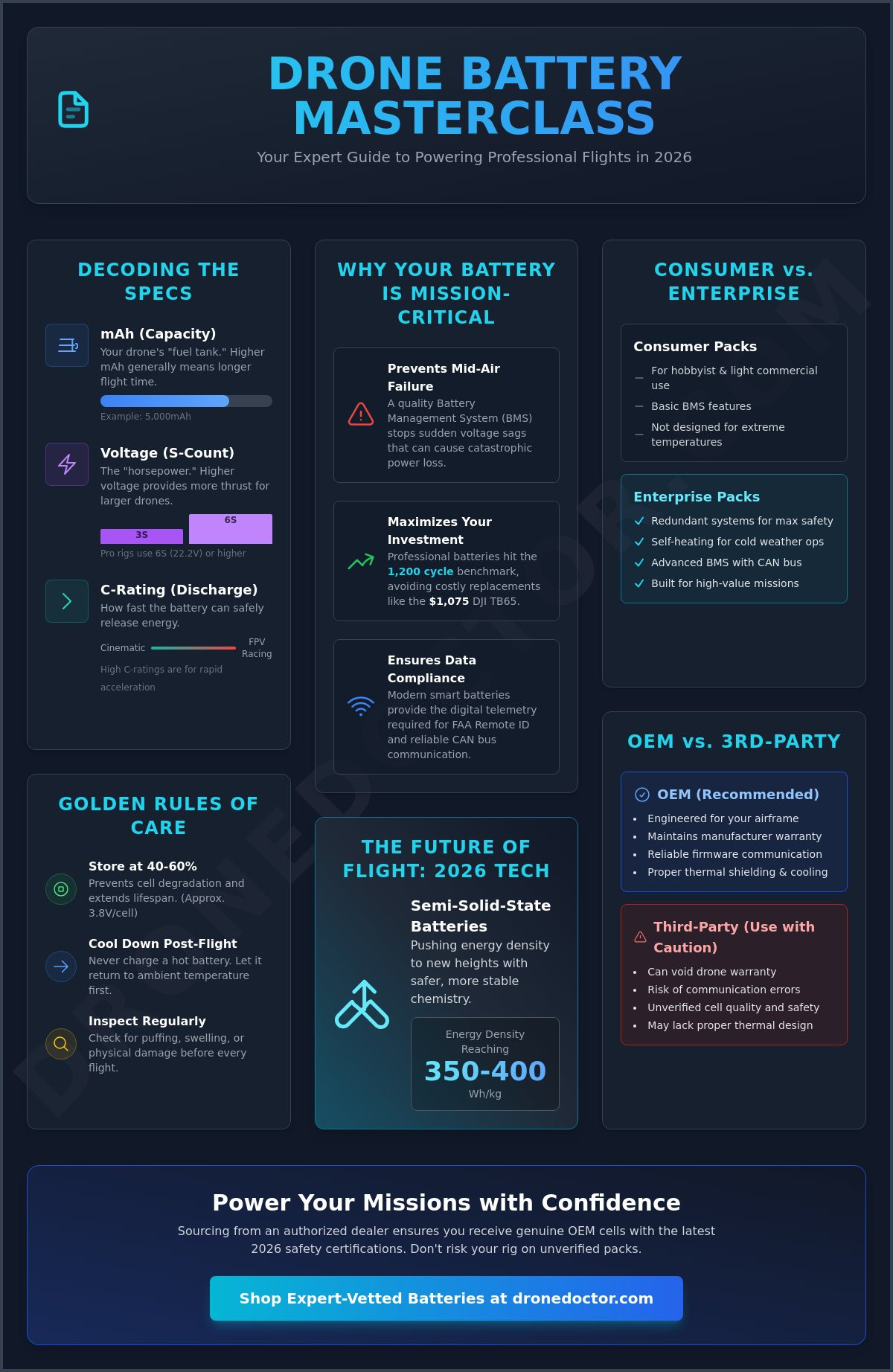
The BMS is the brain of the battery that monitors cell voltage in real-time. This sophisticated internal computer prevents overcharging and over-discharging by balancing individual cells during every cycle. In 2026, smart batteries are essential for FAA Remote ID compliance, as they provide the digital telemetry needed for real-time health reporting. Without a robust BMS, you risk cell swelling or thermal runaway that could ground your fleet permanently. Secure your gear by choosing packs with advanced CAN bus communication for the most reliable data flow.
OEM vs. Third-Party: The Great Debate
While third-party cells often promise higher capacities at lower prices, the risks usually outweigh the rewards for professional pilots. Official DJI or Autel batteries are engineered specifically for the airframe's power draw and cooling requirements. Using non-OEM cells can void your manufacturer warranty and lead to communication errors between the battery and the autopilot. The Drone Doctor recommendation is clear: stay with genuine OEM batteries for any high-value mission. We've seen too many repairs caused by "budget" cells that lacked proper thermal shielding. Shop with confidence and stick to the brands that built your drone!
Decoding Drone Battery Specs: mAh, Voltage, and C-Ratings
Understanding the numbers on your battery label is the difference between a smooth flight and a mid-air emergency. When you look at drone batteries for sale, the first number you usually see is the Milliampere-hours (mAh). This represents your "fuel tank" capacity. A 5,000mAh battery can theoretically provide 5 amps of current for one hour. However, capacity is only half the story. You also need to understand Voltage and Cell Count (S). Each "S" represents a cell connected in series, with a nominal voltage of 3.7V. A 3S battery provides 11.1V, while a 6S powerhouse delivers 22.2V. Higher voltage translates to more motor thrust and increased efficiency for larger props, which is why professional rigs almost exclusively use 6S or higher configurations in 2026.
Then there is the C-rating, or discharge rate. This tells you how fast the battery can safely dump its energy. FPV drones require high C-ratings, often 100C or more, to handle rapid throttle punches during racing. Cinematic drones, like the Mavic 3 series, usually prioritize lower discharge rates for smoother, longer endurance. By May 2026, the industry has pivoted toward semi-solid-state batteries for enterprise models. These offer a massive leap in energy density, reaching up to 400 Wh/kg, providing much more power without the volatile liquid electrolytes found in older packs. Safety remains a top priority when handling these high-energy packs. Always consult the FAA guidelines on lithium battery safety before traveling, as most airlines strictly limit carry-on batteries to under 100Wh without special approval.
Understanding Capacity vs. Weight
Don't fall for the trap of thinking bigger is always better. The law of diminishing returns applies here perfectly. Weight increases power draw, which can negate extra mAh and actually reduce your total airtime. Every gram you add requires the motors to spin faster just to maintain a hover. Calculating the "sweet spot" for your airframe involves balancing the battery's energy density against the total takeoff weight. If you're unsure which pack fits your specific needs, you can browse our 2026 inventory to find expert-matched power solutions for every model.
Flight Time Realities in 2026
Advertised flight times are usually recorded in a vacuum. In the real world, 15mph winds or a heavy gimbal payload can slash those numbers by 25% or more. Temperature also plays a massive role. Lithium ions move slower in the cold, which is why winter flying requires pre-heating your cells to at least 20 degrees Celsius. The latest 2026 releases from DJI and Autel now feature self-heating technology to combat this, ensuring you get consistent performance even in sub-zero conditions. Expect these high-density cells to become the standard for all professional operations this year.
Finding the Perfect Match: Consumer vs. Enterprise Battery Guide
Selecting the right power source is about matching the battery's capabilities to your specific mission profile. When you browse drone batteries for sale, you'll notice a clear divide between consumer-grade portability and enterprise-grade resilience. Consumer batteries, like those for the DJI Mini 5 Pro or Air series, are designed for ease of use. These "Smart Flight" packs handle their own cell balancing and storage discharge. They're perfect for creators who need to get in the air quickly without managing complex charging parameters. However, don't let their simplicity fool you. These packs still require a deep level of understanding drone battery specs to ensure you aren't pushing them past their thermal limits during high-speed maneuvers.
For custom UAV builders and FPV pilots, the world looks much different. You'll often deal with raw LiPo packs using XT60 or XT90 connectors. These lack an internal management system, meaning the pilot is responsible for monitoring every milliampere. Regardless of your drone type, always verify your firmware compatibility before a purchase. In 2026, many manufacturers use software "handshakes" to verify battery authenticity. Using an outdated firmware version with a brand-new high-density pack can trigger "unauthorized battery" errors that will ground your aircraft mid-mission. Stay updated and fly safe!
The "Fly More" Value Proposition
Buying batteries individually is almost always the most expensive route for hobbyists. The 2026 "Fly More" combos provide massive value by bundling three batteries with a sequential charging hub and a high-wattage power bank. These hubs are essential because they prioritize the battery with the most remaining juice, getting you back in the air in record time. If you're looking to start your fleet, checking our guide on drones for sale is the best way to secure your first complete power set at a significant discount. Act now to grab these bundles before the peak flying season begins!
Enterprise Power: Matrice and Beyond
Enterprise operations like infrastructure inspection or search and rescue demand zero downtime. Rigs like the DJI Matrice 350 RTK utilize dual-battery systems to provide critical redundancy. If one pack experiences a cell failure, the secondary battery provides enough power for a controlled return-to-home. These enterprise packs also feature internal self-heating elements that activate in temperatures as low as -20°C. For maximum efficiency, we recommend using a specialized Battery Station. These rugged cases can charge eight batteries simultaneously, reaching a 90% charge in just 30 minutes. Many 2026 enterprise models even support "hot-swapping," allowing you to change batteries without powering down the drone, keeping your GNSS lock and sensors active for continuous operation.
Pro-Level Battery Care: Maximize Life and Ensure Safety
Owning high-performance gear requires a commitment to maintenance. You've already invested in the best drone batteries for sale, so don't let poor habits turn those cells into paperweights. The most important "Golden Rule" is the storage voltage. Never leave your batteries fully charged or completely drained for more than 48 hours. Aim for 3.8V per cell. This is the chemical "stasis" point where the lithium ions are most stable. Leaving a battery at 100% causes internal stress that leads to permanent capacity loss; meanwhile, a 0% charge can cause the battery to fall into a "deep discharge" state where it may never wake up again.
Respect the chemistry after every flight. Never plug a hot battery into a charger immediately after landing. Thermal stress is the primary killer of expensive flight packs. Wait at least 15 to 20 minutes for the cells to reach room temperature before starting a charge cycle. As your packs age, watch for signs of failure. Swelling, often called "puffing," is a clear signal that the internal layers have delaminated and gas has built up. If you notice cell voltage deviations of more than 0.1V or high internal resistance during charging, it's time to retire that pack. Safely dispose of damaged batteries at a dedicated recycling center. Don't toss them in the trash, as they remain a significant fire risk even when they seem dead.
Storage and Transportation Safety
In 2026, air travel regulations remain strict for drone operators. FAA and TSA guidelines state that spare lithium batteries must stay in your carry-on luggage only. Most standard drone batteries stay under the 100Wh limit, but always double-check the label on larger enterprise packs before heading to the airport. Use LiPo-safe bags or reinforced hard cases to prevent terminal shorting during transit. If you've accidentally deep-discharged a battery, don't try to "jumpstart" it with a non-intelligent charger. This is a major fire hazard. While some smart chargers have recovery modes, roughly 85% of deep-discharged cells suffer permanent capacity damage.
Maintenance Software and Firmware
Stay on top of your fleet health by using tools like DJI Assistant or Autel Explorer. These programs allow you to view exact cycle counts and discharge history. Manufacturers frequently release battery firmware updates to fix power-drain bugs or improve thermal management. Check your cell balance after every 20 to 30 cycles to ensure one cell isn't working harder than the others. If your current packs are showing their age, secure your high-performance replacements today and keep your missions on schedule!
Shop Drone Batteries at Drone Doctor: Expert Support & Fast Shipping
Don't trust your professional airframe to a mystery box from an unverified seller. When you're searching for drone batteries for sale, choosing an authorized dealer like Drone Doctor LLC is the only way to guarantee you're getting genuine OEM cells with valid 2026 warranties. Our current stock of DJI and Autel batteries is ready for immediate dispatch from our US warehouse. We know these power systems inside and out because we don't just sell them; we're the leader in sales, repair, and service. Whether you need a high-voltage LiHV pack for a racing rig or a self-heating enterprise brick for a Matrice 350, we have the expert-approved packs you need to stay airborne. 🚨🛍️💳🔥
Our team brings a personal touch to every order. Se habla Español! We pride ourselves on being an inclusive, community-oriented shop where you can get technical advice in the language you're most comfortable with. We understand the pressure of a looming deadline or a critical job site mission. That's why we move fast to get your gear moving even faster. Our staff goes above and beyond to ensure you're equipped with the right technology for your specific mission profile.
Repair or Replace? Ask the Doctor
Sometimes a power issue isn't about the battery at all. A faulty internal power distribution board or a damaged gimbal connector can mimic the symptoms of a dead cell. This is where our "Doctor" status really shines. Our expert technicians, like Liz and Jose, can diagnose whether you actually need a new purchase or a professional drone repair. We've seen cases where a simple firmware calibration or a terminal cleaning saved a pilot hundreds of dollars. We're committed to your long-term flight success, not just a quick sale. If your drone is dropping out of the sky or showing erratic voltage warnings, let us take a look before you retire your expensive fleet.
Secure Your Flight Today
Act NOW to take advantage of our 2026 bulk discounts for enterprise operators and "Fly More" kits. We understand that downtime equals lost revenue; therefore, we offer lightning-fast shipping to ensure your chargers are never empty. Our satisfaction guarantee means you can shop with total confidence. Elevate your capabilities with the advance drone technology and professional power solutions only found at Drone Doctor. Secure yours today and experience the difference that expert support makes! Your mission can't wait, and with our 2026 inventory ready to ship, it doesn't have to.
Secure Your Flight Power and Take to the Skies
Don't let a failing cell ground your next major project. We've explored how the 2026 shift to semi-solid-state chemistry and advanced CAN bus telemetry has redefined what it means to stay airborne. From maintaining that 3.8V storage "sweet spot" to choosing the redundant dual-battery systems required for enterprise safety, your power strategy is now your most vital flight asset. Finding high-quality drone batteries for sale shouldn't be a guessing game. When you shop with Drone Doctor, you're partnering with the leader in Sales, Repair, and Service.
As an authorized DJI and Autel dealer, we provide more than just a box in the mail. Our team, including experts like Liz and Jose, is ready to offer the personal support you need to troubleshoot complex power delivery issues. Se habla Español! Whether you're flying a hobbyist mini or a heavy-lift rig, we ensure your satisfaction is the top priority. Act now to elevate your capabilities and keep your rotors spinning with confidence. We can't wait to see you in the air!
Shop our 2026 Drone Battery Collection NOW!
Frequently Asked Questions
How long do drone batteries usually last before needing replacement?
Most 2026 industrial batteries hit the 1,200 cycle benchmark before dropping below 80% capacity. Consumer packs typically reach 300 to 500 cycles depending on your storage habits and discharge depth. If you notice your maximum flight time has dropped by more than 20%, it is time to browse our drone batteries for sale to ensure your aircraft remains reliable.
Can I use a DJI Mini 4 battery in a DJI Mini 5?
No, the DJI Mini 5 Pro uses a proprietary high-density cell that is not backward compatible with the Mini 4 series. The physical dimensions and pin layouts changed to accommodate the 2026 power requirements and increased energy density. Always verify your specific model before purchasing to avoid grounding your rig with incompatible hardware.
What should I do if my drone battery starts to swell or puff up?
Stop using the battery immediately and move it to a fire-safe location away from flammable materials. Swelling indicates internal delamination and gas buildup, which can lead to a dangerous thermal runaway event. Don't try to "vent" the battery or charge it again. Take it to a specialized recycling center for safe disposal to prevent a workshop fire.
Is it safe to charge my drone batteries overnight?
Never charge your batteries overnight or while you are away from the room. While modern Smart Flight batteries include protective circuits, LiPo chemistry remains volatile if an internal cell failure occurs. Always charge in a fireproof bag and keep a fire extinguisher nearby for total peace of mind. Safety is your top priority!
How many batteries do I really need for a professional drone shoot?
A professional set usually includes a minimum of 6 batteries to maintain a continuous flight rotation. This allows you to have one pack in the air while others are cooling down or charging on a rapid station. When you find the right drone batteries for sale, buying in bulk ensures you never miss a critical shot because of a "Low Battery" warning.
What is the best temperature for storing my drone batteries long-term?
Store your batteries in a cool, dry place between 20 and 25 degrees Celsius. Avoid humid basements or hot vehicles where temperatures can fluctuate wildly and damage the chemistry. Always ensure the cells are at a 3.8V storage charge. This prevents permanent chemical degradation during periods when you aren't flying.
Can I travel on an airplane with drone batteries in my checked luggage?
No, FAA regulations strictly prohibit spare lithium batteries in checked luggage. You must keep them in your carry-on bag with the terminals protected by tape or individual plastic bags. Most batteries under 100Wh are permitted without prior approval, but check with your airline if you are carrying high-capacity enterprise packs exceeding 160Wh.
Why does my drone battery show a "cell deviation" error?
Cell deviation happens when the voltage difference between individual cells exceeds 0.1V. This usually signals an aging pack, a faulty internal management system, or a history of improper storage. If a full balance charge doesn't fix the error, the battery is no longer safe for high-performance flight and requires immediate replacement to avoid a crash.