

5 señales críticas de un motor de dron defectuoso: ¡No estrelles tu inversión!
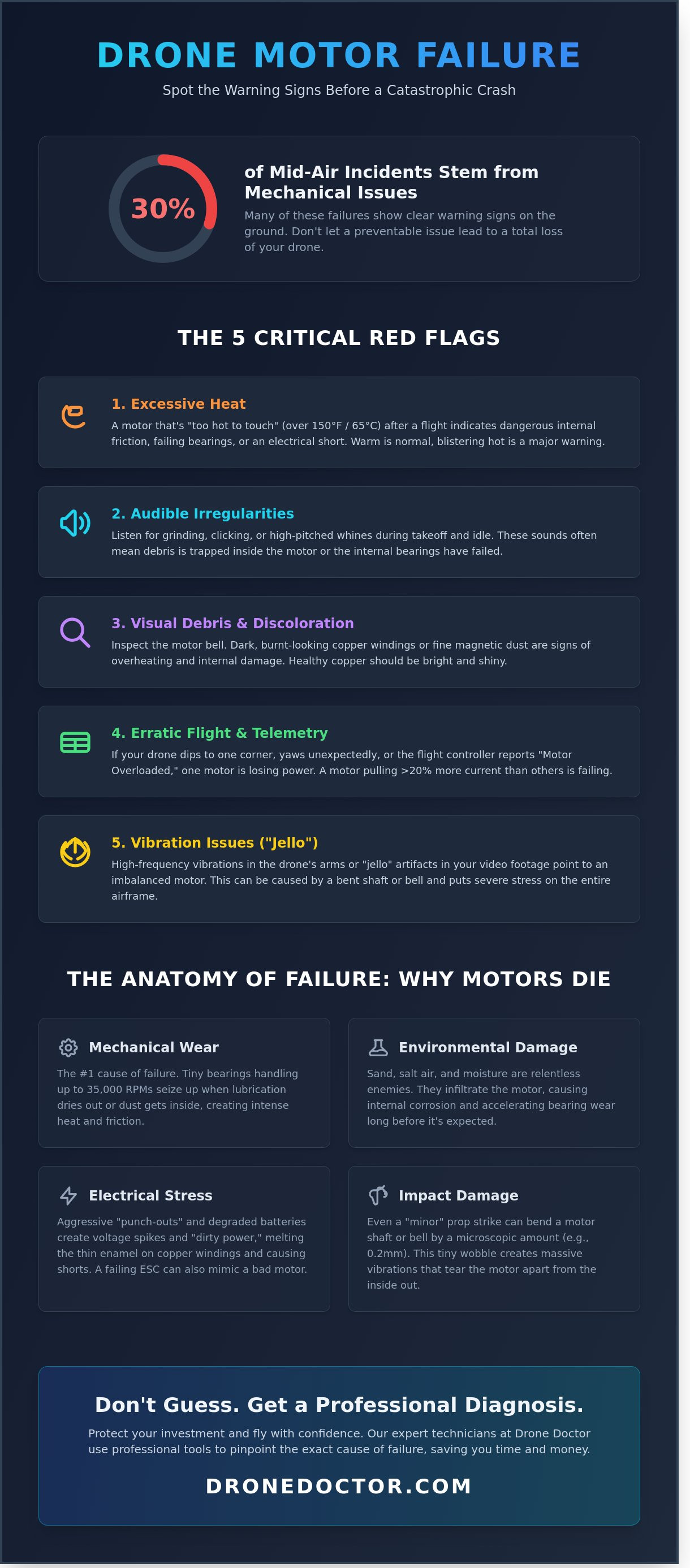
El sábado pasado, un piloto en Florida vio su dron FPV de $1,500 caer en picada a un lago después de ignorar un ligero temblor en el brazo delantero izquierdo. Es una escena desgarradora que ocurre con más frecuencia de lo que cabría esperar. Los datos de la industria indican que el 30% de los incidentes en el aire provienen de problemas mecánicos, específicamente las señales de un motor de dron defectuoso, que eran visibles en tierra. No debería tener que adivinar si ese zumbido extraño es normal o un desastre a punto de ocurrir. Sabemos que desea proteger su inversión y mantener su equipo en óptimas condiciones.
En Drone Doctor, somos líderes en servicio y reparación, y queremos asegurarnos de que nunca se enfrente a una pérdida total. Le ayudaremos a detectar estas señales de advertencia antes de su próximo vuelo para que pueda permanecer en el aire. Aprenderá exactamente cómo interpretar pitidos técnicos, detectar daños por calor y decidir si es hora de una solución rápida o un reemplazo completo. Devolvamos la potencia profesional a su dron y mantengámoslo volando de forma segura.
Puntos Clave
- Identifique las 5 señales de advertencia críticas, incluyendo el calor excesivo y los ruidos de molienda, que actúan como signos tempranos de un motor de dron defectuoso.
- Comprenda cómo los peligros ambientales comunes como la arena y la humedad causan corrosión interna y desgaste de los cojinetes en sus motores sin escobillas.
- Aprenda a realizar pruebas de diagnóstico de nivel profesional, como la prueba de giro manual, para detectar la resistencia antes de que provoque un accidente.
- Domine el análisis de costo-beneficio de reparar versus reemplazar componentes para asegurar que su dron siga siendo una inversión segura y de alto rendimiento.
- ¡Descubra cómo los diagnósticos expertos y el servicio profesional de Drone Doctor LLC pueden hacerle volver a volar rápidamente y con total confianza!
Las 5 Señales de Alerta: Cómo Detectar Signos de un Motor de Dron Defectuoso
No espere a que su dron caiga desde 400 pies antes de actuar. Detectar a tiempo los signos de un motor de dron defectuoso salva su gimbal, su batería y su cuenta bancaria. ¡Actúe AHORA si nota alguna de estas señales de alerta! 🚨
- Calor Excesivo: Sus motores deben estar calientes después de un vuelo, no ardiendo. Si un motor se siente "demasiado caliente al tacto" o supera los 150°F (65°C), es una bomba de tiempo. El calor elevado suele indicar fricción interna, cojinetes defectuosos o un cortocircuito en el sistema.
- Irregularidades Audibles: Escuche atentamente durante el ralentí y el despegue. Un ruido de molienda, clic o un zumbido agudo son llamadas de auxilio. Estos ruidos a menudo señalan que hay arena o escombros atrapados en la campana, o que los cojinetes internos se han secado.
- Escombros y Decoloración Visual: Inspeccione el interior de la campana regularmente. La mayoría de los drones modernos dependen de motores de CC sin escobillas de alto rendimiento brushless DC motors para mantener la estabilidad. Busque bobinados de cobre oscuros y quemados o polvo magnético fino adherido a los imanes. Si el cobre no está brillante y lustroso, el motor está estropeado.
- Telemetría de Vuelo Errática: ¿Su dron "se inclina" en una esquina específica durante un vuelo estacionario? Si el controlador de vuelo trabaja horas extras para nivelar la aeronave, es probable que un motor esté perdiendo su fuerza magnética. Este cabeceo o inclinación inesperado es un precursor de una pérdida total en pleno vuelo.
- Problemas de Vibración: Los desequilibrios del motor destruyen la calidad del video. Si ve "gelatina" en sus imágenes o siente vibraciones de alta frecuencia en los brazos del dron, su motor está a un 15% de un agarrotamiento total. Estas vibraciones también ejercen una tensión innecesaria sobre las sensibles cintas de su gimbal.
La "Prueba del Olfato" para Cortocircuitos Eléctricos
Su nariz es una poderosa herramienta de diagnóstico. Un olor distintivo y acre a "electrónica quemada" después del aterrizaje es una señal de advertencia crítica. Este olor, a menudo combinado con un olor metálico a ozono, indica arcos eléctricos dentro de los devanados. Si huele a humo o ve una bocanada de hollín gris durante un cambio de batería, no despegue de nuevo. Desconecte la energía inmediatamente. Nuestro equipo en Drone Doctor ve estos motores "fritos" a diario, y detectarlo ahora evita un incendio completo del ESC. 🔥
Advertencias de Telemetría y Anomalías en el Registro de Vuelo
Revise la pantalla de su controlador en busca de mensajes de "Motor Sobrecargado" o "Error de ESC". No son sugerencias; son demandas urgentes de mantenimiento. Puede detectar picos de consumo de energía en los datos de la caja negra de su dron. Si un motor consume consistentemente un 20% más de corriente que los demás solo para mantener un vuelo estacionario, está fallando. Un solo motor girando a RPMs significativamente más altas que sus contrapartes es una señal clara de un motor de dron defectuoso que necesita un cambio profesional hoy. 🛠️
La Anatomía del Fracaso: Por Qué Mueren los Motores Sin Escobillas
Los motores sin escobillas son maravillas de la ingeniería, pero no son invencibles. Comprender las causas fundamentales de las fallas le ayuda a detectar las señales de un motor de dron defectuoso antes de que su aeronave caiga del cielo. La mayoría de los problemas mecánicos comienzan en los rodamientos. Estos pequeños componentes de acero soportan hasta 35,000 RPM en equipos de alto rendimiento. Cuando la lubricación se seca o el polvo se infiltra en la pista, la fricción crea calor que eventualmente agarrota la unidad. Es la causa número 1 de fallas en drones de consumo como la serie DJI Air.
A veces, el motor es víctima de su entorno. La arena, el aire salino y la humedad son implacables. Incluso un "pequeño" golpe de hélice puede ser fatal. Golpear una rama a 30 mph puede doblar la campana o el eje de un motor tan solo 0.2 mm. Esa microscópica oscilación crea vibraciones que destrozan el motor desde el interior. Si nota que su dron tiembla, actúe AHORA para evitar una falla total en el aire.
También es vital darse cuenta de que el motor podría estar bien, pero el "cerebro" está fallando. Los errores de comunicación del Controlador Electrónico de Velocidad (ESC) a menudo se disfrazan de muerte del motor. Investigaciones como el Análisis de Modos de Falla y Efectos de la NASA Failure Mode Effects Analysis demuestran cómo las interacciones complejas entre los sistemas de energía y el software pueden conducir a desincronizaciones repentinas. Si su motor tartamudea durante el arranque, el ESC podría ser el verdadero culpable.
El Impacto de la "Energía Sucia" y los Picos de Voltaje
Los vuelos agresivos de FPV y los "punch-outs" masivos ejercen un estrés extremo en los devanados del motor. Estas maniobras extraen una corriente masiva, creando calor que puede derretir el fino recubrimiento de esmalte del cable de cobre. La salud de la batería juega un papel enorme aquí. Una LiPo degradada con alta resistencia interna puede causar caídas y picos de voltaje que estresan todo el sistema de propulsión. Además, las hélices baratas del mercado secundario a menudo están mal equilibradas. Esto obliga al motor a trabajar un 15% más para mantener la estabilidad, lo que lleva a una muerte prematura. Mantenga su equipo auténtico y consulte a nuestros expertos en reparación si nota un calor inusual después de un vuelo.
Corrosión: El Asesino Silencioso de los Drones Empresariales
Para pilotos marítimos o agrícolas, la corrosión es una amenaza constante. El aire salino no solo se asienta en la superficie; cristaliza dentro de la carcasa del motor, creando una pasta abrasiva que destruye los imanes y las bobinas. En ambientes de alta humedad, la vida útil del motor puede reducirse en un 50% en comparación con climas secos. Identifique la cristalización de sal buscando residuos blancos y pulverulentos cerca de la base de la campana del motor. Para proteger su inversión, utilice aire comprimido y limpiadores de contactos especializados después de cada misión en áreas costeras. La prevención siempre es más barata que un reemplazo completo del motor.
Cómo Probar los Motores de su Dron Como un Técnico Profesional
No espere a una falla en el aire para descubrir que su sistema de propulsión está comprometido. Detectar los signos de un motor de dron defectuoso a tiempo salva su gimbal, su estructura y su tranquilidad. Comience con la "Prueba de Giro Manual". Con el dron apagado, mueva cada campana del motor con el dedo. Deben girar libremente con un deslizamiento suave y consistente. Si un motor se siente "dentado" o se detiene 2 segundos más rápido que los demás, es probable que tenga suciedad en la campana o un punto plano en un rodamiento. 🚨
Para una inmersión más profunda, use un multímetro configurado en el modo de resistencia. Verifique las tres almohadillas del motor; debería ver lecturas de resistencia consistentes, típicamente entre 0.1 y 0.5 ohmios dependiendo del tamaño del motor. Si una fase muestra "OL" o una resistencia significativamente mayor, los devanados de cobre internos probablemente estén quemados. Los técnicos profesionales también usan sensores térmicos FLIR durante una prueba de banco controlada. Cualquier motor que funcione 15 grados Celsius más caliente que sus contrapartes es una bomba de tiempo. 🌡️
Procedimientos Avanzados de Prueba en Banco
SEGURIDAD PRIMERO: Retire siempre las hélices antes de conectarse a una computadora. Una prueba de motor de escritorio puede desencadenar un evento a toda velocidad; no arriesgue un viaje a la sala de emergencias. Conecte su aeronave a DJI Assistant 2 o Betaflight Configurator para ejecutar rampas de motor individuales. Deslice los probadores de motor al 15% de potencia y escuche si hay "chillidos" o chirridos agudos. Si un motor tartamudea, cambie los cables del motor a una salida ESC (Controlador Electrónico de Velocidad) que se sabe que funciona bien. Si el tartamudeo sigue al motor, el motor está muerto. Si el tartamudeo permanece en el brazo original, su ESC es el culpable. 🛠️
Interpretación de Códigos de Pitidos del ESC
Su dron se comunica a través de "pitidos" generados por la vibración de las bobinas del motor. Una secuencia de arranque estándar de DJI presenta un distintivo tintineo de cuatro notas. Si escucha un pitido único repetitivo o un tono "bajo-alto" que no termina, su ESC no puede sincronizarse con el motor. Esto a menudo indica un imán deslizado o un cable de señal roto. Un escenario de "no pitido" en un solo brazo generalmente significa que el motor tiene un cortocircuito interno, lo que impide que el ESC inicie la secuencia de arranque. Esta es una de las señales más definitivas de un motor de dron defectuoso que requiere atención inmediata. ¡Compre con confianza y reemplace estos componentes antes de su próximo despegue para garantizar potencia y seguridad profesionales! 🚀
El Dilema del Piloto: ¿Reparar o Reemplazar?
Una vez que identifique los signos de un motor de dron defectuoso, el reloj comienza a correr. Tiene que decidir: ¿soluciona el problema o invierte en una revisión completa del sistema? Un reemplazo de motor individual suele ser la ruta más barata, pero rara vez es la más segura para vuelos a largo plazo. Los pilotos profesionales consideran la marca de 200 horas de vuelo como un umbral crítico. Si un motor está chirriando o sobrecalentándose, sus hermanos probablemente han soportado el mismo estrés. Reemplazar el kit de propulsión completo asegura que su dron mantenga un empuje perfectamente equilibrado en todos los brazos. ¡Asegure su vuelo hoy mismo! 🚨
No ignore tampoco el chasis. Incluso los motores más potentes no pueden arreglar un chasis fatigado. Los marcos de fibra de carbono pierden rigidez después de múltiples maniobras de alta G o impactos menores. Si su marco muestra un 5% o más de flexión en comparación con su estado original, los nuevos motores no detendrán las vibraciones. Necesita una base estable para proteger su inversión. Deje de reparar una plataforma muerta y sepa cuándo pasar a una nueva construcción. La potencia profesional requiere equipo profesional.
Reparaciones DIY vs. Servicio Profesional
¿Pensando en un cambio de rodamientos de bricolaje? Piénselo de nuevo. Asentar un rodamiento requiere prensas de precisión; un desalineamiento de 1 mm provoca una vibración catastrófica a 30,000 RPM. También corre el riesgo de quemar su ESC 4 en 1 con un solo puente de soldadura. Una pequeña gota de soldadura perdida puede convertir su controlador de vuelo en humo caro. Asegure su tranquilidad con un servicio profesional de reparación de drones. Nuestros expertos se encargan del trabajo técnico pesado para que usted mantenga su garantía intacta y su dron en el aire. ¡Compre con confianza!
Actualización Durante la Reparación
Si ha notado los signos de un motor de dron defectuoso, es el momento perfecto para una actualización. Cambiar a motores de alto rendimiento puede añadir un 15% más de potencia a su velocidad de ascenso. Sin embargo, debe igualar las clasificaciones KV con su configuración actual. Instalar motores de 2750KV en una batería 6S diseñada para 1750KV quemará sus componentes electrónicos en segundos. Aproveche esta oportunidad para darle nueva vida a un dron a la venta más antiguo y volver al rendimiento de nivel profesional. 🔥
Cada cambio de motor requiere una calibración profesional. Sus ESCs necesitan "aprender" el nuevo hardware para garantizar una respuesta suave del acelerador. Sin este paso, corre el riesgo de un vuelo descontrolado o un vuelo estacionario errático. Hágalo bien la primera vez. Nuestro equipo se asegura de que su dron esté calibrado y listo para volar antes de que salga del banco.
¡Vuelva a Volar RÁPIDO con Drone Doctor LLC!
Ha detectado los signos de un motor de dron defectuoso y ahora es el momento de actuar. No permita que su costoso equipo se convierta en un pisapapeles. Drone Doctor LLC es líder en Ventas, Reparación y Servicio para todas las principales marcas del mercado. No solo solucionamos problemas; optimizamos su experiencia de vuelo. Nuestro equipo de expertos utiliza herramientas de diagnóstico avanzadas para identificar la fricción interna, el desgaste de los rodamientos o los cortocircuitos eléctricos antes de que se conviertan en un desastre en pleno vuelo. 🚨🛍️💳🔥
Cuando nos envía su aeronave, obtiene más que una solución rápida. Dependemos exclusivamente de componentes OEM genuinos o de alto rendimiento certificados. Usar piezas de marca blanca es una apuesta que generalmente termina en otro accidente. Nos aseguramos de que cada cambio de motor cumpla con las especificaciones de fábrica, devolviéndole esa "Potencia Profesional" a sus manos. Nuestro proceso de diagnóstico implica más que una verificación visual. Realizamos pruebas de estrés en los ESC (Controladores Electrónicos de Velocidad) y verificamos las irregularidades de voltaje que a menudo se esconden detrás de los signos de un motor de dron defectuoso. Al detectar estos problemas a tiempo, hemos ayudado a más de 1,200 pilotos a evitar pérdidas catastróficas del casco solo en los últimos 12 meses.
Por Qué Drone Doctor es la Elección de Confianza
Nuestro compromiso con la calidad es la razón por la que pilotos de todo el país confían en nosotros. Entendemos que el tiempo en tierra es dinero perdido, especialmente para operadores comerciales. Por eso nuestra garantía de "Potencia Profesional" forma parte de cada reparación que realizamos. Estamos orgullosos de apoyar a nuestra diversa comunidad; Se habla Español, y estamos listos para ayudarle en el idioma con el que se sienta más cómodo. Lo hemos visto todo. El mes pasado, nuestro técnico principal, Jose, identificó una grieta fina en la carcasa de un motor que un cliente pasó por alto. Ese diagnóstico de 10 minutos salvó un dron empresarial de $5,000 de una pérdida total. Nuestro personal, incluyendo expertos como Liz y Jose, van más allá para asegurar su satisfacción. ¡Actúe AHORA para asegurar su lugar de reparación o explore nuestro inventario de motores hoy mismo!
- Tiempos de respuesta rápidos para sistemas DJI, Autel y Skydio
- Técnicos certificados con más de 15,000 reparaciones exitosas completadas
- Pruebas de vuelo exhaustivas después de cada reemplazo de motor
- Comunicación transparente y sin tarifas ocultas
¿Listo para una Actualización?
A veces, una reparación no tiene sentido financiero si la aeronave tiene varias generaciones de antigüedad. Si sus problemas de motor son parte de un patrón más amplio de desgaste, podría ser el momento de subir de nivel. Puede explorar los últimos drones a la venta en nuestra guía completa del comprador de 2026. Tenemos el inventario más reciente de DJI y sistemas de propulsión especializados de grado empresarial que ofrecen una mayor eficiencia y tiempos de vuelo más largos. No espere a que ocurra el próximo fallo. ¡Contáctenos hoy mismo para obtener un presupuesto de reparación rápido y preciso! Le ayudaremos a decidir si reparar su equipo actual o invertir en una nueva máquina que se adapte perfectamente a sus necesidades. Su seguridad y su inversión son nuestras principales prioridades.
Proteja el Rendimiento de su Vuelo Hoy Mismo
Su dron es un instrumento de precisión, y sus motores sin escobillas son el corazón de cada misión. Ignorar el calor excesivo o los ruidos de molienda a menudo conduce a fallas catastróficas en el aire. Hemos detallado cómo realizar pruebas técnicas para verificar la salud del motor antes de despegar. Como distribuidor y centro de servicio autorizado de DJI, Drone Doctor LLC se especializa en restaurar equipos de nivel profesional a los estándares de fábrica. Técnicos expertos como Jose y Liz son elogiados con frecuencia en reseñas verificadas de 5 estrellas por su precisión y velocidad. Aseguran que su equipo permanezca en el aire sin el riesgo de un accidente repentino. Al reconocer los signos de un motor de dron defectuoso a tiempo, salva su gimbal, chasis y cámara de la destrucción total. Nuestro equipo ofrece los rápidos tiempos de respuesta que necesita para minimizar el tiempo de inactividad y maximizar su fotografía aérea. No deje que un pequeño problema mecánico detenga su pasión o su negocio. Estamos aquí para ayudarle a volar con total tranquilidad. Haga que su equipo vuelva al cielo, donde pertenece.
¡No espere a un accidente, obtenga su presupuesto de reparación de dron profesional AHORA!
Preguntas Frecuentes
¿Cuánto suelen durar los motores de los drones?
Los motores sin escobillas suelen durar entre 300 y 500 horas de vuelo, dependiendo de sus hábitos de mantenimiento y del entorno de vuelo. Los motores con escobillas que se encuentran en los drones de juguete más pequeños tienen una vida útil mucho más corta, de aproximadamente 5 a 20 horas de tiempo total de vuelo. Nuestros técnicos expertos, como Jose, a menudo ven motores fallar prematuramente debido al aire salino o arena fina. Mantenga un registro de vuelo detallado para seguir estas horas con precisión.
¿Puedo volar mi dron si solo un motor está actuando de forma extraña?
No, debe aterrizar su aeronave de inmediato si nota señales de una falla en el motor del dron, incluso en una sola unidad. Volar con un motor comprometido provoca una pérdida instantánea de estabilidad y un alto riesgo de un choque catastrófico. Actúe ahora y tráiganos su equipo para un diagnóstico profesional. Es la única manera de garantizar que su costosa inversión se mantenga segura y en condiciones de aeronavegabilidad.
¿Por qué uno de los motores de mi dron está más caliente que los otros?
El calor excesivo generalmente indica un cortocircuito eléctrico interno, un eje doblado o residuos como cabello enrollado alrededor de la campana del motor. Si un motor alcanza temperaturas un 20 por ciento más altas que los otros después de un vuelo de 10 minutos, es probable que los cojinetes estén fallando. Esta fricción obliga al motor a consumir más corriente. Esto crea un ciclo de calor peligroso que puede derretir marcos de plástico o destruir su ESC.
¿Qué significa cuando el motor de mi dron solo se contrae pero no gira?
Un motor que se contrae generalmente indica un cable roto, una fase del ESC quemada o un cojinete completamente agarrotado. Este tartamudeo ocurre porque el motor no está recibiendo la energía trifásica que necesita para completar una rotación completa. Revise primero las uniones de soldadura en busca de grietas. Si las conexiones son sólidas, es probable que los bobinados internos estén quemados y requieran un reemplazo profesional para que pueda volver a volar.
¿Es más barato reparar un motor de dron o comprar un dron nuevo?
Reemplazar un solo motor es significativamente más barato que comprar una aeronave nueva, especialmente para modelos profesionales como la serie DJI Mavic o Matrice. Un reemplazo de motor generalmente cuesta una pequeña fracción del valor total del dron. Reparar el motor conserva sus baterías, controladores y accesorios existentes. Es una forma inteligente de prolongar la vida útil de su equipo profesional sin una inversión masiva nueva.
¿Cómo puedo evitar que los motores de mi dron fallen prematuramente?
Use un plumero de aire a presión para limpiar los residuos después de cada 5 vuelos y evite aterrizar en césped alto o arena suelta. Inspeccione las campanas en busca de abolladuras físicas y escuche los ruidos de molienda durante su verificación previa al vuelo. Según los datos de la industria de los principales fabricantes, la limpieza regular puede aumentar la longevidad del motor en un 40 por ciento. No espere un accidente; el mantenimiento proactivo mantiene su dron funcionando como nuevo.
¿Un motor defectuoso hará que mi dron se voltee al despegar?
Sí, un motor que falla es la razón principal por la que los drones se voltean en el momento en que despegan del suelo. Cuando un motor no produce las RPM requeridas, el controlador de vuelo intenta compensar sobrepotenciando los otros. Esto crea un desequilibrio que inclina la aeronave. Reconocer las señales de un motor de dron que falla antes de acelerar le evita hélices rotas y costosas reparaciones del cardán.
¿Necesito reemplazar los cuatro motores si solo uno está fallando?
Solo necesita reemplazar el motor específico que está fallando, siempre que los otros tres no muestren signos de desgaste o ruido. Los controladores de vuelo modernos son excelentes para equilibrar motores con perfiles de antigüedad ligeramente diferentes. Sin embargo, si su dron ha registrado más de 400 horas de vuelo, reemplazar el conjunto completo es una decisión inteligente. Esto garantiza un rendimiento constante en todos los brazos y evita otra sesión de reparación la próxima semana.