

El mejor dron para inspeccionar líneas eléctricas en 2026: La guía definitiva para empresas de servicios públicos
Una única fractura indetectable en un aislador de alto voltaje puede provocar una falla en la red de 1.2 millones de dólares en menos de 60 segundos. Ya sabe que mantener a sus equipos seguros mientras recopila datos de alta fidelidad es la máxima prioridad para 2026. Es frustrante cuando los sensores de baja calidad no detectan defectos críticos o la interferencia electromagnética (EMI) amenaza con hacer caer su costoso equipo en pleno vuelo. Encontrar el mejor dron para inspeccionar líneas eléctricas no debería parecer una apuesta arriesgada con el presupuesto de su empresa de servicios públicos. 🚨
En Drone Doctor LLC, somos líderes en ventas y reparación, por lo que sabemos exactamente lo que se necesita para mantener su flota en el aire y sus datos precisos. Le prometemos mostrarle las plataformas empresariales de élite que manejan entornos de alta EMI con facilidad y brindan la resolución térmica que necesita para una precisión del 100%. Esta guía desglosa los modelos mejor calificados para 2026, compara su ROI y explica cómo nuestro soporte de nivel profesional garantiza que nunca enfrente tiempos de inactividad inesperados. ¡Hagamos que su programa de inspección despegue! 🔥
Puntos clave
- Descubra cómo los UAV modernos transforman la seguridad de los servicios públicos y reducen los costos en comparación con los métodos tradicionales, al tiempo que mejoran significativamente las métricas de confiabilidad de su red.
- Descubra cómo seleccionar el mejor dron para inspeccionar líneas eléctricas priorizando características empresariales críticas como el blindaje EMI y el posicionamiento RTK a nivel de centímetro.
- Compare la confiabilidad líder en la industria del DJI Matrice 350 RTK con la autonomía inigualable impulsada por IA y la evitación de obstáculos del Skydio X10.
- Domine la división técnica entre LiDAR y fotogrametría para asegurarse de que sus sensores capturen los datos precisos y procesables necesarios para un mantenimiento complejo de la red.
- Comprenda por qué un socio de servicio dedicado es vital para escalar sus operaciones y mantener su flota empresarial "Back in the Air FAST" con soporte profesional.
Por qué los drones son innegociables para las inspecciones de servicios públicos en 2026
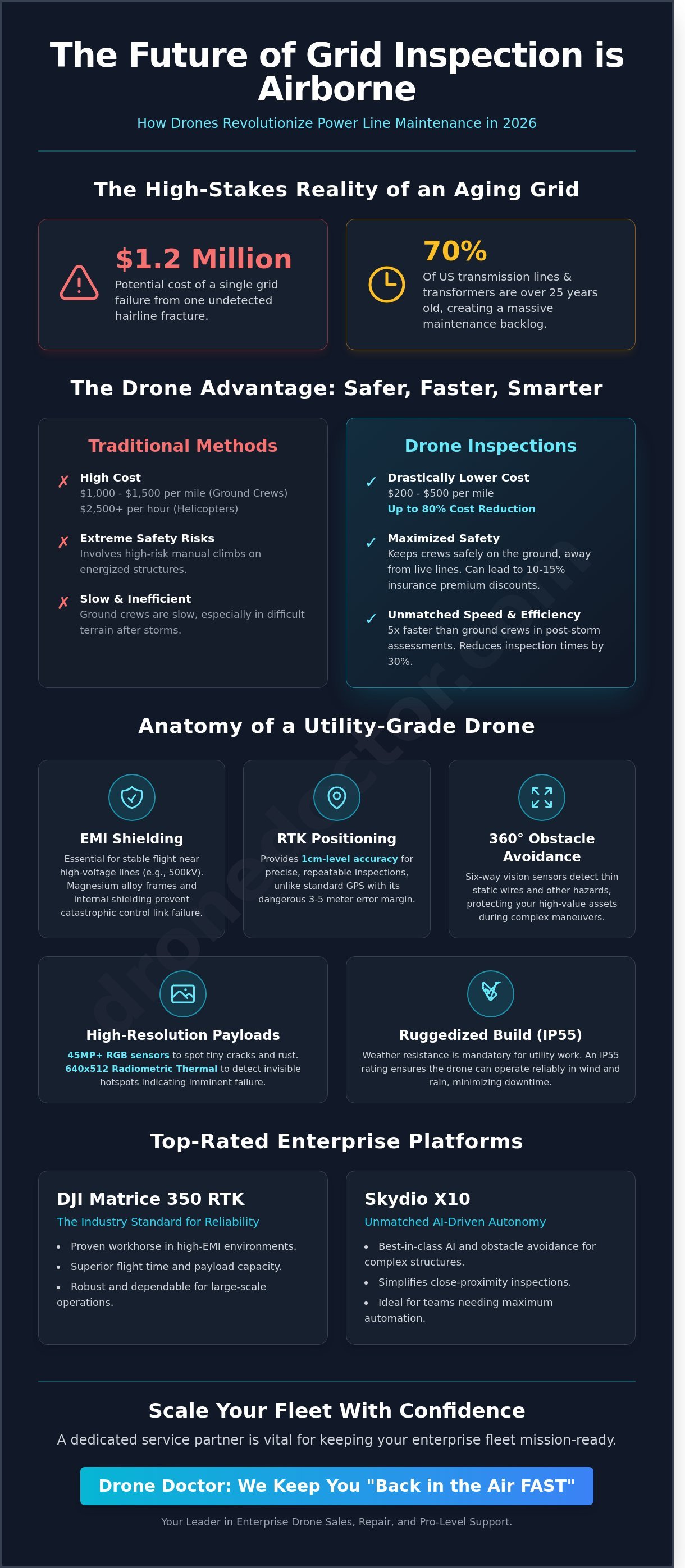
La red eléctrica de EE. UU. está llegando a un punto de ruptura crítico. Los datos del Departamento de Energía muestran que el 70% de las líneas de transmisión y los transformadores tienen más de 25 años, lo que crea una enorme acumulación de mantenimiento que los equipos manuales no pueden manejar solos. Ya no puede depender de métodos del siglo XX como la escalada manual o el alquiler de helicópteros por $2,500 por hora. Escalar su flota en 2026 es la única manera de adelantarse a las fallas de equipos y al aumento de la presión regulatoria. La integración de un vehículo aéreo no tripulado de alto rendimiento en sus operaciones diarias garantiza que su equipo identifique la fatiga estructural antes de que provoque un apagón catastrófico.
Los proveedores de servicios públicos modernos se centran en dos métricas críticas: SAIDI (Índice de duración promedio de interrupciones del sistema) y CAIDI (Índice de duración promedio de interrupciones del cliente). Los drones mejoran directamente estos números al reducir los tiempos de inspección en un 30% en comparación con las patrullas terrestres tradicionales. Cuando implementa el mejor dron para inspeccionar líneas eléctricas, no solo está tomando fotos; está recopilando inteligencia procesable. Un dron verdaderamente "de grado utilitario" es una herramienta reforzada que cuenta con resistencia a la intemperie IP55 y sensores térmicos de 640x512. Está diseñado para soportar la intensa interferencia electromagnética que se encuentra cerca de líneas de alto voltaje donde los drones de consumo a menudo fallan.
La seguridad primero: eliminando las escaladas de alto riesgo
La seguridad es la mayor ventaja para cualquier gerente de servicios públicos. Los drones mantienen a sus mejores técnicos en tierra y lejos de las líneas energizadas. Durante las evaluaciones posteriores a las tormentas, los UAV pueden volar sobre árboles caídos y áreas inundadas 5 veces más rápido de lo que un equipo terrestre puede navegar por ellas. Esta respuesta rápida restaura la energía a los clientes horas antes. La estandarización de estos flujos de trabajo también ayuda a reducir las primas de seguro; algunos proveedores ahora ofrecen descuentos del 10% al 15% para las empresas que reemplazan las escaladas manuales de alto riesgo con inspecciones documentadas con drones.
El ROI de los datos aéreos de servicios públicos
La matemática financiera es simple. Las inspecciones terrestres tradicionales cuestan aproximadamente entre $1,000 y $1,500 por milla si se tienen en cuenta la mano de obra, el combustible del camión cesta y el desgaste del equipo. Las inspecciones con drones reducen ese costo a un rango de $200 a $500 por milla. Detectará fallas "invisibles" como descargas de corona o grietas en aisladores que el ojo desnudo pasaría por alto desde el suelo. Para fines de 2026, se proyecta que las empresas de servicios públicos que adopten la automatización completa con drones reduzcan los gastos anuales de operación y mantenimiento en un 22% por milla de circuito. No espere a una falla para actualizar su kit de herramientas; asegure hoy mismo el mejor dron para inspeccionar líneas eléctricas y proteja su infraestructura.
Características principales de los mejores drones para la inspección de líneas eléctricas
Seleccionar el mejor dron para inspeccionar líneas eléctricas requiere un enfoque en hardware reforzado. Los drones de consumo estándar a menudo fallan cerca de líneas de 500 kV debido a campos electromagnéticos masivos. El blindaje contra interferencias electromagnéticas (EMI) es la base absoluta para la seguridad. Sin él, los controladores de vuelo pueden fallar, lo que lleva a pérdidas catastróficas del casco. Los modelos empresariales de alta gama utilizan marcos de aleación de magnesio y blindaje interno especializado para operar de forma segura a metros de conductores energizados. Esta protección garantiza que su enlace de control se mantenga sólido incluso cuando el aire esté denso de estática.
La precisión es el siguiente pilar del trabajo profesional de servicios públicos. La tecnología cinemática en tiempo real (RTK) proporciona una precisión de posicionamiento de 1 centímetro. Esto no se trata solo de un vuelo estacionario estable; se trata de la repetibilidad de la trayectoria de vuelo. Puede volar exactamente la misma misión cada seis meses para rastrear cómo se degrada un aislador específico con el tiempo. El GPS estándar tiene un margen de error de 3 a 5 metros, lo cual es demasiado peligroso para trabajos de proximidad. Cuando vuela cerca de activos que valen millones, esa precisión de 1 cm es su póliza de seguro.
Navegando entornos energizados
Cuando un dron carece de un blindaje EMI adecuado, la interferencia de la brújula hace que la aeronave se desvíe sin control. Los sistemas redundantes, incluidos los IMU duales y las antenas duales, son obligatorios para evitar fugas cerca de las torres de celosía de acero. También debe exigir la evitación de obstáculos de 360 grados. Los sistemas modernos utilizan sensores de visión binocular de seis vías para detectar cables estáticos delgados que son invisibles a simple vista. Esta red de seguridad es esencial para proteger su equipo mientras trabaja en corredores de transmisión estrechos.
Versatilidad de la carga útil: más allá de lo visual
Las cargas útiles son donde ocurre el trabajo real. Los sensores RGB de alta resolución de 45 MP son necesarios para detectar óxido en pasadores o microfisuras en aisladores de porcelana. Para un análisis más profundo, las imágenes térmicas radiométricas identifican puntos calientes que señalan una falla inminente de los componentes. Un sistema automatizado de inspección con drones puede procesar estos datos para encontrar anomalías térmicas un 50% más rápido que los equipos terrestres manuales, detectando diferencias de temperatura tan pequeñas como 2 grados Celsius.
LiDAR es un cambio de juego para la gestión de la vegetación. Crea nubes de puntos 3D para medir la distancia exacta entre las ramas de los árboles y los cables, asegurando un estricto cumplimiento de las normas de seguridad. Las capacidades de zoom óptico, a menudo alcanzando un zoom óptico de 30x y digital de 200x, permiten a los pilotos capturar fotos de alta calidad de hardware desde una distancia segura. Esto mantiene la aeronave bien fuera de la peligrosa zona de descarga. Invertir en una plataforma con cargas útiles intercambiables asegura el futuro de su empresa. Puede cambiar una cámara RGB por una unidad LiDAR en menos de 60 segundos. Si está listo para actualizar sus capacidades de inspección, explore hoy nuestros paquetes de drones profesionales.
Los 5 mejores drones para inspeccionar líneas eléctricas: clasificaciones de 2026
La industria de los drones ha alcanzado un punto álgido en 2026. Elegir el hardware adecuado ya no se trata solo del tiempo de vuelo; se trata de la precisión de los datos y la seguridad cerca de los activos de alto voltaje. Si desea dominar el sector de servicios públicos, necesita el mejor dron para inspeccionar líneas eléctricas que se ajuste a su perfil de misión específico. Los sensores modernos y los controles de vuelo con IA han convertido lo que solía ser un trabajo peligroso de varios días en una tarea simplificada de una tarde.
DJI Matrice 350 RTK: El campeón de peso pesado
El M350 RTK es el rey indiscutible para torres de transmisión de alto voltaje. Ofrece un tiempo de vuelo de 55 minutos y una clasificación IP55 resistente, lo que significa que puede trabajar bajo la lluvia o el polvo sin dudarlo. Cuando combina este fuselaje con el Zenmuse H30T, obtiene un zoom digital de 400x y una claridad térmica superior. Esta combinación permite a los pilotos detectar anomalías térmicas en líneas de 500 kV desde una distancia segura. ¿Listo para mejorar su equipo? Encuentre drones DJI a la venta en Drone Doctor y obtenga el soporte experto que se merece. Este dron es el estándar de oro de la industria por una razón; su fiabilidad en entornos de alta interferencia es inigualable.
Skydio X10: El futuro de la inspección autónoma
La autonomía es la herramienta definitiva para escalar su programa de drones. El Skydio X10 utiliza IA a bordo para manejar la evitación de obstáculos en entornos electromagnéticos complejos. Esta tecnología reduce significativamente la fatiga del piloto durante los agotadores vuelos de pasillo de 10 millas. Al automatizar la trayectoria de vuelo, las empresas de servicios públicos pueden maximizar los recursos limitados y centrarse en el análisis de datos en lugar de volar manualmente. El paquete "NightVision" es una gran ventaja, ya que permite inspecciones de emergencia las 24 horas del día durante los cortes de energía por tormentas nocturnas. La autonomía no es solo un lujo; es la clave para eliminar el error humano de la ecuación de inspección. Asegure esta potencia autónoma y deje de preocuparse por los accidentes.
Además de estos líderes, otros tres modelos están causando sensación en 2026:
- DJI Mavic 3 Enterprise: Esta es la potencia portátil para líneas de distribución. Cuenta con un obturador mecánico que evita el desenfoque por movimiento, lo que permite disparos rápidos a intervalos de 0.7 segundos. Es el mejor dron para inspeccionar líneas eléctricas en áreas residenciales urbanas densas donde un dron más grande sería demasiado intrusivo.
- Autel Evo II Dual 640T: Una alternativa de primera línea, no DJI, para equipos que prefieren no tener geocercas. Su sensor térmico de 640x512 proporciona las firmas de calor exactas necesarias para identificar transformadores defectuosos. Es un caballo de batalla confiable y de alta resolución que hace el trabajo.
- Inspired Flight IF800 Tomcat: Este contendiente fabricado en EE. UU. está diseñado para misiones de carga pesada. Con una capacidad de carga útil de 3 kg, es la opción profesional para transportar LiDAR de alta gama o sensores de gas especializados. Cumple totalmente con la NDAA, lo que lo convierte en la opción ideal para contratos de servicios públicos vinculados al gobierno.
¡Actúe AHORA para asegurar estos imprescindibles antes de que se agoten! Ya sea que necesite las capacidades de carga pesada del Tomcat o el ágil Mavic 3E, Drone Doctor tiene el inventario y la experiencia en reparación para mantenerlo en el aire. Compre con confianza; ¡su satisfacción es nuestra máxima prioridad!
Más allá del hardware: software y sensores para UAVs de servicios públicos
Elegir el mejor dron para inspeccionar líneas eléctricas es solo la mitad de la batalla. Para elevar realmente sus operaciones, necesita el "cerebro" que convierte píxeles sin procesar en informes de mantenimiento procesables. Los drones utilitarios modernos se basan en una sofisticada pila de software impulsado por IA y sensores de alta precisión para garantizar que la red permanezca energizada y segura. Se trata de pasar de simples imágenes a gemelos digitales de alta fidelidad en los que su equipo de ingeniería pueda confiar.
Soluciones de software: de DroneDeploy a Pix4D
Las plataformas líderes como DroneDeploy y Pix4D son esenciales para generar modelos 3D de subestaciones. Estos gemelos digitales permiten a los equipos medir distancias y holguras sin pisar una zona de alto voltaje. Al utilizar el reconocimiento automático de defectos, los algoritmos de IA ahora pueden detectar aisladores agrietados o pernos oxidados con una precisión de hasta el 95 %, lo que reduce el tiempo de revisión manual en un 70 %. Los informes basados en la nube garantizan que cuando un piloto finaliza un vuelo, las partes interesadas vean los resultados en tiempo real, lo que permite tomar decisiones inmediatas de reparación.
Análisis profundo de sensores: térmicos y LiDAR
Los sensores son los ojos de su operación. Para las inspecciones térmicas, una resolución de 640x512 es el requisito mínimo absoluto. Cualquier resolución inferior carece de la densidad de píxeles para identificar "puntos calientes" en componentes pequeños desde una distancia segura. Si bien los datos térmicos visuales muestran patrones de calor básicos, los datos térmicos radiométricos capturan el valor de temperatura específico para cada píxel individual en el fotograma. Esta precisión es vital para documentar desequilibrios fase a fase.
LiDAR se ha convertido en el estándar de oro para la gestión de la vegetación. A diferencia de la fotogrametría, que puede tener dificultades con los cables delgados, los pulsos de LiDAR pueden penetrar la cubierta del dosel para medir la distancia exacta entre una rama y un conductor. Esto proporciona una precisión de nivel de 2 cm para los mapas de intrusión. Si está administrando una red densa con mucho follaje, LiDAR es una herramienta imprescindible para su kit.
- Planificación de vuelos automatizada: Garantiza que cada inspección siga la misma ruta exacta para una comparación año tras año.
- LiDAR: Lo mejor para la detección de cables finos y la medición del crecimiento de la vegetación en el espacio 3D.
- Fotogrametría: Ideal para el mapeo visual 3D de alta resolución de componentes estructurales.
- Seguridad de los datos: Busque el cifrado AES-256 para proteger los mapas de infraestructura confidenciales del acceso no autorizado.
Cuando elige el mejor dron para inspeccionar líneas eléctricas, también está eligiendo una estrategia de seguridad de datos. Los drones utilitarios modernos deben cumplir con estrictas leyes de soberanía de datos, asegurando que los registros de vuelo y los mapas de infraestructura se almacenen en servidores locales seguros. Este nivel de cumplimiento de grado profesional es lo que separa una configuración de aficionado de una verdadera solución industrial.
¿Listo para actualizar su flota de servicios públicos con la última tecnología de sensores? ¡Compre nuestros drones de inspección de nivel profesional en Drone Doctor y obtenga el soporte experto que necesita para mantenerse en el aire!
Escalando su flota de inspección con Drone Doctor
Seleccionar el mejor dron para inspeccionar líneas eléctricas es una inversión importante, pero la compra es solo la línea de partida. Sus operaciones de servicios públicos dependen de un tiempo de actividad del 99.9% para mantener la red eléctrica funcionando de manera segura. Drone Doctor no es solo un minorista; somos su socio de misión crítica. Vivimos según la filosofía "Back in the Air FAST" porque cada hora que un dron pasa en un banco de trabajo es una hora en la que no está identificando riesgos críticos de infraestructura o peligros de incendios forestales. Nuestro equipo proporciona kits empresariales personalizados, asegurando que su equipo reciba un paquete listo para volar con las cargas útiles exactas, baterías de alta capacidad y estuches de transporte reforzados necesarios para los agotadores turnos de campo de 12 horas. También ofrecemos soporte bilingüe completo. Se habla español. Esto garantiza una comunicación clara y capacitación técnica en proyectos de servicios públicos nacionales desde Florida hasta California.
Servicios expertos de reparación y mantenimiento
Las fallas en el campo a menudo provienen de hardware descuidado o microfracturas en el fuselaje. Recomendamos un estricto programa de mantenimiento preventivo cada 50 horas de vuelo para cambiar hélices desgastadas, revisar los rodamientos del motor y calibrar sensores térmicos sensibles. Si ocurre una colisión, nuestros técnicos utilizan un enorme inventario de piezas OEM originales para proporcionar tiempos de respuesta rápidos que superan el promedio de la industria en un 40%. Puede confiar en nuestros servicios profesionales de reparación de drones para minimizar el tiempo de inactividad y proteger sus resultados. No solo reparamos drones; restauramos su capacidad operativa para que pueda volver a trabajar de inmediato.
Asegure su flota de 2026 hoy mismo
No espere a que una falla de hardware lo haga pensar en su próxima unidad. Las restricciones globales de la cadena de suministro significan que los plazos de entrega para sensores térmicos especializados de alta gama pueden superar actualmente los 90 días. ¡Actúe AHORA para asegurar su flota de 2026 y vencer estos retrasos en toda la industria! Nuestro proceso de ventas consultivo lo ayuda a elegir el mejor dron para inspeccionar líneas eléctricas según su voltaje de red específico y los requisitos del terreno local. Cuando nos compra, se une a la comunidad de Drone Doctor. Esto significa que obtiene acceso directo a soporte técnico continuo de expertos reales como Liz y José, quienes comprenden lo mucho que está en juego en la inspección de servicios públicos. Compre con confianza; ¡su satisfacción es nuestra máxima prioridad! 🚨🛍️💳🔥
Tome el mando de la red en 2026
El panorama del mantenimiento de servicios públicos ha cambiado. El despliegue de UAV avanzados reduce los costos de inspección en un 70% mientras mantiene a los equipos terrestres a salvo de los riesgos de alto voltaje. Hemos identificado a los líderes de 2026 que cuentan con ciclos de vuelo de 45 minutos y sensores térmicos de alta resolución que detectan variaciones de temperatura de 0.1 grados. Seleccionar el mejor dron para inspeccionar líneas eléctricas garantiza que su equipo capture datos procesables antes de que una falla menor se convierta en una interrupción catastrófica. Necesita un socio que comprenda que el tiempo de inactividad no es una opción para su flota.
Drone Doctor se erige como el distribuidor autorizado de DJI y Enterprise en el que puede confiar. Somos líderes en ventas, reparación y servicio; nuestros expertos de habla hispana están listos para apoyar su misión. No permita que su infraestructura se quede atrás. Asegure la última tecnología y mantenga sus operaciones funcionando con la máxima eficiencia. Nuestro equipo está aquí para ayudarlo a escalar con confianza.
¡Eleve sus capacidades de servicios públicos y compre drones empresariales ahora!
El futuro del sector energético está en el aire y estamos encantados de ayudarle a liderar el camino.
Preguntas frecuentes
¿Cuál es el mejor dron para la inspección de líneas eléctricas en 2026?
El DJI Matrice 350 RTK es el mejor dron para inspeccionar líneas eléctricas en 2026 debido a su tiempo de vuelo de 55 minutos y a su transmisión O3 Enterprise. Esta potencia admite la carga útil Zenmuse H30T, lo que le brinda un zoom óptico de 34x para detectar con seguridad pequeños defectos desde la distancia. Maneja líneas de 500 kV sin perder la señal. ¡Asegure el suyo hoy y manténgase por delante de la competencia!
¿Cómo manejan los drones la interferencia electromagnética (EMI) cerca de las líneas eléctricas?
Los drones manejan las EMI utilizando blindaje especializado de aleación de magnesio y módulos de posicionamiento RTK. Estos sistemas proporcionan una precisión de nivel centimétrico incluso cuando vuelan a 3 metros de hardware de alto voltaje. Hemos visto a pilotos mantener una estabilidad de control del 100% cerca de transformadores de 345 kV. No se arriesgue a una fuga; utilice fuselajes equipados con RTK para cada trabajo de servicios públicos para garantizar el éxito total de la misión.
¿Necesito una licencia FAA Parte 107 para inspeccionar líneas eléctricas con un dron?
Definitivamente necesita una licencia FAA Parte 107 para cualquier trabajo profesional en líneas eléctricas. El vuelo comercial de drones sin esta certificación conlleva sanciones federales que alcanzan los $32,666 por día. Nuestro equipo puede ayudarlo a navegar por estas regulaciones. Certifíquese ahora para proteger su negocio y su reputación. ¡Nuestros instructores certificados han ayudado a más de 500 pilotos a aprobar sus exámenes en el primer intento!
¿Pueden los drones inspeccionar líneas eléctricas por la noche?
Los drones pueden inspeccionar líneas eléctricas por la noche si están equipados con cargas útiles térmicas y luces estroboscópicas compatibles con la FAA. Estas luces deben ser visibles a 3 millas terrestres para cumplir con los estándares de seguridad de la Parte 107. Los vuelos nocturnos a menudo revelan descargas de corona que son invisibles durante el día. La mayoría de las empresas de servicios públicos ahora exigen una cobertura térmica del 100% para la respuesta a emergencias por tormentas y la confiabilidad de la red 24/7.
¿Cuál es la diferencia entre la inspección visual y térmica para servicios públicos?
Las inspecciones visuales utilizan cámaras de 45 megapíxeles para detectar pernos oxidados o aisladores agrietados. Las inspecciones térmicas utilizan firmas de calor para encontrar componentes defectuosos antes de que se enciendan. Un sensor DJI H30T detecta cambios de temperatura de 0.05 grados Celsius. Esta combinación lo convierte en el mejor dron para inspeccionar líneas eléctricas porque detecta tanto daños físicos como fallas eléctricas antes de que causen interrupciones.
¿Cuánto cuesta un dron empresarial para la inspección de servicios públicos?
Una configuración de dron empresarial para servicios públicos generalmente oscila entre $12,000 y $40,000, dependiendo de los sensores. Un DJI Matrice 30T básico comienza alrededor de $10,000, mientras que un Matrice 350 RTK completamente equipado con LiDAR cuesta $35,000. Estas son herramientas de alto rendimiento, no juguetes. Invierta en equipos de calidad para asegurar un retorno de la inversión del 100% dentro de sus primeras 100 millas de inspección de línea.
¿Qué sucede si mi dron de inspección se estrella o necesita reparación?
Si su dron se estrella, nuestros técnicos expertos proporcionan un diagnóstico completo dentro de las 24 horas posteriores a la llegada. Somos líderes en servicio, utilizando piezas OEM 100% genuinas para cada reparación. La mayoría de las reparaciones empresariales en Drone Doctor se completan en 3 a 5 días hábiles. Compre con confianza sabiendo que lo respaldamos. No permita que el tiempo de inactividad arruine sus ganancias; ¡vuelva a poner su ave en el aire!
¿Es necesario LiDAR para las inspecciones de líneas eléctricas?
LiDAR es esencial si necesita medir la distancia del cable al suelo o controlar el crecimiento de la vegetación. Crea nubes de puntos 3D con una precisión absoluta de 5 centímetros. Sensores como el Zenmuse L2 capturan 240,000 puntos por segundo. Si bien las cámaras visuales funcionan para verificaciones básicas, LiDAR es el estándar de oro para la ingeniería estructural y el mapeo de la red. ¡Actúe ahora para actualizar sus capacidades de datos!