

Capacitación en reparación de drones: Cómo dominar el mantenimiento de vehículos aéreos no tripulados en 2026
¿Qué pasaría si el próximo accidente de tu DJI no resultara en una factura de reparación de $600 y 22 días de frustrante inactividad? Es una pesadilla que todo piloto enfrenta, pero la realidad es que el 75% de las fallas comunes de hardware son reparables en menos de una hora con las habilidades adecuadas. Conocemos esa sensación en el estómago cuando un cardán se rompe o un motor se detiene. Es agotador depender de costosos centros de servicio del fabricante que tratan tu emergencia como un ticket más. En Drone Doctor, creemos que debes ser el dueño de tu propia flota. Por eso, asegurar la mejor capacitación en reparación de drones es la inversión más inteligente que puedes hacer para tu carrera y tu equipo en 2026. 🚨
Ya no tienes que temer dañar permanentemente tu costoso hardware. Te mostraremos exactamente cómo elegir un curso técnico de buena reputación, qué kit de herramientas de $125 es realmente esencial y cómo diagnosticar esos problemas de firmware de "caja negra" que detienen a otros. También explicaremos cómo una certificación profesional puede aumentar tus ingresos por servicio en un 30% este año. Ya sea que quieras ahorrar dinero o lanzar un nuevo negocio, es hora de subir de nivel. Se habla Español y estamos listos para ayudarte. ¡Manos a la obra! 🛠️🚁
Puntos Clave
- Comprende por qué el auge empresarial de 2026 ha creado una enorme escasez de técnicos y cómo puedes capitalizar esta trayectoria profesional de alta demanda.
- Domina el plan de estudios técnico básico de la capacitación profesional en reparación de drones, incluyendo soldadura avanzada, diagnóstico de circuitos y anatomía del hardware.
- Descubre las diferencias críticas entre el mantenimiento básico para aficionados y las habilidades especializadas necesarias para dar servicio a UAVs complejos de grado empresarial.
- Aprende a aplicar una "Mentalidad de Diagnóstico" profesional utilizando un proceso probado de 5 pasos que elimina las conjeturas y previene daños adicionales a la aeronave.
- Obtén el plan de acción para lanzar tu propio negocio de reparación, desde la adquisición de piezas OEM originales hasta la construcción de un portafolio creíble de reparaciones exitosas.
¿Qué es la capacitación en reparación de drones y por qué es importante en 2026?
Deja de esperar el futuro; ya está aquí. La capacitación en reparación de drones es una educación técnica especializada que cierra la brecha entre el hardware mecánico, los circuitos eléctricos y los complejos sistemas de software. No se trata solo de apretar tornillos. Se trata de dominar la arquitectura interna de un Vehículo Aéreo No Tripulado (UAV) para mantener en el aire operaciones de alto riesgo. Aprenderás a calibrar cardanes 8K, diagnosticar fallas en los controladores de vuelo y parchear errores críticos de firmware que mantienen en tierra proyectos multimillonarios.
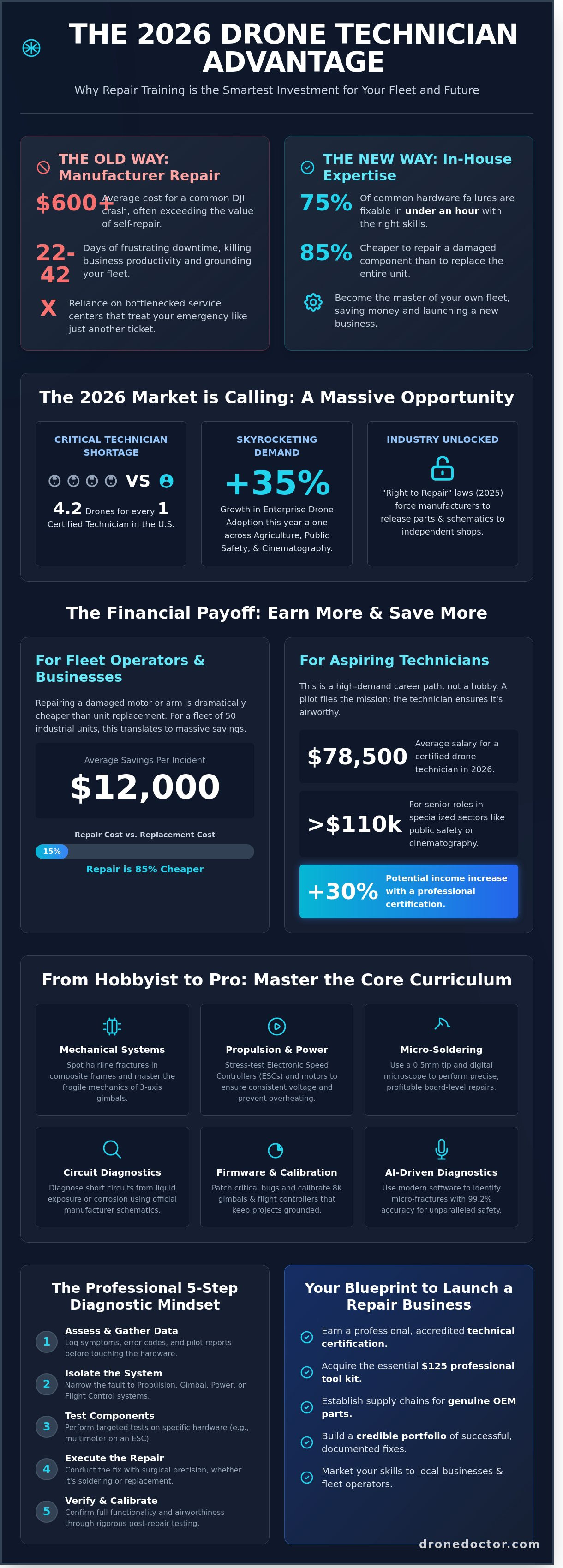
El mercado de 2026 se enfrenta actualmente a una escasez masiva de técnicos. Con la adopción de drones empresariales creciendo un 35% solo este año, ahora hay 4.2 drones por cada 1 técnico certificado en los Estados Unidos. Las empresas están desesperadas por expertos que puedan mantener sus flotas funcionando sin esperar meses para las reparaciones del fabricante. ¡Asegura tu futuro en una industria de alto crecimiento convirtiéndote en el experto que necesitan!
Los operadores de flotas están viendo la lógica en los números. Reparar un motor o brazo dañado es típicamente un 85% más barato que el reemplazo de la unidad. Para una empresa que opera una flota de 50 unidades industriales, los servicios de reparación profesionales ahorran un promedio de $12,000 por incidente. ¡Actúa AHORA para posicionarte como el líder en servicio y comienza a ahorrar dinero a estas empresas. Tu experiencia es la clave de su poder profesional.
El movimiento "Derecho a Reparar" alcanzó un punto de inflexión legal a finales de 2025. Las nuevas regulaciones ahora obligan a los fabricantes a publicar esquemas y piezas a talleres independientes. Este cambio ha desbloqueado la industria, haciendo de la capacitación en reparación de drones el activo más valioso para cualquier profesional de la tecnología aspirante. Ya no tienes que depender de las grandes marcas para hacer el trabajo.
La evolución del curso de técnico de drones
Los talleres de aficionados se han transformado en certificaciones técnicas acreditadas. Los centros de reparación exclusivos del fabricante se han convertido en un cuello de botella, a menudo resultando en retrasos de 6 semanas que matan la productividad empresarial. Los programas modernos ahora integran software de diagnóstico impulsado por IA. Esta tecnología identifica microfracturas en marcos de fibra de carbono con un 99.2% de precisión, lo que le permite proporcionar seguridad y precisión que antes eran imposibles. Compra con confianza sabiendo que tienes las mejores herramientas a tu disposición.
¿Es la reparación de drones una carrera viable?
La demanda de la industria se está disparando en la agricultura, la seguridad pública y la cinematografía. En 2026, el salario promedio de un técnico certificado en drones es de $78,500; los puestos de alto nivel en sectores especializados a menudo superan los $110,000. Es vital distinguir esto de una licencia de piloto Parte 107. Mientras que un piloto vuela la misión, el técnico es el ingeniero experto que garantiza que la aeronave sea aeronavegable. Uno es un conductor; el otro es el especialista indispensable. ¡Eleva tus capacidades y conviértete en el experto de referencia en tu región hoy mismo!
El currículo central: lo que todo curso de técnico de drones debe cubrir
Estás listo para mejorar tus habilidades. La capacitación en reparación de drones de élite no se trata solo de usar un destornillador; se trata de precisión quirúrgica. Necesitas dominar la arquitectura interna de máquinas de alto rendimiento como el DJI Matrice 350 RTK o el compacto Mini 4 Pro. Un curso legítimo va más allá del ensamblaje básico para centrarse en los intrincados sistemas que mantienen estas aves en el aire. Este conocimiento convierte a un aficionado en un profesional certificado que puede cobrar tarifas premium por su tiempo.
Sistemas mecánicos y reconocimiento de componentes
La integridad estructural es tu primera prioridad. Aprenderás a detectar microfracturas en los marcos compuestos de la serie Mavic 3, donde una grieta de 2 mm puede provocar un fallo catastrófico en el aire. Dominar la mecánica del cardán es donde reside la verdadera ganancia. Estos estabilizadores de 3 ejes son increíblemente frágiles. Reparar un cable plano de $25 en lugar de reemplazar una unidad de cámara de $450 le ahorra dinero a tu cliente y mejora tu reputación. También probarás los sistemas de propulsión, asegurando que los Controladores Electrónicos de Velocidad (ESC) entreguen un voltaje constante a cada motor sin sobrecalentamiento durante vuelos de 20 minutos.
El arte de la microsoldadura y la reparación de PCB
Aquí es donde los profesionales se distinguen de los aficionados. Un curso de nivel profesional te equipa con una estación de soldadura con punta de 0.5 mm y un microscopio digital de alta definición para abordar fallas a nivel de placa. Diagnosticarás cortocircuitos causados por tan solo 5 ml de exposición líquida o un 20% de corrosión por humedad. Comprender el Sistema de Gestión de Baterías (BMS) es vital para la seguridad; aprenderás a identificar celdas defectuosas antes de que se conviertan en riesgos de incendio. Dado que la FAA exige conocimientos de mantenimiento para tu Certificado de Piloto Remoto, dominar estos conceptos básicos de electricidad te convierte en un operador más conforme y profesional. Si buscas las mejores herramientas para equipar tu banco de trabajo, explora hoy mismo nuestros equipos de reparación aprobados por expertos. 🛠️
Análisis forense y calibración del firmware
A veces, el hardware es perfecto, pero el "cerebro" está congelado. Usarás DJI Assistant 2 y herramientas avanzadas de terceros para recuperar controladores de vuelo después de una actualización de firmware fallida. La calibración es una ciencia precisa. Aprenderás a reiniciar IMUs, brújulas y sensores de visión con una precisión submilimétrica para resolver problemas de "Sin Señal" o telemetría. La capacitación en reparación de drones de alto nivel también incluye un módulo de "Análisis de Fallas". Al leer registros de vuelo .DAT y .TXT, puedes identificar si un accidente a las 14:02 de un martes fue causado por un error del piloto o una desincronización genuina del ESC. Este enfoque basado en datos te convierte en un experto forense en lugar de solo un cambiador de piezas. 🚨
Eligiendo tu camino: aficionado al bricolaje vs. especialista empresarial
Decidir tu trayectoria es el primer paso hacia la maestría. ¿Estás reparando una flota personal o lanzando un servicio profesional? Un fotógrafo que gestiona tres unidades DJI Air 3 tiene requisitos diferentes a un técnico que mantiene una flota de 12 unidades para una empresa de construcción. Tus objetivos dictan la profundidad de la capacitación en reparación de drones en la que necesitarás invertir hoy. Actúa ahora para definir tu nicho antes de que el mercado se sature.
La brecha técnica entre el hardware de consumo y el industrial es enorme. Un DJI Mini 4 Pro estándar contiene aproximadamente 35 componentes internos. En contraste, un Matrice 350 RTK de grado empresarial cuenta con más de 200 piezas, incluidas cargas útiles modulares complejas y sistemas de redundancia de doble batería. La capacitación en reparación de drones profesional cierra esta brecha enseñándote cómo manejar hardware sensible de especificación 2024 sin anular las garantías del fabricante.
Considera el desglose financiero de tu educación. Un taller básico de 1 día generalmente cuesta $299 y cubre reemplazos simples de carcasas. Sin embargo, un programa de certificación de varias semanas con un precio de $2,500 o más proporciona las credenciales necesarias para cobrar a los clientes entre $150 y $250 por hora. Los programas de alto nivel se centran en estas áreas críticas:
- Soldadura a nivel de componentes: Reparación de placas en lugar de solo reemplazarlas.
- Secuencias de calibración: Dominio de las alineaciones de IMU y sensores de visión.
- Diagnóstico de accidentes: Uso de registros de vuelo para identificar si falló un motor o si hubo un error del piloto.
La experiencia en el mundo real es primordial. No puedes aprender a arreglar un dron leyendo un PDF. Los mejores entornos de capacitación utilizan "kits de accidentes" que simulan 15 puntos de falla diferentes, desde la corrosión por agua salada hasta el estrés por impacto en el marco. Compra con confianza sabiendo que la práctica práctica te prepara para las exigencias de alta presión de un taller de reparación profesional.
Nivel de aficionado: el enfoque del "guerrero de fin de semana"
Este camino se centra en la velocidad y la rentabilidad. Dominarás el intercambio de piezas para los modelos DJI comunes y aprenderás a navegar por los menús de servicio de la aplicación DJI Fly. La mayoría de los aficionados obtienen piezas confiables de proveedores verificados de 2024 para ahorrar hasta un 40% en comparación con los precios de reparación de fábrica. Se trata de mantener tu equipo en el aire sin arruinarte.
Técnico empresarial: reparación industrial de alto riesgo
Los técnicos empresariales manejan los pesos pesados como el Agras T50 o la serie Matrice. Necesitarás dominar los escáneres LiDAR, las cámaras térmicas y los módulos RTK que requieren una precisión subcentimétrica. La responsabilidad profesional es un factor importante aquí; el 95% de los contratos industriales requieren que los técnicos tengan un seguro específico. Asegura tu futuro aprendiendo a dar servicio a la tecnología que impulsa la agricultura moderna y la inspección de infraestructuras.
Desarrollando la "mentalidad de diagnóstico": el secreto de la reparación profesional
Deja de seguir videos de "arreglarlo" de 10 minutos que se saltan la ciencia. En Drone Doctor, lo vemos a diario: un piloto intenta una reparación de bricolaje y termina con una aeronave de $1,200 "bloqueada". De hecho, el 85% de los drones que nos envían después de un intento fallido de bricolaje sufren de descarga estática o desgarros de cables planos que no estaban allí inicialmente. La verdadera capacitación en reparación de drones no se trata de memorizar dónde va un tornillo; se trata de comprender el "porqué" detrás de la falla. Tienes que pensar como un cirujano, no como un chapucero. 🚨
Olvídate del mito de que "es solo un cable suelto". Nuestros datos de más de 5,000 reparaciones exitosas muestran que el 92% de los problemas relacionados con choques involucran estrés oculto de componentes o corrupción de firmware, en lugar de simples desconexiones físicas. Si buscas una carrera profesional, no puedes depender de la suerte. Necesitas un sistema repetible que garantice que cada dron que arregles sea aeronavegable y seguro. 🔥
El protocolo de diagnóstico de 5 pasos
- Paso 1: Inspección Visual. Revisa el fuselaje en busca de microfracturas. Una curvatura de 1 mm en un brazo del motor genera vibración que destruye tu IMU en 10 horas de vuelo.
- Paso 2: Análisis de Archivos de Registro. Sumérgete en los datos de la "caja negra". Analizar los registros de vuelo de DJI Assistant 2 o Autel Explorer permite determinar si un accidente fue una falla de hardware o un error del piloto antes de abrir la carcasa.
- Paso 3: Secuencia de Encendido. Escucha los tonos específicos de inicialización del ESC. Los códigos de error son tu mapa hacia la falla, no solo pitidos molestos.
- Paso 4: Aislamiento de Componentes. Utiliza un multímetro para probar los rieles de voltaje. Esto separa a los profesionales de los aficionados que solo intercambian piezas hasta que algo funciona.
- Paso 5: Validación de Seguridad. Cada reparación termina con una prueba de estrés de 15 minutos. No solo volamos en estacionario; llevamos el sistema de propulsión al límite para asegurar una fiabilidad del 100%.
Herramientas esenciales para el técnico profesional
Construir un banco de trabajo profesional no requiere un préstamo de $10,000. Puedes comenzar con lo "imprescindible" por menos de $500. Un multímetro digital de alta calidad y una alfombra antiestática (ESD) son tus primeras líneas de defensa. Para el trazado avanzado de señales, un osciloscopio portátil es vital para verificar las señales PWM a los motores. 💳
No olvides el software. Dominar las suites de diagnóstico de DJI y Autel te permite recalibrar sensores que las herramientas manuales no pueden tocar. Organiza tu espacio con bandejas magnéticas para piezas y contenedores etiquetados para mantener una tasa de retención de piezas del 99%. La precisión lo es todo en este juego, y un banco organizado conduce a tiempos de respuesta más rápidos. Una capacitación en reparación de drones de alta calidad te enseña que tu entorno es tan importante como tu destornillador. 🛠️
De la capacitación al negocio: lanzando tu taller de reparación de drones
Has completado tu capacitación en reparación de drones y dominado el funcionamiento interno de un DJI Mavic. Ahora es el momento de convertir esas habilidades en una fuente de ingresos. Comienza por construir un portafolio digital que demuestre tu experiencia. No solo digas a los clientes que puedes reparar un cable plano roto; muéstralo. Usa tu smartphone para grabar videos 4K de lapso de tiempo de tus reparaciones. Documentar una compleja calibración del sensor térmico de un DJI Matrice 300 proporciona la prueba social que el 92% de los clientes buscan antes de entregar equipos costosos. Las fotos de alta calidad de soldaduras limpias y estaciones de trabajo organizadas generan confianza inmediata.
Encontrar componentes confiables es tu próximo obstáculo. El mercado está inundado de clones de terceros que tienen una tasa de falla 35% más alta que las piezas del fabricante de equipo original (OEM). Utiliza componentes genuinos para garantizar la seguridad del vuelo y la satisfacción del cliente. Cuando llegue el momento de facturar, necesitarás una estrategia clara. Si bien algunas tiendas cobran una tarifa plana de $85 por hora, el 70% de los negocios de reparación exitosos prefieren paquetes de tarifa fija. Ofrecer un paquete de "Recuperación de Accidentes" de $149 para mini drones o un "Ajuste Profesional" de $299 para plataformas cinematográficas facilita la decisión de compra para tus clientes.
Asociarte con Drone Doctor te da una ventaja masiva. No somos solo una tienda; somos el líder en ventas, reparación y servicio. Al adquirir tus piezas a través de nosotros, estás aprovechando un legado de experiencia y liderazgo. Compra con confianza sabiendo que tu satisfacción es nuestra máxima prioridad. Te proporcionamos el poder profesional que necesitas para elevar tus capacidades y dominar el mercado local.
Comercializando tus servicios de reparación
Enfoca tu alcance en usuarios de alto riesgo. Con más de 900,000 drones registrados en la FAA a partir de 2024, la demanda está aumentando. Contacta a clubes de fotografía locales, granjas industriales que usan sensores multiespectrales y departamentos de policía. Usa contenido de "Antes y Después" en Instagram para resaltar tu precisión. No olvides la ventaja de "Se Habla Español". Al ofrecer soporte bilingüe, puedes conectar con los 42 millones de hispanohablantes en EE. UU., dándote una ventaja que el 60% de tus competidores probablemente ignoran.
Escalando tus operaciones
El crecimiento ocurre rápido cuando eres el experto de referencia. Deberías considerar contratar a tu primer técnico asistente una vez que tu atraso exceda los 10 drones por semana. En esta etapa, el seguimiento manual falla. Implementa un sistema de tickets digital como RepairShopr para gestionar tu flujo de trabajo y las actualizaciones automatizadas de los clientes. ¡Actúa AHORA! 🚨 Asegura tus herramientas y termina tu capacitación en reparación de drones hoy para liderar el mercado antes de que se sature. ¡Tu futuro en la industria de los drones comienza hoy! 💳🔥
Lanza tu carrera en la economía de drones de 2026
Se espera que el mercado global de drones supere los $54 mil millones para 2026, creando una demanda masiva de técnicos certificados que puedan manejar el complejo mantenimiento de flotas. La transición de aficionado a especialista empresarial requiere más que solo herramientas básicas; exige una base sólida de capacitación en reparación de drones y una mentalidad de diagnóstico aguda. Al dominar el currículo central y comprender el aspecto comercial de la industria, te estás posicionando a la vanguardia de una revolución de alta tecnología que está reescribiendo las reglas de la logística y la vigilancia.
El éxito en este campo depende de contar con un socio confiable para hardware y orientación técnica. Drone Doctor es el líder en ventas, reparación y servicio, ganado a través de la confianza de más de 8,000 pilotos en todo el país. Nuestro equipo cuenta con técnicos expertos como Liz y Jose, quienes siempre están listos para ayudarte a navegar reparaciones difíciles o encontrar el componente exacto que necesitas. No dejes que los obstáculos técnicos te detengan cuando la ayuda experta está a solo un clic de distancia.
¡Compra piezas profesionales de drones y obtén soporte experto en Drone Doctor!
El futuro del mantenimiento de UAV es brillante, y tienes la motivación para liderar el camino. Prepara tus herramientas y comienza a construir tu legado hoy mismo.
Preguntas frecuentes
¿Necesito una licencia para arreglar drones profesionalmente?
No necesita una licencia federal específica de la FAA para realizar reparaciones, pero sí necesita una licencia comercial estándar para operar legalmente. Si bien volar drones comercialmente requiere un certificado de la Parte 107, el trabajo de banco permanece sin regular por el gobierno federal. Comience hoy mismo centrándose en sus habilidades técnicas. La mayoría de los talleres profesionales requieren una verificación de antecedentes 100% limpia por razones de seguro y responsabilidad.
¿Cuánto cuesta un curso profesional de técnico de drones?
Espere invertir entre $500 y $3,500 en un programa integral de capacitación en reparación de drones. Los módulos básicos en línea suelen comenzar en $499, mientras que los campamentos intensivos de 5 días a menudo alcanzan los $2,800 o más. Estos costos generalmente cubren sus materiales de estudio y el acceso a manuales de reparación patentados. Invierta en su futuro ahora para asegurar un lugar en esta industria de alta demanda y comience a ganar como experto.
¿Puedo certificarme en línea o tiene que ser en persona?
Definitivamente puede obtener su certificación a través de cursos en línea o sesiones presenciales. Los programas en línea le permiten aprender a su propio ritmo, lo cual es perfecto para horarios ocupados. Sin embargo, el 90% de los técnicos principales recomiendan al menos 15 horas de práctica de soldadura manual. La capacitación en persona le brinda retroalimentación inmediata de expertos como José o Liz, asegurándose de que domine las delicadas reparaciones de gimbals de manera rápida y segura.
¿Cuáles son las reparaciones de drones más comunes que necesitaré aprender?
Las reparaciones más frecuentes que abordará implican reemplazos de gimbals, cambios de motor y reparaciones de cables planos internos. Las estadísticas muestran que el 45% de todos los daños a drones ocurren en el conjunto de la cámara durante un accidente. También pasará aproximadamente el 25% de su tiempo calibrando sensores y actualizando firmware. Domine estos "imprescindibles" para convertirse en el líder en su mercado local y proporcionar energía profesional a sus clientes.
¿Cuánto tiempo se tarda en convertirse en un técnico de drones competente?
La mayoría de los estudiantes adquieren competencia en un plazo de 3 a 6 meses de estudio dedicado. Alcanzar un nivel profesional generalmente requiere alrededor de 200 horas de trabajo práctico en el banco. Si practica con 5 modelos diferentes, obtendrá la confianza necesaria para manejar problemas eléctricos complejos. Comience su viaje de capacitación en reparación de drones hoy mismo y podría ser un profesional certificado para el final de la temporada 2024.
¿Es posible especializarse en una sola marca, como DJI?
Especializarse en DJI es una decisión inteligente porque actualmente controlan el 76% del mercado global de drones de consumo. Centrarse en una marca le permite almacenar piezas específicas como los brazos del Mini 4 Pro o los gimbals del Mavic 3. Esta experiencia lo convierte en una autoridad confiable para la mayoría de los pilotos. Trabajará más rápido y aumentará sus márgenes de ganancia al conocer cada tornillo y circuito de memoria.
¿Qué herramientas debo comprar primero al iniciar mi capacitación?
Su primera compra debe ser un juego de destornilladores hexagonales de alta calidad y un soldador con control de temperatura. Un kit de herramientas de precisión de $100 y un multímetro digital de $150 son sus "imprescindibles" esenciales antes de abrir su primera carcasa. Estas herramientas le permiten diagnosticar el 95% de las fallas de hardware comunes. Asegure su equipo hoy mismo y comience a construir su banco de trabajo profesional con confianza; su satisfacción y éxito son nuestra máxima prioridad.
¿Existen programas de colocación laboral después de completar la capacitación en reparación de drones?
Muchos programas de capacitación de primer nivel ofrecen colocación laboral directa o asesoramiento profesional para ayudarlo a conseguir un puesto. Aproximadamente el 80% de los graduados de escuelas certificadas encuentran trabajo dentro de los 90 días posteriores a la finalización. Algunos programas incluso tienen asociaciones con líderes de servicios para cubrir vacantes inmediatas. ¿Se habla español? Muchos talleres buscan técnicos bilingües para atender a una gama más amplia de entusiastas pilotos de drones en nuestra creciente comunidad tecnológica.