

Cómo elegir un dron para fotografía: Guía del comprador de 2026
En 2026, la cámara más potente de su equipo profesional no es la que lleva colgada al cuello; es la que se eleva 120 metros en el aire. Muchos creadores están retrasando sus actualizaciones porque la Ley contra los drones del PCCh de 2024 y la compleja jerga como OcuSync 5.0 hacen que el mercado parezca un campo minado. Aprender cómo elegir un dron para fotografía no debería requerir un título en derecho o una certificación de ingeniería. Desea archivos RAW nítidos de 48 MP sin el temor constante de que una sola actualización de software o una ligera brisa conviertan su inversión de 2.000 $ en un pisapapeles.
Para proyectos comerciales complejos, también puede ser útil ver lo que un servicio dedicado puede lograr. Los equipos profesionales especializados en fotografía y videografía aérea demuestran todo el potencial de los drones de alta gama para aplicaciones inmobiliarias, industriales y artísticas.
Escuchamos estas preocupaciones exactas todos los días de nuestra comunidad. Es estresante sopesar los tamaños de los sensores CMOS con los tiempos de vuelo mientras se pregunta si su nuevo equipo será legal para volar en los EE. UU. para el próximo verano. Esta guía elimina el ruido para ayudarlo a dominar las especificaciones técnicas y las tendencias del mercado para que pueda encontrar la cámara aérea perfecta para su visión creativa. Obtendrá un desglose claro de los mejores modelos listos para volar para 2026, las características esenciales para evitar choques y las especificaciones exactas que necesita para impresiones con calidad de galería. Subamos al cielo para que pueda comprar y volar con total confianza.
Puntos clave
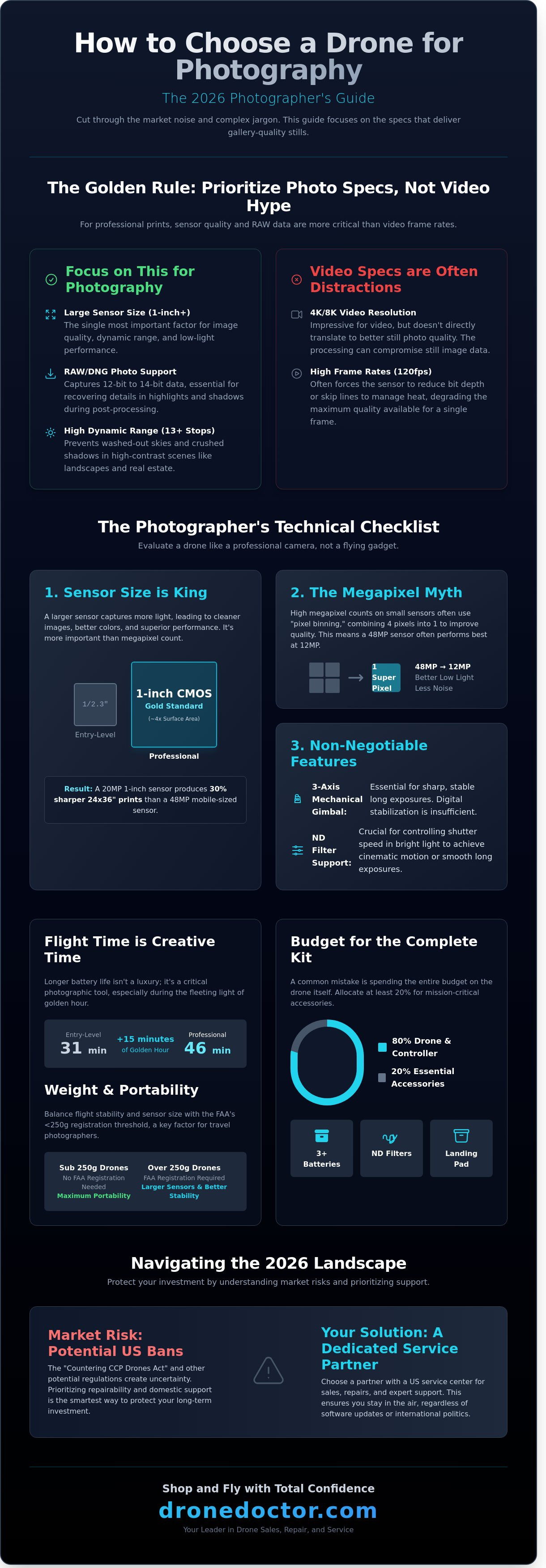
- Descubra por qué un sensor CMOS de 1 pulgada es el estándar de oro para impresiones de alta calidad y cómo navegar por el debate de los megapíxeles de 48 MP frente a 12 MP.
- Comprenda las compensaciones técnicas entre el video cinematográfico y el rango dinámico fotográfico para asegurarse de que sus fotos nunca se vean descoloridas.
- Domine cómo elegir un dron para fotografía equilibrando el umbral de 250 g de la FAA con la portabilidad que necesita para su visión creativa.
- Obtenga las últimas actualizaciones de 2026 sobre la prohibición de DJI en los EE. UU. y por qué priorizar la capacidad de reparación es el secreto para proteger su inversión a largo plazo.
- Descubra por qué asociarse con un líder de servicio dedicado le garantiza obtener energía de grado profesional y accesorios imprescindibles antes de que se agoten.
Cómo elegir un dron para fotografía: por qué las fotos importan más que el video
La mayoría de los compradores se deslumbran con las llamativas especificaciones de video 4K u 8K, pero si usted es fotógrafo, esos números suelen ser distracciones. Las altas velocidades de fotogramas, como 120 fps, suelen obligar a un sensor a saltarse líneas o reducir la profundidad de bits para gestionar el calor. Para una impresión profesional de galería, necesita archivos RAW de 14 bits y el máximo rango dinámico, no solo un movimiento suave. Aprender cómo elegir un dron para fotografía comienza priorizando la capacidad del sensor para capturar luz estática sobre su capacidad para procesar fotogramas de video de movimiento rápido.
El mercado de 2026 ha cambiado significativamente. Si bien los modelos más antiguos dependían de las funciones de vuelo "inteligentes" para destacarse, la IA moderna ha convertido el vuelo estable en una mercancía. Hoy, el diferenciador es la calidad óptica. El vidrio de alta gama y los sensores más grandes de 1 pulgada o Micro Cuatro Tercios ahora proporcionan 13 pasos de rango dinámico. Esto es crucial para el trabajo de paisajes e inmobiliario, donde debe equilibrar cielos brillantes con sombras arquitectónicas oscuras.
Rompiendo el mito de la "cámara voladora"
No ignore el tiempo de vuelo como una especificación fotográfica. Un dron con una batería de 46 minutos le brinda una ventaja de 15 minutos durante la "hora dorada" en comparación con los modelos de nivel de entrada. Este tiempo adicional le permite flotar y esperar la luz perfecta para golpear el horizonte. El encuadre asistido por IA moderno ahora maneja los microajustes para el viento, lo que le permite concentrarse por completo en su composición e histograma. La aerofotografía es la intersección de la estabilidad de vuelo y la captura RAW de alta tasa de bits.
Cuando observamos la historia de la fotografía aérea, el objetivo siempre ha sido la perspectiva y la claridad. Hoy en día, eso significa elegir una plataforma que maneje fotos de 20 a 45 megapíxeles sin ruido digital. Ya sea que esté fotografiando bellas artes o propiedades comerciales, el vidrio frente al sensor importa más que el software dentro del controlador.
Presupuesto para el kit completo
Evite gastar todo su presupuesto en el dron en sí. Debe asignar al menos el 20% de sus fondos a accesorios esenciales que hagan posible la fotografía profesional. Necesitará un juego de filtros ND para controlar la velocidad del obturador, al menos tres baterías para un día completo de filmación y una plataforma de aterrizaje dedicada para proteger su cardán del polvo y los escombros. ¡Asegure su equipo hoy para asegurarse de que estará listo para el próximo amanecer!
También es vital elegir una marca con un centro de servicio doméstico en EE. UU. En Drone Doctor LLC, nos enorgullecemos de ser el líder en ventas, reparación y servicio. Nuestro personal, incluidos expertos como Jose y Liz, hace todo lo posible para mantenerlo en el aire. Apoyamos su viaje desde "Agregar al carrito" hasta su primera impresión de galería. Compre con confianza; su satisfacción es nuestra principal prioridad. Si desea saber cómo elegir un dron para fotografía que dure, busque un socio que ofrezca soporte en el mundo real después de la venta.
Lista de verificación del fotógrafo: sensores, RAW y rango dinámico
Deje de mirar el precio y comience a mirar el cristal. Cuando está aprendiendo cómo elegir un dron para fotografía, el sensor es su inversión más crítica. Un sensor CMOS de 1 pulgada es el estándar de oro profesional; ofrece aproximadamente cuatro veces la superficie de un sensor estándar de 1/2 pulgada. Este espacio adicional permite píxeles individuales más grandes que absorben más luz, razón por la cual un sensor de 1 pulgada de 20 MP produce impresiones de 24x36 un 30% más nítidas que un sensor de tamaño móvil de 48 MP. Comprender estas especificaciones técnicas es el secreto para saber cómo elegir un dron para fotografía que no quede obsoleto la próxima temporada.
No se distraiga solo con los altos recuentos de megapíxeles. Muchos drones modernos utilizan la combinación de píxeles, un proceso en el que cuatro píxeles se combinan en uno para mejorar el rendimiento con poca luz. Esto significa que su dron de 48 MP podría producir su mejor trabajo a 12 MP. Para aquellos que buscan los mejores drones para fotografía, concéntrense en el tamaño físico del sensor en lugar de los números de marketing en la caja. El cristal de alta calidad y un sensor grande superan a los altos recuentos de píxeles en todo momento.
- Soporte RAW/DNG: Esto no es negociable para trabajos serios. Los archivos DNG capturan 12 bits de datos por canal, lo que le brinda la latitud para recuperar luces en Lightroom que se perderían en un JPEG estándar.
- Cardán mecánico de 3 ejes: La estabilización digital no funciona para exposiciones largas. Necesita un sistema de motor físico de 3 ejes para mantener la cámara estable durante un obturador de 2 segundos por la noche.
Comprensión de la física del sensor
Los sensores más grandes manejan mejor el ruido al proporcionar datos limpios para su flujo de trabajo de posprocesamiento. En los modelos de 2026, la verdadera calidad óptica supera el zoom digital en todo momento. Por ejemplo, el sensor DJI Mavic 4 Pro proporciona una relación señal/ruido un 18% mejor que el Autel EVO II V3 en entornos con poca luz. Si está indeciso, nuestro equipo de expertos puede ayudarlo a comparar las últimas especificaciones de la cámara para encontrar su combinación perfecta.
Controles de apertura y velocidad de obturación
Una apertura ajustable (f/2.8 a f/11) es vital para controlar la exposición sin cambiar constantemente los filtros ND. También le permite gestionar su profundidad de campo para obtener resultados más cinematográficos. Los obturadores mecánicos son otra característica imprescindible para la acción de alta velocidad; eliminan el efecto de obturador rodante que hace que los edificios parezcan inclinados cuando se vuela a 65 km/h. El rango dinámico es la capacidad del dron para preservar los detalles tanto en nubes brillantes como en sombras oscuras. Los sensores de alta gama ahora alcanzan 14 pasos de rango dinámico, lo que garantiza que sus tomas de la hora dorada no se conviertan en una mancha blanca de cielo sobreexpuesto.
Navegando por el panorama de 2026: la prohibición de DJI y la reparabilidad
Comprender cómo elegir un dron para fotografía en 2026 requiere mirar mucho más allá de los megapíxeles o el tiempo de vuelo. Debe asegurarse de que su inversión se mantenga legal y lista para volar. Las resoluciones de la FCC de 2024 se implementaron por completo en enero de 2026, creando un entorno complejo para los pilotos de DJI. Si bien la mayoría de los modelos de consumo comprados antes de 2025 siguen siendo volables en zonas de aficionados, las nuevas autorizaciones de hardware se someten a un intenso escrutinio. Debe verificar que cualquier compra nueva cumpla al 100% con la identificación remota para evitar una inmovilización inmediata por parte de las autoridades federales. Curiosamente, los drones de grado empresarial a menudo eluden estas restricciones de nivel de consumidor, lo que los convierte en una opción poderosa para los fotógrafos profesionales que necesitan un tiempo de actividad garantizado.
La realidad de la prohibición de DJI
Los mandatos federales ahora exigen que todo dron de más de 250 gramos transmita una matrícula digital. Si consulta la guía de The New York Times para elegir un dron, verá que las características de seguridad y cumplimiento son ahora tan críticas como el tamaño del sensor. Las alternativas "Blue UAS" fabricadas en Estados Unidos, como Skydio o Freefly, han capturado este año un 18% más del mercado profesional. Estos modelos son esenciales si planea filmar cerca de edificios gubernamentales o infraestructuras críticas. No permita que una "gran oferta" en un modelo no verificado lo deje con un dispositivo bloqueado que no puede pasar una verificación de despegue.
Por qué los drones "desechables" son una mala inversión
El mayor error que cometen los pilotos es ignorar la reparabilidad. Muchos fabricantes modernos diseñan unidades "selladas" que son casi imposibles de reparar sin herramientas patentadas. Esto crea un costo oculto donde un choque menor de 50 $ resulta en un reemplazo de 1.200 $. En Drone Doctor, luchamos contra esta tendencia "desechable" todos los días. Nuestros expertos, incluidos los técnicos principales como Jose, se especializan en mantener en el aire modelos "no compatibles" al obtener cardanes, brazos y motores de alta calidad que las grandes marcas dejaron de almacenar hace años. Podemos extender la vida útil de su equipo entre 3 y 4 años, ahorrándole miles a largo plazo.
Antes de decidir cómo elegir un dron para fotografía, revise esta rápida lista de verificación de reparabilidad:
- Disponibilidad de piezas: ¿Puede comprar brazos de motor individuales, o el marco es una sola pieza moldeada?
- Soporte de terceros: ¿Tiene una tienda como Drone Doctor el software para recalibrar los sensores de visión?
- Duración de la batería: ¿Todavía se fabrican baterías para este fuselaje específico?
Asegurarse un dron que realmente pueda repararse es la decisión más inteligente que tomará este año. ¡Actúe AHORA para asegurarse de que su kit esté diseñado para durar! 🚨🛍️🔥
Combinando el dron con su visión: opciones para viajes, profesionales y económicas
Seleccionar el equipo adecuado es el paso más crítico para aprender a elegir un dron para fotografía. Necesita una máquina que se adapte a su entorno específico sin arruinarlo ni cargarlo. Siga estos cuatro pasos para reducir su búsqueda de inmediato.
- Paso 1: Verifique el límite de 250 g. Si su dron pesa 250 gramos o más, la FAA exige el registro para uso recreativo. Para cualquier fotografía comercial, debe tener un certificado Parte 107, independientemente del peso. Mantenerse por debajo de los 249 gramos le permite evitar algunos de estos obstáculos para vuelos ocasionales.
- Paso 2: Portabilidad vs. Estabilidad. Los marcos plegables reducen su huella hasta en un 70 por ciento, lo que los hace perfectos para excursionistas. Los marcos rígidos, aunque más voluminosos, a menudo proporcionan una mejor disipación del calor para tomas profesionales prolongadas.
- Paso 3: Exija una transmisión de primer nivel. No se conforme con tecnología anticuada. OcuSync 4.0 proporciona un alcance de 20 km y una transmisión en vivo estable de 1080p/60fps. Los competidores que usan Wi-Fi estándar a menudo experimentan caídas de señal a solo 600 metros.
- Paso 4: Tamaño del sensor para la salida. Si solo publica en Instagram, un sensor de 1/1.3 pulgadas es suficiente. Para impresiones de galería de 24 pulgadas, necesita un sensor de 1 pulgada o un sensor CMOS de 4/3 para mantener el detalle y el rango dinámico.
¿Listo para actualizar su equipo? Compre nuestras últimas combinaciones de drones para fotografía y obtenga soporte experto del líder en ventas y servicio.
La elección del fotógrafo de viajes
El DJI Mini 4 Pro y la próxima serie Mini 5 de 2026 son el estándar de oro para los mochileros. Estos drones son potentes con disparos verticales de 48 MP para TikTok y Reels. Aunque son ligeros, manejan sorprendentemente bien vientos de nivel 5 de hasta 38 km/h. Para aquellos que buscan alternativas, el Potensic Atom de 2026 ofrece un cardán de 3 ejes de alta calidad a un precio más bajo, mientras que el Autel EVO Nano+ sigue siendo uno de los favoritos por su procesamiento de color nocturno superior.
Los poderosos profesionales y empresariales
El trabajo serio con clientes requiere el Mavic 3 Pro con su sistema de triple cámara. Le brinda distancias focales equivalentes de 24 mm, 70 mm y 166 mm para capturar diversas perspectivas sin aterrizar. Para inspecciones arquitectónicas o mapeo de alta gama, el Matrice 350 RTK es la herramienta definitiva. Admite sensores LiDAR y de imágenes térmicas como el Zenmuse H20T, que detecta firmas de calor dentro de 0.1 grados Celsius. Drone Doctor recomienda estas combinaciones empresariales para empresas que necesitan un tiempo de actividad del 99.9 por ciento y una fiabilidad robusta en el campo.
No espere a que se le escape la toma perfecta. ¡Asegure su equipo profesional hoy! Nuestro equipo, incluidos expertos como Jose y Liz, está listo para ayudarlo a encontrar la combinación perfecta para su visión. ¡Actúe AHORA para obtener las mejores ofertas en tecnología de 2026!
Eleve sus capacidades: ¡asegure su potencia profesional hoy!
Ha dominado los matices técnicos de cómo elegir un dron para fotografía. Ahora es el momento de invertir en equipos que realmente transformen su cartera creativa. Comprar en Drone Doctor significa que no solo está comprando una caja; está asegurando una asociación técnica de por vida. No solo vendemos equipos. Brindamos la experiencia que necesita para mantenerse en el aire y ser rentable. Nuestros paquetes de 2026 están actualmente en stock, con accesorios esenciales como filtros ND de múltiples pasos y baterías de vuelo de alta capacidad que normalmente se agotan antes del 5 de diciembre. Actúe AHORA para reclamar su poder profesional antes de que estos kits de edición limitada desaparezcan por la temporada. Somos el líder indiscutible en ventas, reparación y servicio, brindándole una red de seguridad que los grandes minoristas simplemente no pueden igualar.
Compre con confianza
El soporte personalizado es la piedra angular de nuestro negocio. ¡Se habla español! Nuestros expertos dedicados, como Liz y Jose, eliminan el estrés de su compra al combinar las especificaciones específicas del dron con su entorno de disparo único. Desde que abrimos nuestras puertas en 2018, hemos guiado a más de 14.500 clientes a través de las complejidades de la imagen aérea. Ya sea que necesite un cardán de alta resolución para tomas arquitectónicas o un equipo portátil para vlogging de viajes, nuestro equipo se asegura de que obtenga la herramienta adecuada la primera vez. No adivine con su equipo. Consulte nuestras últimas ofertas de DJI y Autel hoy para encontrar kits de grado profesional a los mejores precios de la industria. 🚨🛍️
Su satisfacción es nuestra máxima prioridad
Proteja su inversión con nuestro servicio de reparación de 5 estrellas de clase mundial. Si bien muchas tiendas envían unidades a los fabricantes durante meses, nuestros técnicos en el lugar mantienen un tiempo de respuesta promedio de 72 horas para la mayoría de las reparaciones estándar. Entendemos que cada día que su dron está en tierra es un día en el que no está creando. Saber cómo elegir un dron para fotografía es solo el primer paso; tener un equipo para arreglarlo después de una ráfaga de viento de 30 km/h es lo que lo mantiene en el negocio. Manténgase a la vanguardia de la competencia suscribiéndose a nuestro boletín para recibir las últimas noticias sobre drones de 2026 y ofertas exclusivas. Eleve su arte y únase a una comunidad que se preocupa por su éxito. ¡Compre nuestros drones para fotografía ahora! 💳🔥
Tome el mando de los cielos con la mejor tecnología de 2026
El panorama de 2026 para la fotografía aérea exige más que una simple cámara voladora; requiere una herramienta que ofrezca 14 pasos de rango dinámico y fotos RAW de 20 megapíxeles. Ha aprendido que priorizar un sensor de 1 pulgada sobre la simple resolución de video es el secreto para obtener resultados de calidad profesional. Dominar cómo elegir un dron para fotografía significa prepararse para los cambios regulatorios de 2026 mientras se asegura de que su equipo siga siendo reparable y cumpla con las normativas. Le hemos demostrado por qué combinar un dron con sus necesidades específicas de viaje o profesionales es la única forma de garantizar un alto retorno de la inversión.
No deje que su visión creativa se quede en tierra. En Drone Doctor, somos un distribuidor autorizado de DJI y Autel listo para ayudarlo a navegar estas opciones técnicas con confianza. Jose y nuestro equipo de expertos en reparación brindan diagnósticos en 48 horas para mantener su flota en el aire. Ya sea que necesite soporte técnico o asesoramiento de ventas, aquí se habla español. Tenemos el inventario y la experiencia para garantizar que su inversión valga la pena en los años venideros. Su próxima obra maestra espera la lente adecuada para capturarla. Actúe ahora y obtenga el equipo que necesita para tener éxito.
Asegure su dron de fotografía profesional hoy mismo. ¡Compre ahora!
Preguntas frecuentes
¿Vale la pena comprar un dron para fotografía si soy principiante?
Absolutamente. Los drones modernos cuentan con estabilización GPS y evasión de obstáculos que hacen que volar sea increíblemente sencillo para los principiantes. Puedes capturar impresionantes tomas aéreas de 12MP con un DJI Mini 2 SE por menos de $300 ahora mismo. Estas máquinas de nivel de entrada proporcionan un retorno del 100 por ciento de emoción mientras aprendes los fundamentos de la composición. Deja de esperar y comienza tu viaje aéreo hoy; tu primer paisaje de aspecto profesional está a solo un vuelo de distancia.
¿Cuál es el mejor dron para fotografía por menos de $500 en 2026?
El DJI Mini 4 SE es el campeón indiscutible para los creadores con un presupuesto limitado en 2026. Ofrece video 4K HDR y fotos RAW de 48MP por exactamente $499. Esta potente y compacta máquina pesa solo 249 gramos, lo que significa que no tienes que lidiar con el complejo registro de la FAA para uso recreativo. Asegura el tuyo hoy en Drone Doctor para obtener el mejor precio en esta pieza esencial de equipo antes de que se agote nuestro stock actual.
¿Necesito una licencia para volar un dron de fotografía en los EE. UU.?
Necesitas un certificado de piloto remoto Parte 107 si planeas ganar incluso un dólar con tus fotos. Los pilotos recreativos deben aprobar la prueba en línea TRUST gratuita y registrar cualquier dron que pese más de 0.55 libras con la FAA. Los requisitos de licencia se aplican al 100 por ciento de las operaciones comerciales para garantizar la seguridad en el espacio aéreo nacional. Nuestro equipo, incluidos expertos como José, puede ayudarte a comprender estas regulaciones para que vueles legalmente en todo momento.
¿Cómo afecta la prohibición de DJI a los drones que ya tengo?
Los drones existentes siguen siendo completamente operativos y legales para volar bajo las directrices federales actuales de 2025. La Ley de Contratación de Drones CCP se dirige principalmente a futuras autorizaciones en lugar de inmovilizar las 58 millones de unidades que ya están en manos de los consumidores estadounidenses. Puedes seguir usando tu equipo DJI actual para todos tus proyectos profesionales sin temor a una desactivación inmediata. Compra con confianza en Drone Doctor; brindamos soporte completo y piezas para cada modelo que vendemos.
¿Puede Drone Doctor reparar mi dron si lo estrelló en el agua?
Sí, nuestros técnicos especializados tienen una tasa de éxito del 85 por ciento en la recuperación de componentes electrónicos dañados por el agua. Debes enviarnos tu dron dentro de las 48 horas posteriores al accidente para obtener los mejores resultados. Liz y nuestro equipo de reparación utilizan limpieza ultrasónica avanzada y productos químicos para el desplazamiento de la humedad para salvar tu inversión. ¡Actúa AHORA si tu dron se dio un chapuzón; cada hora cuenta cuando la corrosión comienza a atacar las placas de circuitos internos.
¿Cuál es la diferencia entre un dron FPV y un dron de fotografía?
Los drones FPV se centran en la velocidad inmersiva y el control manual, mientras que los drones de fotografía priorizan imágenes estables y cinematográficas. Un dron de fotografía utiliza un gimbal de 3 ejes para mantener la cámara nivelada incluso con vientos de 25 mph. Por el contrario, los drones FPV como el DJI Avata 2 pueden alcanzar velocidades de 60 mph y realizar giros acrobáticos. Comprender esta distinción es vital al aprender a elegir un dron para fotografía que se adapte a tu estilo creativo específico.
¿Cuántos megapíxeles necesito realmente para impresiones aéreas de alta calidad?
Necesitas al menos 20 megapíxeles para producir impresiones nítidas de 16x20 pulgadas con una resolución estándar de 300 DPI. Si bien 12MP es suficiente para Instagram o impresiones pequeñas de 8x10, la potencia profesional proviene de sensores más grandes que se encuentran en la serie Mavic 3. Un alto número de megapíxeles te da la flexibilidad de recortar tus imágenes en un 50 por ciento sin perder detalles críticos. Esta especificación técnica es una prioridad principal para cualquiera que investigue cómo elegir un dron para fotografía para trabajos con calidad de galería.
¿Qué dron tiene la mejor resistencia al viento para fotografía de montaña?
El DJI Mavic 3 Pro ofrece la mejor estabilidad con una resistencia al viento de Nivel 6 que soporta ráfagas de hasta 27 mph. Los entornos de gran altitud a menudo enfrentan vientos impredecibles de 20 mph que arrojarían drones más pequeños. Este modelo utiliza potentes sistemas de propulsión y motores de alta resistencia para mantener un vuelo estacionario sólido en el aire enrarecido de la montaña. Es un elemento imprescindible para los fotógrafos alpinos que se niegan a dejar que una fuerte brisa arruine su sesión al amanecer.