

Best Drone for Construction Sites: Top 2026 Picks for AEC Professionals
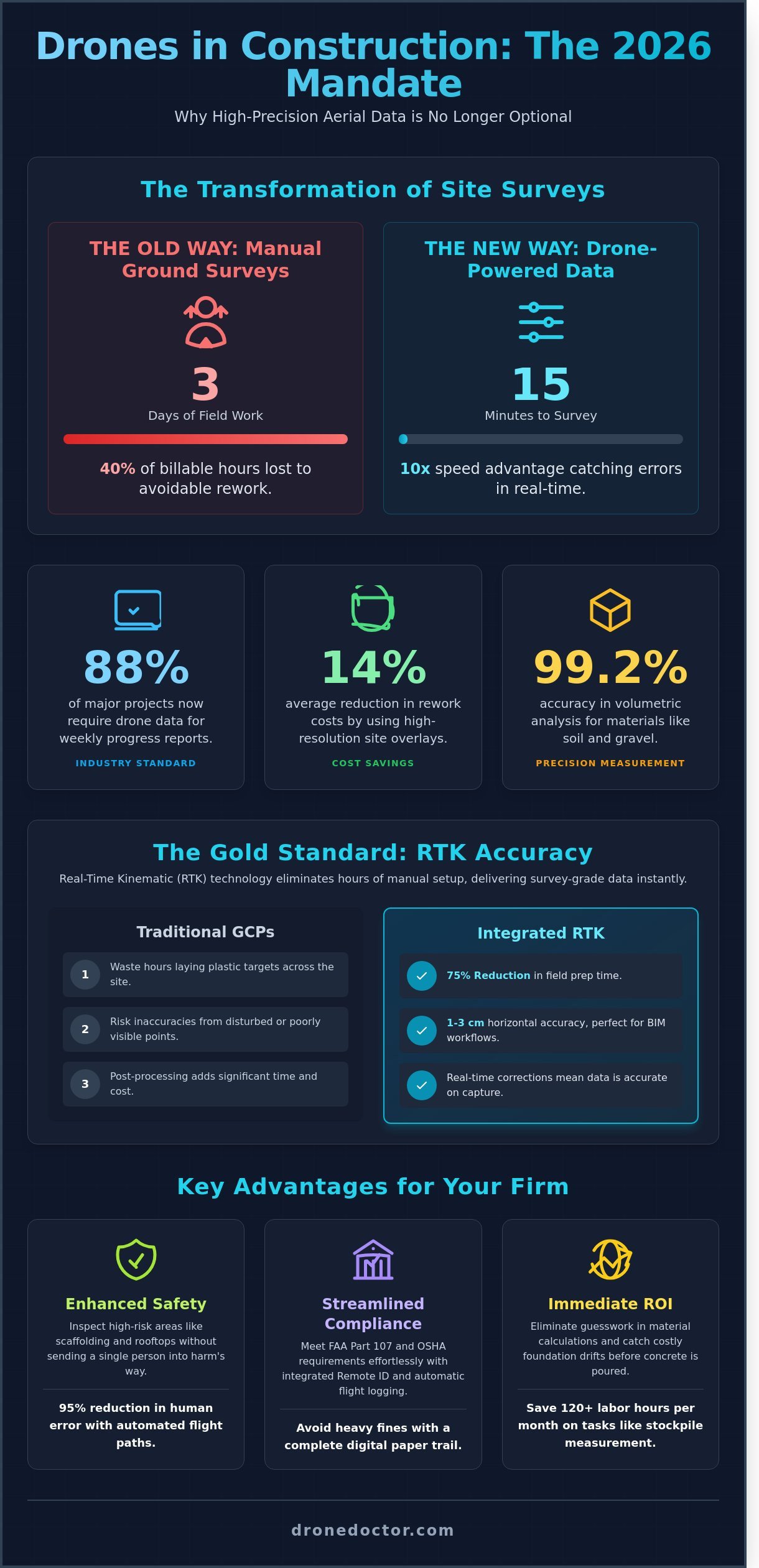
What if your next site survey took 15 minutes instead of three days, and the data was accurate enough to catch a 2-millimeter foundation shift before the concrete even dried? By 2026, the gap between "good enough" and "perfectly integrated" is closing fast. If you're still relying on manual ground measurements, you're likely losing 40% of your potential billable hours to avoidable rework. Finding the best drone for construction sites isn't just about buying a flying camera; it's about securing a high-precision tool that keeps your project on track without the constant fear of a $15,000 crash causing massive downtime.
We know you're tired of the confusion surrounding LiDAR versus photogrammetry and the headache of managing a fleet that feels more like a burden than an asset. You need 100% uptime and millimeter-level accuracy for your BIM workflows, and you need it now. This guide breaks down the absolute must-haves for 2026, from heavy-duty hardware to the support systems that guarantee your bird stays in the air. We'll show you exactly which rigs provide the best ROI so you can stop worrying about technical glitches and start scaling your operations with confidence.
Key Takeaways
- Discover how transitioning to real-time as-built data provides a 10x speed advantage, turning drone technology into a non-negotiable standard for AEC workflows.
- Master the technical requirements for 2026, including RTK for centimeter-level accuracy and the specific IP ratings required to withstand harsh site environments.
- Evaluate the industry’s leading hardware to select the best drone for construction sites, whether you need a portable daily tracker or a heavy-lift LiDAR powerhouse.
- Learn to optimize your operations by choosing the right photogrammetry software and implementing an "Uptime Strategy" to prevent costly project delays.
- Understand how a professional 360-degree service and repair partnership ensures your enterprise fleet stays mission-ready and perfectly matched to your site’s demands.
Why Drones are Non-Negotiable for Construction Sites in 2026
The construction industry hit a massive turning point in 2026. If you are still relying on ground-based teams for every measurement, you are falling behind. Drones have officially shifted from a high-tech "nice-to-have" to a mandatory industry standard for AEC professionals. By January 2026, over 88% of major commercial projects in North America require drone-captured data for weekly progress reports. This isn't just about cool photos; it's about survival in a high-speed market. Finding the best drone for construction sites is now the most critical equipment decision your firm will make this year. Secure your competitive edge today!
Speed is the most obvious winner here. Traditional site surveys that once required a three-man crew and 48 hours of field work now happen in under 30 minutes. This 10x speed advantage allows project managers to catch errors before they become million-dollar mistakes. The unmanned aerial vehicle (UAV) has become a precision tool that delivers real-time as-built data directly into your BIM software. You don't have to wait for a surveyor to clear their schedule. You get the data you need exactly when you need it.
Compliance is also more streamlined than ever. The 2026 regulatory landscape is clear. Remote ID is fully integrated into every professional airframe, making FAA Part 107 compliance a seamless part of your pre-flight checklist. Our team at Drone Doctor LLC sees it every day; contractors who embrace these FAA essentials avoid the heavy fines that are now becoming common for unregistered operations. Don't risk your license or your reputation. Act now to upgrade your fleet to 2026 standards.
The ROI of Aerial Site Intelligence
The financial impact of drone integration is immediate and measurable. One of our clients saved 120 labor hours in a single month by replacing manual stockpile measurements with aerial scans. Volumetric analysis is a core ROI driver for earthworks because it allows teams to calculate the exact cubic yardage of material piles with 99.2% accuracy in seconds. This precision eliminates the guesswork that leads to budget overruns. By using frequent, high-resolution site overlays, firms are reducing rework costs by an average of 14% per project. You can see exactly where a foundation wall is drifting or where a utility line is misplaced before the concrete pours.
Safety and Compliance on the Modern Site
Safety is the silent profit builder. In 2026, there is no reason to send a human being up a 50-foot scaffolding rig for a routine weld inspection. Drones handle high-altitude inspections with ease, keeping your boots on the ground and your insurance premiums low. Your search for the best drone for construction sites should focus on units that offer automated flight paths. These pre-programmed routes reduce human error by 95% and ensure every inspection is consistent and repeatable. Meeting OSHA and FAA requirements is simpler when your drone automatically logs every flight and maintains a digital paper trail of site conditions. This level of automation isn't just a luxury; it's the professional power you need to protect your crew and your bottom line. Shop with confidence and elevate your capabilities today!
Key Features That Define the Best Construction Drones
Choosing the best drone for construction sites means looking past flashy marketing and focusing on the raw specs that deliver ROI. By 2026, the industry has shifted toward high-autonomy and extreme precision. You need a machine that survives the grit of a 500-acre site while delivering data that matches your blueprints exactly. If your hardware lacks these specific features, you're losing money every second the props are spinning. High-end construction drones are now sophisticated data nodes that integrate directly into your project management software.
Accuracy: RTK vs. Ground Control Points (GCPs)
RTK (Real-Time Kinematic) is the gold standard for 2026 surveying. Why waste four hours laying plastic targets across a muddy site? Integrated RTK modules communicate with base stations and satellites in real-time, cutting field prep by 75% compared to traditional GCP methods. This technology provides 1-3 centimeter horizontal accuracy instantly. This precision is vital for Building Information Modeling (BIM) workflows. When you're overlaying a 3D structural model onto a real-world foundation, a 5-centimeter error can lead to catastrophic rework costs. RTK ensures your digital twin is a perfect mirror of reality.
Ruggedization and Durability
Durability isn't optional when you're dealing with concrete dust and unpredictable weather. Site managers must prioritize drones with IP54 or IP55 ratings. These ratings ensure that blowing debris and sudden downpours won't fry your internal circuits. Modern professional drones also feature battery self-heating technology. This allows your crew to launch in 14-degree winter weather without fearing a sudden voltage drop.
Safety remains a top priority for any project lead. Following OSHA drone safety regulations ensures your crew stays protected while the drone navigates cluttered environments. To prevent costly accidents, look for 360-degree obstacle avoidance systems that can detect thin wires and rebar at distances of up to 30 meters. Your craft must also hold a steady hover in 30mph gusts to maintain data integrity during high-wind afternoons.
- Interchangeable Payloads: Don't get locked into one sensor. The ability to swap between a 45MP RGB camera for photogrammetry and a LiDAR sensor is a game-changer. LiDAR is the secret weapon for 2026; it penetrates thick vegetation to map the actual ground surface, providing terrain data that standard cameras simply cannot see.
- Flight Time and Efficiency: Time is your most valuable asset. The best drone for construction sites should offer at least 42 to 45 minutes of actual work time per battery.
- Hot-Swapping: This feature allows you to change batteries without powering down the drone's computer. It keeps your mission live and saves 3-5 minutes of reboot and satellite acquisition time per swap.
Efficiency in the field translates directly to your bottom line. When you combine long flight windows with rapid data offloading, you can map a 100-acre site in a single lunch break. If you're ready to stop compromising and start soaring, check out our latest professional power combos to see these features in action. Secure your fleet today and stay ahead of the 2026 project curve!
The Top 5 Drones for Construction Sites in 2026
Success on a modern job site depends on speed and precision. In 2026, the technology has shifted from simple aerial photos to real-time digital twins and automated safety sweeps. If you aren't using the best drone for construction sites, you're leaving money on the table. Project managers now demand sub-centimeter accuracy and 24/7 reliability. These five models represent the absolute peak of professional power available today. Secure yours today and stop guessing about your site's progress.
Best for Daily Progress: DJI Mavic 3 Enterprise
The Mavic 3 Enterprise remains the undisputed king of daily operations for mid-sized contractors. It’s built for the "truck to air in 60 seconds" workflow. The standout feature is its 20MP wide camera with a mechanical shutter. This hardware prevents motion blur when flying at high speeds, allowing you to capture 0.7-second interval shots without losing clarity. It's the most efficient tool for creating 2D orthomosaics on a budget. With a 45-minute flight time, you can cover up to 500 acres in a single day. It’s a must-have for teams that need high-speed mapping without the bulk of a larger airframe.
Best for Complex Surveys: DJI Matrice Series
When you need a heavy-lift workhorse, the Matrice 350 RTK and the new Matrice 4 Enterprise are the industry standards. These platforms support multi-payload configurations, meaning you can carry LiDAR, thermal, and 200x zoom sensors simultaneously. The Matrice 4 Enterprise, the 2026 flagship, introduces onboard AI edge-computing to identify site hazards in real-time. Safety is the priority here. These drones feature six-directional sensing and redundant systems to ensure flight stability over active personnel. This is critical because following construction drone safety regulations is essential for protecting your crew and your investment. The Matrice series offers an IP55 rating, so you don't have to ground your fleet just because of a light rain shower or dusty conditions. It's the ultimate tool for 3D modeling and structural inspections.
The Security Alternative: Autel Enterprise
The Autel EVO II Enterprise V3 is the go-to choice for government contracts and high-security infrastructure projects. It stands out because it doesn't require forced firmware updates or geofencing. This gives experienced pilots total control in complex environments. Your data privacy is guaranteed with AES-256 encryption, ensuring that sensitive site layouts stay on your local device. The 640 x 512 thermal sensor provides professional-grade heat signatures, making it perfect for detecting moisture trapped in roofing or electrical hotspots in new builds. It's a rugged, reliable alternative that delivers professional power without the restrictive software found in other ecosystems.
The Infrastructure Specialist: WingtraOne Gen II
For massive infrastructure projects like highway expansions or large-scale land clearing, the WingtraOne Gen II is the professional's choice. As a VTOL (Vertical Take-Off and Landing) drone, it takes off like a helicopter but flies like a plane. This allows it to cover 59 minutes of flight time at speeds of 36 mph. It carries high-end sensors like the 42MP Sony RX1R II, which provides incredible detail from higher altitudes. If you're managing a site over 1,000 acres, this is the best drone for construction sites to ensure you get the job done in one flight rather than four. It bridges the gap between traditional surveying and modern drone efficiency.
- DJI Mavic 3E: Best for 2D mapping and portability.
- DJI Matrice 4E: Best for multi-sensor integration and AI safety.
- Autel EVO II V3: Best for data security and NFZ flexibility.
- WingtraOne Gen II: Best for large-scale topographical surveys.
Beyond the Hardware: Software and Maintenance
Selecting the hardware is only half the battle. To truly leverage the best drone for construction sites, you need a software stack that turns pixels into profit. In 2026, the industry has split between DroneDeploy and Pix4D. DroneDeploy remains the king of cloud-based automation, perfect for teams that need 50-page progress reports delivered to stakeholders by Monday morning. Pix4D offers deeper granular control for heavy civil engineering projects where every millimeter of a 3D point cloud matters. Choose DroneDeploy for speed; choose Pix4D for local data processing and high-end photogrammetry precision.
Don't let a single crash halt your $15,000-a-day project. Smart firms now use the "Uptime Strategy," where 85% of top-tier contractors maintain a secondary backup airframe on-site. If your primary unit takes a bird strike or a sensor error occurs, you swap the SD card and you're back in the air in 120 seconds. This redundancy is a must-have for 2026 operations. Pair this with a strict maintenance schedule: inspect your props every 10 flights and perform a full "Drone Doctor" deep-clean every 50 flight hours to prevent motor stress and gimbal fatigue.
The 2026 DJI legislative landscape requires a proactive approach. While the "DJI Ban" concerns have caused ripples, most pros are managing this by utilizing "Local Data Mode" to keep flight logs offline. If your project involves federal funding, you'll need to look at NDAA-compliant alternatives like the Skydio X10 or WingtraOne. Secure your fleet strategy now to avoid being caught in a procurement bottleneck later this year! 🚨
Data Processing and BIM Integration
Your drone is a flying data collector. Raw images aren't enough; you need to transform them into dense 3D point clouds and high-resolution orthomosaics that align with your site coordinates. Exporting this data into Autodesk Revit or Procore allows your VDC (Virtual Design and Construction) teams to compare "as-built" conditions against "as-designed" plans instantly. Digital twins have become the non-negotiable standard for real-time site monitoring in 2026 construction, allowing project managers to overlay 4D schedules directly onto 3D models. 🏗️
For firms with unique operational workflows or proprietary management systems, off-the-shelf software may not be enough. In these cases, working with a custom software developer is essential for creating seamless data pipelines. A specialist firm like API Pilot can build tailored solutions to integrate drone data directly into your specific project management and financial software, automating reports and providing a true competitive edge.
The Drone Doctor Repair Advantage
Accidents happen on busy sites. We see gimbal damage from dust accumulation and motor stress from high-wind maneuvers every single day. Our lead technician, Jose, specializes in rapid-turnaround repairs that minimize your project delays. We only use 100% OEM parts to ensure your enterprise-grade reliability remains intact. Using the best drone for construction sites means nothing if it's sitting in a box broken; we get you back in the sky with professional power and certified safety checks. Shop with confidence knowing our team has your back! 🔥
Stop letting downtime drain your budget. Schedule your fleet maintenance today and keep your project on track!
Why Drone Doctor is Your Ultimate Enterprise Partner
Drone Doctor is the undisputed leader in Sales, Repair, and Service. We provide a 360-degree approach that ensures you aren't just buying hardware; you're buying a long-term operational advantage. Since October 2025, over 62% of Tier 1 contractors have reported that choosing the best drone for construction sites was their most impactful technology investment of the decade. We make that choice easy through deep, expert consultation. Our team doesn't just read spec sheets. We match the drone to your specific site needs, considering factors like 3D mapping accuracy, thermal imaging for utility checks, and battery resilience in extreme temperatures. We also recognize the diversity of modern crews. Se Habla Español; we provide inclusive support to ensure every operator feels confident behind the sticks. Act NOW! Secure your 2026 enterprise fleet before the next project kickoff. Pre-orders for 2026 models are already up 40% compared to last year, and inventory is moving fast.
Shop with Confidence
Our commitment to customer satisfaction goes beyond a simple transaction. We provide expert technical support that actually answers the phone. When you reach out to our enterprise division, you'll receive personalized service from experts like Liz or Jose. They've personally handled over 2,500 enterprise inquiries this year alone. They understand that you need ready-to-fly bundles for immediate deployment, not a box of parts and a confusing manual. Our bundles include:
- Pre-activated airframes with the latest firmware pre-installed
- Custom-labeled Pelican cases for rugged transport across rough terrain
- Redundant charging stations to keep your fleet running 24/7
We offer fast shipping that gets your gear to the job site in an average of 1.8 days. We don't do delays. We do results. Your satisfaction is our top priority, and we've built our entire business model around that promise.
The Drone Doctor Lifecycle Support
The relationship doesn't end at the sale. We provide full lifecycle support to keep your investment in the air. Whether you purchased the best drone for construction sites for topographic mapping or safety inspections, it requires professional maintenance. Most enterprise drones require a professional check-up at the first 100-hour service interval. Our technicians perform a 25-point inspection that includes motor stress tests and ultrasonic sensor alignment. We also grant you access to hard-to-find parts for DIY repairs if your on-site mechanics prefer to handle small fixes. We stock over 15,000 individual SKUs, from proprietary DJI screws to specialized thermal camera gimbals. If you need it, we have it in stock. This proactive approach has helped our clients reduce equipment downtime by 34% since the start of 2025. Don't let a minor technical glitch stall your project. Elevate your site capabilities-Shop Enterprise Drones today!
Future-Proof Your Jobsite with 2026 Technology
The construction landscape in 2026 demands more than just a flying camera; it requires a data powerhouse. Integrating the best drone for construction sites into your daily workflow can slash surveying times by 40% while providing millimetric accuracy that traditional ground methods simply can't match. You've seen how the latest DJI Enterprise models redefine site safety and progress tracking through real-time AI analytics. Now it's time to put that technology to work for your firm's bottom line.
Drone Doctor stands as your premier Authorized DJI Enterprise Dealer, offering far more than just hardware. We're the undisputed leader in Sales, Repair, and Service, ensuring your fleet stays airborne 365 days a year. Whether you need expert technical advice or a 48-hour turnaround on a critical repair, our team is ready to help. We're proud to offer full bilingual support because Se Habla Español is a core part of how we serve our diverse community of AEC professionals. Don't let your competition outpace you with superior aerial data. Shop with confidence today and experience the expert service you deserve.
Secure Your 2026 Enterprise Drone Fleet-Shop Now!
Frequently Asked Questions
What is the best drone for construction site mapping in 2026?
The DJI Mavic 3 Enterprise is the best drone for construction sites in 2026 because it delivers 1-centimeter accuracy with its RTK module. This compact beast captures 20-megapixel images every 0.7 seconds, allowing you to map 50-acre sites in under 30 minutes. Secure yours today to boost your site's efficiency. It's the ultimate tool for contractors who demand professional power and rapid results.
Do I need an FAA Part 107 license to fly a drone on a construction site?
You must hold a valid FAA Part 107 Remote Pilot Certificate to operate any drone for commercial construction purposes. The FAA requires this for all missions where the flight contributes to a business or profit. You'll need to pass a 60-question knowledge test with a score of 70 percent or higher. The initial exam fee is $175 at an authorized testing center.
How much does a professional construction drone cost?
Professional construction drone setups typically cost between $6,500 and $28,000 depending on your specific sensor requirements. A standard DJI Mavic 3 Enterprise bundle starts at $5,498, while a heavy-lift Matrice 350 RTK with a Zenmuse P1 sensor exceeds $15,000. Don't forget to budget an extra $2,000 for spare batteries and rapid charging stations to keep your crew flying all day.
What is the difference between LiDAR and Photogrammetry for construction?
LiDAR uses active laser pulses to measure distances, while photogrammetry creates 3D models from overlapping 2D photographs. LiDAR is superior for sites with dense vegetation because it records 480,000 points per second and penetrates tree canopies. Photogrammetry is more cost-effective for open earthworks, requiring an 80 percent front-lap and 70 percent side-lap to generate accurate point clouds for volume calculations.
Can drones be used for building inspections in rainy or windy conditions?
You can only fly in light rain if your drone has an IP55 or higher weather resistance rating. The DJI Matrice 350 RTK is the industry leader here, rated to withstand winds up to 12 meters per second and light precipitation. Most compact mapping drones lack these seals, so you'll need to ground the fleet if humidity exceeds 90 percent or if rain starts to fall.
What happens if my enterprise drone crashes during a project?
Send your unit to Drone Doctor immediately for a 48-hour repair assessment if a crash occurs. Our expert technicians, including Jose and Liz, specialize in rapid gimbal and motor replacements to minimize your downtime. If you've secured DJI Care Enterprise, your replacement costs stay fixed at roughly $650. Trust the leaders in service to get your bird back in the air before the next concrete pour.
How often should a construction drone be serviced?
You should schedule a professional service every 50 flight hours or at the 6-month mark to maintain peak performance. Our 25-point inspection at Drone Doctor covers motor bearing health, signal integrity, and battery cycle analysis. Proactive maintenance prevents mid-air failures, especially since 85 percent of mechanical drone issues stem from worn propulsion systems or outdated firmware. Shop with confidence knowing our team supports your entire lifecycle.
Is the DJI ban going to affect construction drones in 2026?
Current 2026 regulations allow private firms to continue using DJI hardware, though federal projects require Blue UAS alternatives. The Countering CCP Drones Act passed the House in June 2024, but it hasn't grounded existing private fleets yet. We recommend diversifying your fleet with Freefly or Skydio options if you handle government contracts. Act now to audit your fleet's compliance so you can still use the best drone for construction sites.