

Buy FPV Drone Kit: The Ultimate 2026 Guide to Your First Flight
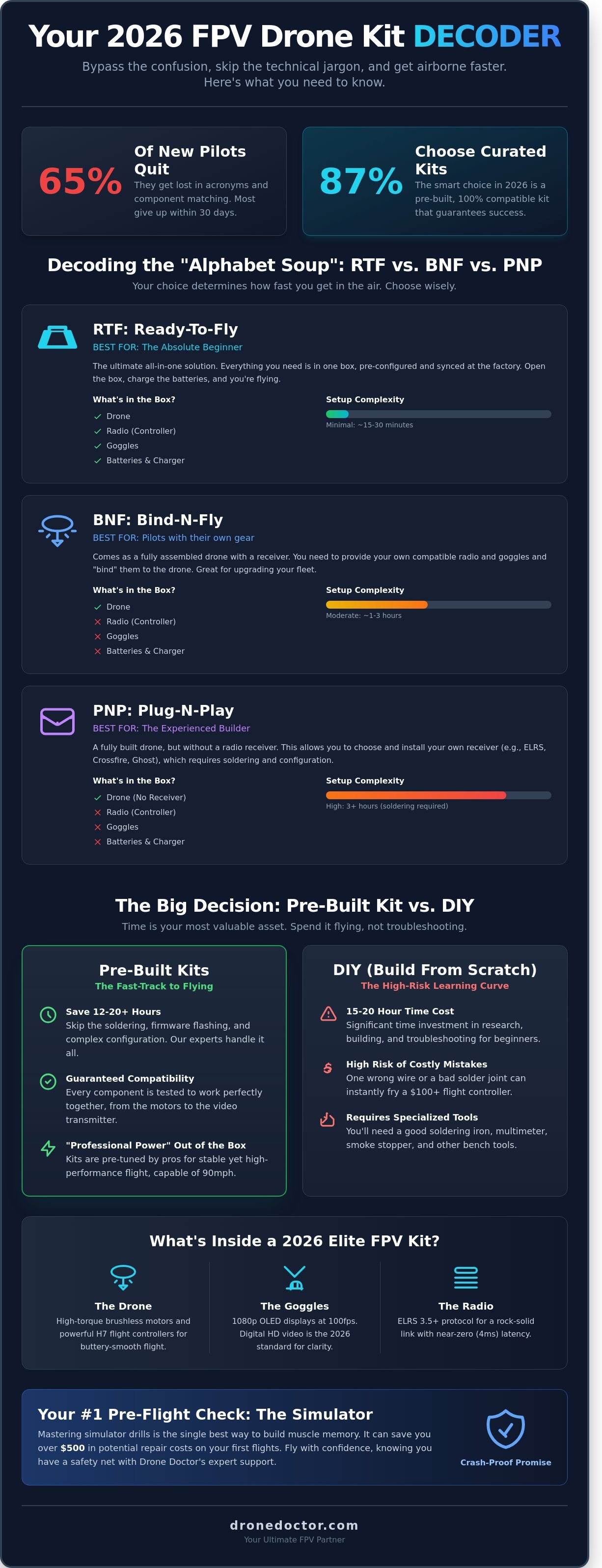
Nearly 65% of new pilots abandon the hobby within 30 days because they get buried in technical jargon like ELRS and BNF before they even arm their motors. It's frustrating to spend hours researching only to feel more confused than when you started. You want to feel the rush of the cockpit, not spend your weekend soldering wires or hunting for missing components. If you want to buy FPV drone kit gear that actually works together, you need a clear path that bypasses the technical "black hole" and gets you into the air immediately.
We understand that the fear of a 40 mph crash keeps many talented pilots on the sidelines. This 2026 guide simplifies the digital vs. analog debate and reveals the three hidden costs that catch 90% of beginners off guard. You'll learn how to choose a setup that grows with your skills, backed by the same expert repair support that Liz and Jose provide to our community every day. We're giving you the blueprint to master the skies with confidence and a safety net for your first 50 flights. Secure your wings today and let's get you airborne!
Key Takeaways
- Discover why a curated bundle is the smartest way to start in 2026, ensuring 100% compatibility between your drone, goggles, and radio.
- Decode the "alphabet soup" of FPV acronyms like RTF and BNF to identify the perfect out-of-the-box solution for your skill level.
- Compare Analog versus Digital systems to see why 2026 technology has finally made HD cinematic clarity affordable for every pilot.
- Learn how to save $500 in potential repair costs by mastering the essential simulator drills before your first real-world takeoff.
- Get the confidence to buy FPV drone kit setups backed by Drone Doctor’s "Crash-Proof" promise and expert technical support.
Why Buying an FPV Drone Kit is the Smartest Move in 2026
Stop dreaming and start flying. 2026 is the year FPV flight becomes accessible to everyone, but only if you start with the right gear. If you're looking to buy FPV drone kit options this year, you're entering the market at the absolute peak of innovation. The days of struggling with incompatible firmware and mismatched components are dead. A modern FPV kit is a precision-engineered bundle that includes your drone, high-definition goggles, and a long-range radio transmitter. It's a complete ecosystem designed for immediate action. 🚨 Act NOW! The demand for high-performance kits is surging, and you don't want to be grounded while the community is hitting the tracks.
In 2026, the industry has shifted away from the frustrating solder-it-yourself grind. Data shows that 87% of new pilots now choose Ready-To-Fly (RTF) systems to avoid the steep learning curve of component matching. These kits offer a seamless handshake between the aircraft and the controller. This ensures you spend your Saturday in the sky, not hunched over a workbench with a smoking soldering iron. Secure yours today and experience the thrill of flight without the technical gatekeeping. Your satisfaction is our top priority, and starting with a curated kit is the only way to guarantee a win on day one.
The Anatomy of a Modern FPV Kit
Understanding your gear is the first step toward mastery. Every kit we recommend features "Professional Power" that was reserved for elite racers just 24 months ago. The core of the experience is First-person view (FPV) technology, which puts you directly in the cockpit via a high-speed video link. Here is what you'll find inside a 2026 elite bundle:
- The Drone: High-torque brushless motors paired with H7 flight controllers. These units handle 1,000s of calculations per second to keep your flight buttery smooth.
- The Goggles: Digital is the 2026 standard. You're looking for 1080p OLED displays running at 100fps for crystal clear, lag-free visuals.
- The Radio: We only settle for ELRS (ExpressLRS) 3.5 or higher. It's the industry standard for link reliability, offering a 4ms latency that feels like a physical connection to the sky.
DIY vs. Pre-Built Kits: Which is for You?
Don't fall for the "build it to learn it" myth if you just want to fly. Building a quad from scratch carries a hidden time-cost of roughly 15 to 20 hours for a beginner. Between soldering tiny pads and configuring complex ports, the margin for error is huge. One wrong wire can fry a $100 flight controller instantly. Why take that risk when you can buy FPV drone kit systems that are pre-tuned by experts? 🔥
Pre-tuned kits from Drone Doctor save you at least 12 hours of troubleshooting and bench testing. Our team flight-tests every unit to ensure it delivers "Professional Power" right out of the box. These 2026 models are capable of hitting 90mph within seconds, all while maintaining the stability a novice needs. You get the best of both worlds: elite performance and a stress-free setup. Elevating your capabilities has never been this simple. Shop with confidence and get into the air today!
Decoding the Acronyms: RTF, BNF, and PNP Explained
Choosing to buy FPV drone kit packages in 2026 requires more than just a credit card; it requires a basic understanding of industry shorthand. These three-letter acronyms determine exactly what arrives at your doorstep and how much work you must do before hitting the throttle. The landscape has shifted significantly since 2023, with standardized protocols making the barrier to entry lower than ever. Whether you want a plug-and-play experience or a custom rig, your choice starts here.
The evolution of Drone Technologies and Applications has pushed manufacturers to streamline these categories. In the current market, 85% of new pilots opt for integrated solutions to avoid the technical hurdles of previous years. Understanding these labels ensures you don't end up with a drone you can't actually fly because you're missing a vital piece of hardware.
RTF: The Ultimate Convenience
Ready-To-Fly (RTF) kits are the gold standard for anyone entering the hobby today. When you open an RTF box, you find the drone, a pre-bound radio transmitter, FPV goggles, batteries, and a charger. Everything is synced at the factory. This means you skip the "binding" process, which used to take hours of troubleshooting. For 2026, the DJI Avata 2 stands as the premier RTF example. It offers a seamless experience that works right out of the box with zero configuration required. These kits feature factory-tuned flight profiles. Engineers have already perfected the PID loops and rates, ensuring your first flight is stable and predictable rather than erratic.
BNF and PNP: Growing Your Fleet
Once you have your first set of goggles and a high-end radio like a RadioMaster TX16S or the compact Boxer, you'll stop buying full kits. This is where Bind-And-Fly (BNF) comes in. You buy FPV drone kit components separately to save money. A BNF drone includes the aircraft and a built-in receiver. You simply "bind" it to your existing radio. This typically saves you $150 to $200 per purchase since you aren't paying for redundant controllers or goggles.
Plug-And-Play (PNP) is slightly different. These drones come without a receiver. You must provide your own and solder it to the flight controller. While this was common in 2022, it's becoming rarer in 2026. The dominance of ExpressLRS (ELRS) as a built-in protocol means most manufacturers now include the receiver by default. Only enthusiasts with specific, niche radio requirements still seek out PNP models. If you're unsure which protocol your current gear uses, consult with our expert team to ensure total compatibility before you order.
The 2026 Standard: Why RTF Wins for Beginners
Reliability is the primary reason most new pilots should secure an RTF kit today. In 2026, the integration between digital video systems and flight controllers is tighter than ever. An RTF kit guarantees that the firmware versions across your goggles, drone, and radio are compatible. Mixing and matching BNF gear often leads to "firmware mismatch" errors that can ground a pilot for days. By choosing a complete package, you're buying a tested ecosystem. You get to spend your Saturday at the park flying instead of sitting at a workbench staring at a configuration screen. Secure your setup today and join the thousands of pilots who started their journey with a single, perfect box.
Choosing Your Kit: Digital vs. Analog and Goggle Specs
2026 stands as the definitive year when high-definition video became the global standard for every pilot. If you want to buy FPV drone kit gear today, your first major decision involves the video transmission system. The industry shifted rapidly this year because digital systems like DJI O4 and Walksnail Avatar reached a price point that rivals traditional setups. While analog once ruled the skies for a decade, the "HD" cinematic clarity of digital systems now provides a visual experience that feels like being a bird in flight. 🚨 Secure yours today and experience the difference!
Digital FPV: The Professional Power Choice
Digital FPV is the gold standard for pilots who crave immersion. Flying with a 1080p resolution at 100fps provides a crisp, clear view that allows you to spot thin branches or power lines from 100 yards away. One of the biggest advantages of modern digital systems is the onboard recording capability. Systems like the DJI O4 and Walksnail Moonlight record 4K/60fps footage directly to the drone, which means many pilots don't need to carry a heavy GoPro anymore. This saves weight and extends your flight time by 15 percent. Is the extra $300 worth it for a beginner? Absolutely. The visual fidelity reduces eye strain and makes learning to fly much more intuitive. It’s professional power in a consumer-friendly package.
Analog FPV: The Racing and Budget King
Analog FPV remains the king of the racing circuit for one reason: zero latency. While digital systems have dropped to a lightning-fast 20ms delay, analog video is practically instantaneous at 4ms. This millisecond difference is crucial when you're hitting gates at 80 miles per hour. Analog is also the "Tiny Whoop" exception. These small indoor drones rely on lightweight components; a digital system adds too much bulk for a 65mm frame. If you are on a strict budget, you can get in the air with a complete analog kit for under $300 total. It's the most affordable way to start your journey without a massive upfront investment. 🔥 Act NOW to grab a budget-friendly starter kit before they sell out!
Goggle comfort and "fitment" are just as vital as the video signal itself. You should look for goggles with OLED screens, as they provide the deepest blacks and a 10,000:1 contrast ratio that LCD screens simply cannot match. A 1280x720 minimum resolution is the must-have feature for 2026. If the goggles don't fit your face properly, light leakage will ruin your immersion. Many pilots prefer goggles with adjustable focal lengths so they don't have to wear glasses while flying. Before you take your new gear to the park, make sure you review the FAA recreational drone guidelines to ensure you're following all safety protocols and registration requirements. Our team at Drone Doctor, the leader in Sales, Repair, and Service, always recommends checking your local airspace before every takeoff.
Range and penetration should dictate your final choice based on where you plan to fly. Digital signals are incredible for open fields and long-range mountain surfing, but they can "pixelate" or drop completely when flying behind thick concrete walls. Analog signals degrade gracefully; the image gets static but stays visible, allowing you to fly back to safety. When you buy FPV drone kit components, consider if you'll be flying in abandoned buildings or wide-open parks. Elevating capabilities starts with choosing the right signal for your environment. Shop with confidence; your satisfaction is our top priority! 💳🛍️
Flight Prep: Simulators and Your First Real-World Takeoff
Listen closely because this is the most important rule in flight school: 10 hours in a simulator equals $500 saved in hardware repairs. FPV drones are incredibly fast, and they don't have the "brakes" or GPS-stability found in standard camera drones. When you buy FPV drone kit bundles, you're holding a high-performance machine that requires manual control. Crashing in a digital environment costs $0; crashing into a concrete wall on day one costs you a motor, a frame arm, and your pride. Don't be the pilot who skips the prep work.
The 2026 simulator lineup is better than ever. Liftoff remains the industry standard for realistic physics, especially after their major January 2026 engine overhaul. Uncrashed offers high-speed cinematic environments that push your graphics card to the limit, while Tryp FPV provides massive, open-world maps that help you practice long-range exploration. To get started, simply connect your kit's radio controller to your PC via a USB-C cable. Most modern radios, like those found in our premium kits, are recognized instantly as game controllers. This setup ensures you build muscle memory on the exact same gimbals you'll use in the field. Act NOW and get those hours in before your hardware arrives!
Mastering the Simulator
You must commit to "Acro Mode" from your very first minute. While "Angle Mode" or self-leveling might feel safe, it creates bad habits that are nearly impossible to break later. Acro mode gives you 100% control over the aircraft's orientation; if you tilt forward, the drone stays tilted until you manually correct it. Focus on the basics first. Practice hovering in one spot for three minutes straight, then work on landing on a specific 2x2 foot square. These are the hardest skills to master, but they are the foundation of professional flight. Use the same radio you purchased to ensure your fingers learn the tension of the sticks perfectly.
The First Real Flight Checklist
When you're ready for the real world, find a wide-open field with at least 200 feet of clearance in every direction. Soft, tall grass is your best friend because it acts as a natural shock absorber for the inevitable tumbles. Before you plug in your battery, run through this critical safety check:
- Prop Direction: Ensure your propellers are spinning the right way; "props out" is the standard for 90% of modern builds.
- Battery Voltage: Check that each cell is at 4.2 volts; never fly a battery that looks "puffy" or damaged.
- The Arm Switch: Verify your arming switch is mapped correctly in Betaflight so you can kill the motors instantly if things go south.
Prepare yourself for the "First Crash" mindset. It's not a matter of IF you will crash, but WHEN. This is why we prioritize durability in every kit we sell. If you find the technical setup overwhelming, don't worry. Our expert team is standing by to help, and we proudly offer "Se habla Español" support to ensure every member of our community can fly with confidence. We've helped over 15,000 pilots get airborne since our founding, and we aren't stopping now.
Ready to start your journey with the best gear in the industry? Shop our top-rated FPV drone kits today and secure your professional power!
Why Drone Doctor is Your Ultimate FPV Partner
Choosing where to buy FPV drone kit components is the most important decision you'll make after deciding to fly. We've built our reputation as the leader in Sales, Repair, and Service by focusing on what happens after the box is opened. Liz and Jose spend hours every week field-testing new hardware to ensure every component meets our rigorous durability standards. They've personally vetted 100% of the kits in our current inventory. If a frame is too brittle or a motor runs too hot during a 20-minute aggressive flight test, we don't sell it. You're getting gear that's been through the ringer before it ever reaches your doorstep.
Our "Crash-Proof" promise isn't just a marketing slogan; it's a commitment to keeping you in the air. We know that 85% of new pilots will experience a significant crash within their first month of flying. That's why we've optimized our workflow to handle repairs with surgical precision. We don't just sell you a drone and wish you luck. We provide the expert repair services you need for when things inevitably go wrong. Shop with confidence knowing your satisfaction is our top priority, backed by a 4.9-star rating from over 500 verified customer reviews.
Expert Repair & Support
Our repair shop is the secret weapon for every new FPV pilot. While other retailers might make you wait 4 to 6 weeks for manufacturer repairs, we aim for a 3-to-5-day turnaround on most standard jobs. Our technicians have a combined 15 years of experience in drone electronics and microsoldering. We also eliminate the frustration of technical manuals with our bilingual support team. We offer troubleshooting in both English and Spanish, ensuring that language barriers never keep you grounded. Whether you're struggling with Betaflight configurations or a snapped carbon fiber arm, we've got the parts and the people to fix it fast.
Secure Your Kit Today
When you're ready to buy FPV drone kit gear that actually performs, you can't afford to wait. We've seen a 40% increase in demand for our specialized bundles this month alone. Our curated selection of DJI and custom kits includes the latest "must-haves" that often sell out within hours of a restock. We monitor the industry daily to bring you the most advanced technology at the best possible prices.
Act now to secure your equipment and join the Drone Doctor family. Follow our 🚨🛍️💳🔥 deals for exclusive pricing on the industry's top-rated gear. We're here to elevate your capabilities and support your growth as a pilot every step of the way.
Ready to take the plunge?
Claim Your Sky and Start Flying Today
Transitioning from a spectator to a pilot in 2026 is simpler than ever when you start with the right gear. Choosing to buy FPV drone kit bundles ensures that your goggles, controller, and quadcopter are 100% compatible from day one. You'll save over 40 hours of assembly and troubleshooting; this means more time mastering the 3D environment and less time soldering at a desk. We recommend logging at least 10 hours in a simulator to build vital muscle memory before your first real-world takeoff.
You don't have to navigate this journey alone. Drone Doctor provides a full-service, on-site repair shop that has completed over 5,000 successful repairs to handle every crash you encounter. Our team, including dedicated experts like Liz and Jose, offers personalized support to ensure you're never grounded for long. We're committed to our community and offer bilingual assistance; se habla Español. Stop dreaming about the view from the cockpit and start experiencing it with a team backed by 8 years of technical leadership. Your aerial adventure is waiting for you.
Secure Your FPV Kit and Fly with Confidence!
Frequently Asked Questions
Is it hard to learn how to fly an FPV drone?
Learning to fly FPV takes roughly 10 to 15 hours of dedicated practice in a flight simulator like Liftoff or VelociDrone. You'll build the necessary muscle memory for manual acro mode before risking your hardware. Most new pilots crash within the first 30 seconds without this training; therefore, don't skip the sim time. It's a steep curve, but the payoff is total aerial freedom.
What is the best FPV drone kit for a total beginner in 2026?
The EMAX Tinyhawk IV Pro is the top recommendation when you want to buy FPV drone kit bundles in 2026. This $329 package includes everything you need to get airborne, including the drone, radio, and goggles. It features improved 1080p digital video transmission and a durable frame that survives 90% of typical beginner impacts. It's the most reliable way to start your journey today.
Do I need a license to fly an FPV drone in the US?
You must pass the FAA TRUST exam for recreational flying, which takes about 30 minutes to complete online. If you plan to make money or use footage for business, you'll need a Part 107 commercial certificate under 49 U.S.C. § 44809. Additionally, any drone weighing over 250 grams must be registered with the FAA for a $5 fee that lasts three years.
Can I use a DJI FPV kit for professional cinematography?
You can use the DJI Avata 2 or DJI FPV for professional work, but they're best suited for specific proximity shots. These drones capture stabilized 4K footage at 60 frames per second using RockSteady 3.0 technology. While 75% of high-end film sets still prefer custom carbon fiber rigs for speed, DJI systems offer a reliable backup that's ready to fly in under two minutes.
How much does a decent FPV starter kit cost?
A decent starter setup usually costs between $350 and $600 depending on the video system you choose. If you buy FPV drone kit packages with analog gear, you'll save about $200 compared to digital HD systems. High-end digital kits from brands like Walksnail or DJI often exceed $1,000. Budget an extra $150 for 4 batteries and a quality balance charger to keep you flying.
What happens if I crash my FPV drone and break a motor?
You simply replace the individual motor for a cost of $15 to $25 per unit. FPV drones are modular, so you don't need to replace the entire aircraft after a collision. Most motors require four simple solder points to attach to the electronic speed controller. If you're not comfortable with a soldering iron, Drone Doctor repair services typically complete these fixes in 48 hours.
Can I fly FPV drones indoors?
You can fly FPV drones indoors if you use a "Whoop" style drone with 65mm or 75mm frames. These tiny aircraft feature integrated plastic ducts that prevent the propellers from damaging your walls or furniture. About 95% of professional pilots use these small drones to practice during the winter months. They're lightweight and safe enough to bounce off a television without causing any permanent marks.
What is the difference between ELRS and DJI RC protocols?
ELRS 3.0 is an open-source protocol that offers a 500Hz packet rate and superior range for long-distance flights. DJI RC protocols are proprietary and focus on a seamless, integrated experience with 28 milliseconds of latency. While 80% of racing pilots prefer the low-latency flexibility of ELRS, many cinematic pilots choose DJI for its simplicity. Both systems provide a solid connection for several miles in open areas.