

Convincing Your Business to Invest in a Drone: The Ultimate 2026 ROI Guide
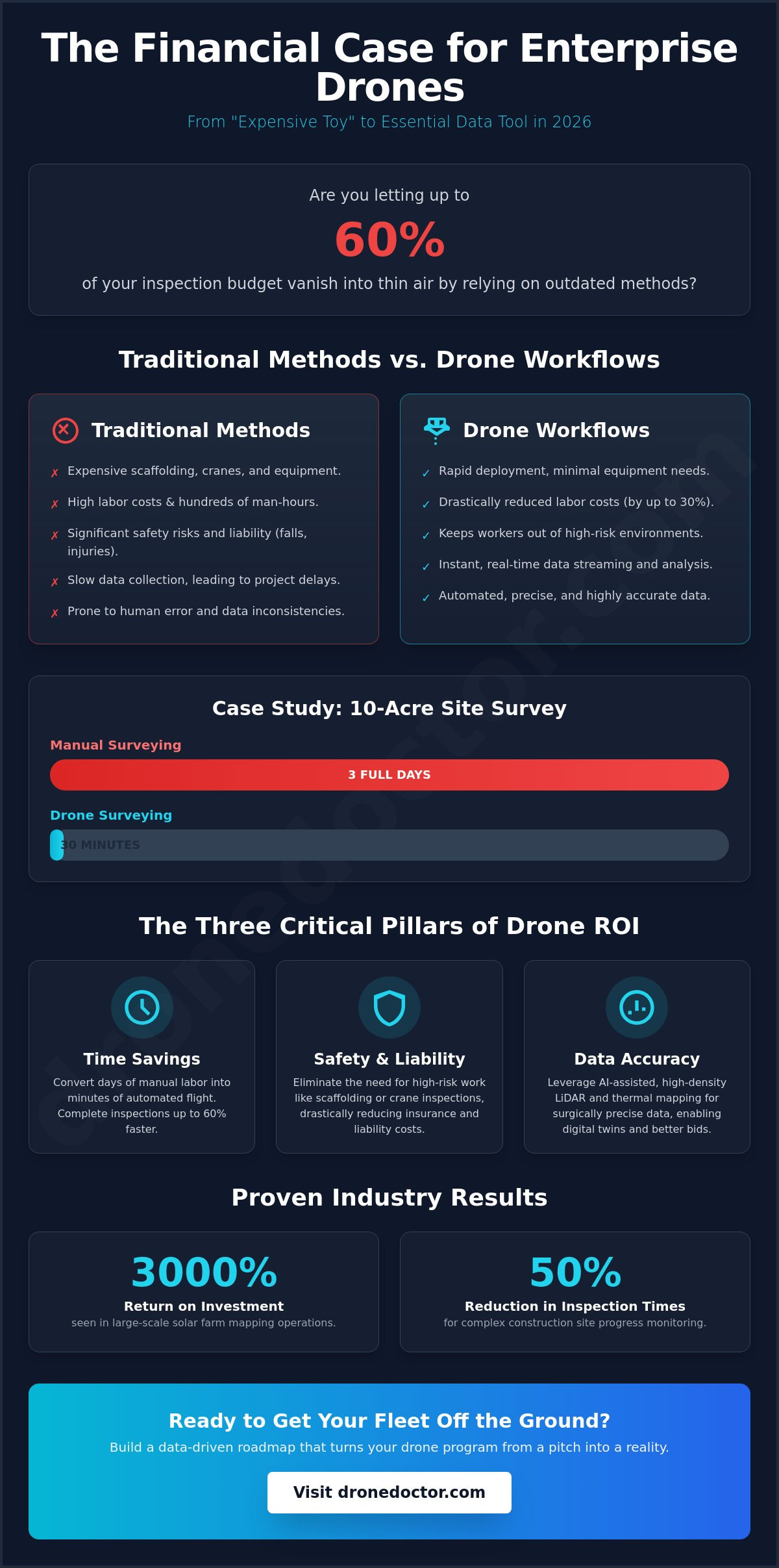
If your leadership still thinks drones are just expensive toys, they are effectively choosing to let 60% of your inspection budget vanish into thin air. In 2026, these machines aren't just "emerging tech"; they're essential hardware that converts dangerous, slow manual labor into safe, instant data. Mastering the art of convincing your business to invest in a drone is no longer about the "cool factor." It's about presenting a bulletproof financial case that executives simply can't ignore.
We understand the frustration of hitting a wall of skepticism regarding FAA compliance and real-world results. You see the potential for massive efficiency, but you need the numbers to back it up. This guide will help you secure that executive sign-off by using data-driven ROI frameworks and industry-specific use cases. You'll learn how to navigate the latest Remote ID requirements and the new Part 108 BVLOS regulations with total confidence.
We're diving deep into everything from the 3000% ROI seen in solar farm mapping to the 50% reduction in construction inspection times. Get ready to build a roadmap that turns your drone program from a pitch into a reality. Let's get your fleet off the ground.
Key Takeaways
- Identify the three critical pillars of drone ROI including time savings, safety, and data accuracy to replace high-cost traditional methods like scaffolding.
- Discover how the 2026 regulatory landscape and advanced fleet management software make FAA compliance more streamlined and accessible than ever before.
- Learn to select the perfect enterprise hardware for your specific industry needs, from agricultural mapping to high-intensity public safety inspections.
- Master the art of convincing your business to invest in a drone by using our proven 15-minute executive pitch blueprint and pilot program strategy.
- Shift the internal narrative from "expensive toys" to "essential data tools" by highlighting the AI-assisted autonomy and weather-resistant features of modern fleets.
Beyond the Hobby: Why 2026 is the Year for Enterprise Drone Adoption
The drone you see at the local park is a world away from the industrial powerhouses dominating the 2026 landscape. If you are struggling with convincing your business to invest in a drone, start by killing the "toy" perception immediately. Enterprise tools today are defined by high-autonomy, AI-assisted flight systems, and rugged, weather-resistant frames. These aren't just flying cameras; they are sophisticated sensors designed to operate in rain, wind, and high-heat environments. The U.S. market has shifted decisively toward specialized industrial UAVs that serve as essential data-acquisition hardware. With 2026 software integrations, these machines now feed directly into digital twin platforms, making your site data more actionable and valuable than ever before.
The Evolution of Drone Data in the Modern Workplace
We've moved far beyond simple photography. Modern enterprise drone adoption relies on high-density LiDAR and thermal mapping to provide a level of detail human inspectors simply cannot match. Automated flight paths now handle the heavy lifting. This reduces human error and ensures that every data point is captured with surgical precision. Real-time data streaming provides instant site visibility. This gives your team a massive competitive edge by allowing for immediate decision-making based on live, high-resolution feeds from across the project site. You aren't just getting a bird's-eye view; you're getting a real-time digital pulse of your entire operation.
Market Maturity and the Cost of Inaction
The cost of inaction is rising every day. While over 30% of large farms worldwide already use drones for field operations, the construction and energy sectors are seeing even faster growth. The "Laggard Penalty" is real. Competitors are already undercutting bids by using drone efficiency to slash inspection times by up to 60% and labor costs by 30%. Waiting for "perfect" technology is a trap that leads to lost market share. In 2026, the technology is reliable, the regulations are clear, and the ROI is proven. You don't want to be the firm still building expensive scaffolding while your competition is already analyzing their data. Act now to secure your place as an industry leader. Our team is ready to help you select the exact hardware needed to stay ahead of the curve.
Calculating the ROI: Hard Data to Back Your Investment
Winning over the CFO requires more than just a passion for tech; it demands a bulletproof financial case. When convincing your business to invest in a drone, your pitch must center on a three-pillar ROI framework: time savings, safety/liability reduction, and data accuracy. Traditional methods are riddled with hidden costs. Think about the expenses tied to scaffolding, heavy cranes, and hundreds of man-hours spent on manual inspections. By switching to a drone-first workflow, companies have documented massive cost reductions in specialized inspections, proving that the hardware pays for itself in record time.
Traditional Methods vs. Drone Workflows
Let's look at a 10-acre site survey as a 2026 benchmark. Manual surveying typically takes three full days of hiking through terrain with a total crew. A professional enterprise drone completes that same task in 30 minutes. You're eliminating the need for specialized access equipment and keeping your team out of harm's way. This directly addresses drone regulatory and safety hurdles by moving from high-risk manual labor to controlled, compliant aerial operations. Reducing workers' compensation claims by keeping boots off roofs and ladders creates a safety ROI that is just as valuable as the time saved. If you're ready to see what's possible, explore our current selection of drones for sale to find a depreciable asset that fits your balance sheet.
The 'Second-Order' Benefits: Better Bidding and Client Trust
The impact goes beyond the job site. High-resolution progress photos and 3D models aren't just for show; they win contracts. Clients in 2026 expect to see tech-forward organizations that can provide instant site visibility. This level of transparency builds immense trust. Perhaps even more critically, drone data helps identify errors in 3D models before they turn into expensive mistakes. Reducing rework is one of the fastest ways to improve your bottom line. When you present this level of precision to your leadership, convincing your business to invest in a drone becomes a conversation about growth rather than just an expense. For those looking to scale quickly, the experts at Drone Doctor LLC can help you identify the hardware that delivers the highest data fidelity for your specific industry.
Navigating the 'Buts': Overcoming Regulatory and Safety Hurdles
Executives often hesitate because they fear a regulatory nightmare. They ask: "Is this legal?" and "What if it crashes?" Winning the internal battle for budget starts with convincing your business to invest in a drone by showing that safety is a built-in feature of a professional program. Compliance has never been simpler. Modern fleet management platforms now track every second of pilot hours and every maintenance milestone automatically. To ensure your fleet stays operational and safe, partnering with a professional drone repair service is essential. It guarantees that your equipment meets industrial safety standards before it ever leaves the ground. Expert maintenance is the backbone of any reliable corporate drone program.
The 2026 Compliance Roadmap
The FAA Part 107 landscape has matured into a streamlined digital ecosystem. In 2026, Remote ID is fully active for all drones over 250g, allowing for transparent and secure airspace. While this sounds like a lot of paperwork, modern enterprise tech handles the broadcast for you. With the FAA finalizing Part 108 regulations in mid-2026, the framework for Beyond Visual Line of Sight (BVLOS) operations is finally becoming accessible without individual waivers for every flight. Automated flight authorizations via LAANC are now instantaneous in most areas. You don't need to be a legal expert; you just need a clear set of Standard Operating Procedures (SOPs) to build a safety culture that protects your company's reputation.
Insurance and Liability Management
Don't let insurance myths stop your pitch. Corporate drone insurance is remarkably affordable and easy to manage. You'll want to balance hull insurance, which covers the hardware, with liability insurance for third-party protection. Surprisingly, drones actually reduce your overall company liability. By replacing a human on a high-voltage tower or a precarious roof with a sensor, you're eliminating the most dangerous part of the job. This shift from manual risk to controlled aerial data collection is a massive win for your legal team. It's a proactive way to lower your risk profile. If you're feeling overwhelmed by the technical requirements, the specialists at Drone Doctor LLC can guide you through selecting the right hardware and parts to keep your liability low and your efficiency high.
Selecting Your Fleet: Matching the Right Drone to Your Industry
Choosing the right hardware is the final hurdle in convincing your business to invest in a drone. You need tools that match your specific operational goals, not just the most expensive model on the shelf. In 2026, the industry has consolidated around "workhorse" platforms like the DJI Matrice 350 RTK. This platform is legendary for its modularity. You can swap a high-resolution zoom camera for a LiDAR sensor or a thermal payload in seconds. This flexibility ensures your investment doesn't become obsolete as your program grows. Beyond the specs, you must consider the "Repairability Factor." Buying from a US-based supplier with local support is critical to avoid weeks of downtime. When a sensor needs calibration or a motor needs a swap, having access to genuine drone parts and expert repair services keeps your fleet in the air and your ROI on track.
Construction and Surveying: The Accuracy Kings
For site mapping in 2026, RTK (Real-Time Kinematic) technology is non-negotiable. It provides centimeter-level accuracy without the need for dozens of manual ground control points. You'll need to decide between LiDAR and Photogrammetry. LiDAR is superior for penetrating thick vegetation and capturing true ground elevation, while photogrammetry is perfect for high-resolution visual 3D models. The DJI Matrice series remains the top choice for high-speed site documentation, allowing you to map hundreds of acres in a single afternoon with professional-grade precision.
Utility and Industrial Inspection: Seeing the Invisible
Industrial inspections require specialized sensors that see what the human eye cannot. Thermal imaging is now standard for finding heat leaks in buildings or electrical faults in power lines from 200 feet away. High-power zoom capabilities allow your team to inspect cell towers or bridge components without ever leaving the ground or risking a climb. For businesses just starting out, the DJI Mavic 3 Enterprise series is the ultimate entry-level pro tool for 2026. It's compact, deployable in under a minute, and carries a mechanical shutter that eliminates motion blur during high-speed inspection flights. This balance of portability and power makes convincing your business to invest in a drone much easier for smaller departments. If you're ready to build your fleet, check out our latest enterprise drone offerings to find the perfect match for your mission.
Presenting the Pitch: A Blueprint for Executive Buy-In
You have analyzed the hardware and calculated the savings. Now comes the final hurdle: the presentation. Successfully convincing your business to invest in a drone requires a shift in strategy. You aren't selling a piece of tech; you're selling a solution to a specific, expensive bottleneck. Executives don't want a lecture on flight dynamics. They want to know how this investment protects the bottom line and reduces site risk. Structure your 15-minute proposal meeting to be fast-paced and results-driven. Focus on a clear decision point that allows the company to move forward without feeling overwhelmed by a massive capital expenditure.
Step 1: The 'Pain Point' Hook
Grab their attention immediately. Open with a recent project delay or a safety incident that a drone would have prevented. If a manual inspection took two weeks and delayed a bid, quantify that failure in dollars. Show, don't just tell. Bring one high-resolution 3D map or a thermal scan from a competitor to the meeting. This serves as bait to show exactly what your team is missing. It makes the "toy" perception impossible to maintain when they see the level of data fidelity your rivals are already using to win contracts. You are highlighting the cost of staying with the status quo.
Step 2: The Phased Implementation Plan
Reduce perceived risk by suggesting a Pilot Program instead of a full fleet purchase. A phased approach is much easier for leadership to swallow. It allows you to prove the concept without a massive upfront commitment. Consider this three-step rollout:
- Phase 1: Focus on training and the acquisition of one workhorse drone for a single high-priority site.
- Phase 2: Scale the fleet and add specialized sensors based on specific KPIs met during the first 90 days.
- Phase 3: Achieve full integration with your existing company software for seamless data workflows.
This roadmap proves you've thought about the long-term lifecycle of the program. It demonstrates that convincing your business to invest in a drone is about building a sustainable, data-driven department that evolves with the industry.
Step 3: The Call to Action
Don't leave the room without a definitive next step. Request a specific budget for a Discovery Quote from a specialized vendor to get exact numbers for your board. Offer to head the internal UAS Committee to ensure total accountability and regulatory compliance. This shows leadership that you are ready to own the results and the safety of the operation. The most logical next step is to get professional eyes on your specific needs. Contact Drone Doctor LLC for a customized enterprise quote today! Our team will help you build a hardware package that makes your internal pitch undeniable. Let's get your business off the sidelines and into the air.
Secure Your Competitive Edge in the 2026 Aerial Economy
You've seen the data. The massive cost reductions in inspections and the incredible ROI seen in solar mapping are no longer theoretical; they're the new industry standard. By mastering the art of convincing your business to invest in a drone, you're positioning your team to lead rather than lag. You now have the framework to navigate 2026 FAA regulations and the blueprint to pitch a phased, low-risk pilot program that executives can't ignore. The transition from manual labor to automated aerial data is the single most impactful move your organization can make this year.
Don't let technical uncertainty stall your progress. As an Authorized DJI Enterprise Dealer with US-based expert support and repair, we provide the hardware and the peace of mind your leadership demands. We even offer certified FAA compliance consulting to ensure your fleet stays on the right side of the law from day one. It's time to turn your proposal into a high-performance reality. Get a Custom Enterprise Drone Quote for Your Business today and start scaling your operations. The sky is no longer the limit; it's your new workspace. Let's get your program off the ground!
Frequently Asked Questions
How much does a professional enterprise drone cost in 2026?
Total investment costs vary significantly based on the specialized sensors and payloads your specific industry requires. A compact thermal mapping unit is a different capital expenditure than a heavy-lift platform equipped with high-density LiDAR. Beyond the aircraft, you should account for essential accessories like high-capacity battery sets, ruggedized controllers, and transport cases. Choosing modular hardware allows you to scale your investment as your program's needs evolve.
Is it better to hire a drone service or buy our own equipment?
Owning your equipment is the superior choice for recurring operations like weekly site mapping or frequent infrastructure inspections. While hiring a service avoids upfront costs, convincing your business to invest in a drone fleet provides instant site visibility and long-term data consistency. Internal programs eliminate the scheduling delays and high day-rates associated with third-party contractors. Building an in-house fleet ensures your tools are ready the moment a mission-critical need arises.
How long does it take to train an employee to be a drone pilot?
Most employees can prepare for and pass the FAA Part 107 remote pilot exam within two to four weeks of dedicated study. While the legal certification is the baseline, gaining true proficiency on complex enterprise platforms often requires several additional weeks of flight practice. Modern AI-assisted flight modes and autonomous mission planning have significantly flattened the learning curve. This allows your team to focus on data quality rather than just basic stick-and-rudder skills.
What are the most common mistakes businesses make when buying a drone?
The most frequent error is prioritizing a low initial price over long-term modularity and repairability. Many firms mistakenly purchase consumer-grade hardware that lacks the durability or specialized sensors required for industrial environments. This often leads to expensive "buyer's remorse" when the need for thermal imaging or RTK accuracy becomes apparent. Another major pitfall is failing to establish a reliable pipeline for genuine drone parts and professional maintenance support from day one.
Can drones really work in bad weather like wind and rain?
Yes, many 2026 enterprise models feature high IP (Ingress Protection) ratings designed specifically for operation in rain and dusty environments. Advanced motor systems enable these "workhorse" machines to maintain flight stability in significant wind gusts that would ground smaller hobbyist units. Always verify the specific IP rating of your hardware before deploying in adverse conditions. This ensures you protect your investment while capturing critical data during windows of opportunity that competitors might miss.
What kind of software do we need to process drone data?
You will typically need specialized photogrammetry or LiDAR processing software to transform raw aerial imagery into actionable 3D models and maps. Most professional programs also utilize fleet management platforms to track pilot logs and maintenance schedules automatically. It is best to check with your software providers to ensure seamless compatibility with your hardware and existing company platforms like Procore or Autodesk. Selecting the right software stack is just as vital as picking the drone itself.
How do we handle drone repairs and maintenance internally?
Most successful programs perform basic maintenance like propeller changes in-house while outsourcing complex repairs to specialized technicians. Professional repair services provide the necessary expertise for intricate sensor calibrations and internal hardware fixes that guarantee flight safety. Keeping a stock of genuine drone parts on hand is the most effective way to minimize downtime. Partnering with a US-based repair center ensures your fleet meets industrial safety standards before every mission.
Are there specific tax benefits or incentives for investing in drone tech?
Drones are generally classified as depreciable business assets, which can offer significant tax advantages under Section 179 in the United States. This provision often allows businesses to deduct the full purchase price of qualifying equipment in the year it is placed in service. You should consult with a tax professional to see how convincing your business to invest in a drone impacts your specific financial strategy. Leveraging these incentives can dramatically accelerate your program's path to total ROI.