

Drone Camera Upgrade Guide: Elevate Your Aerial Imagery in 2026
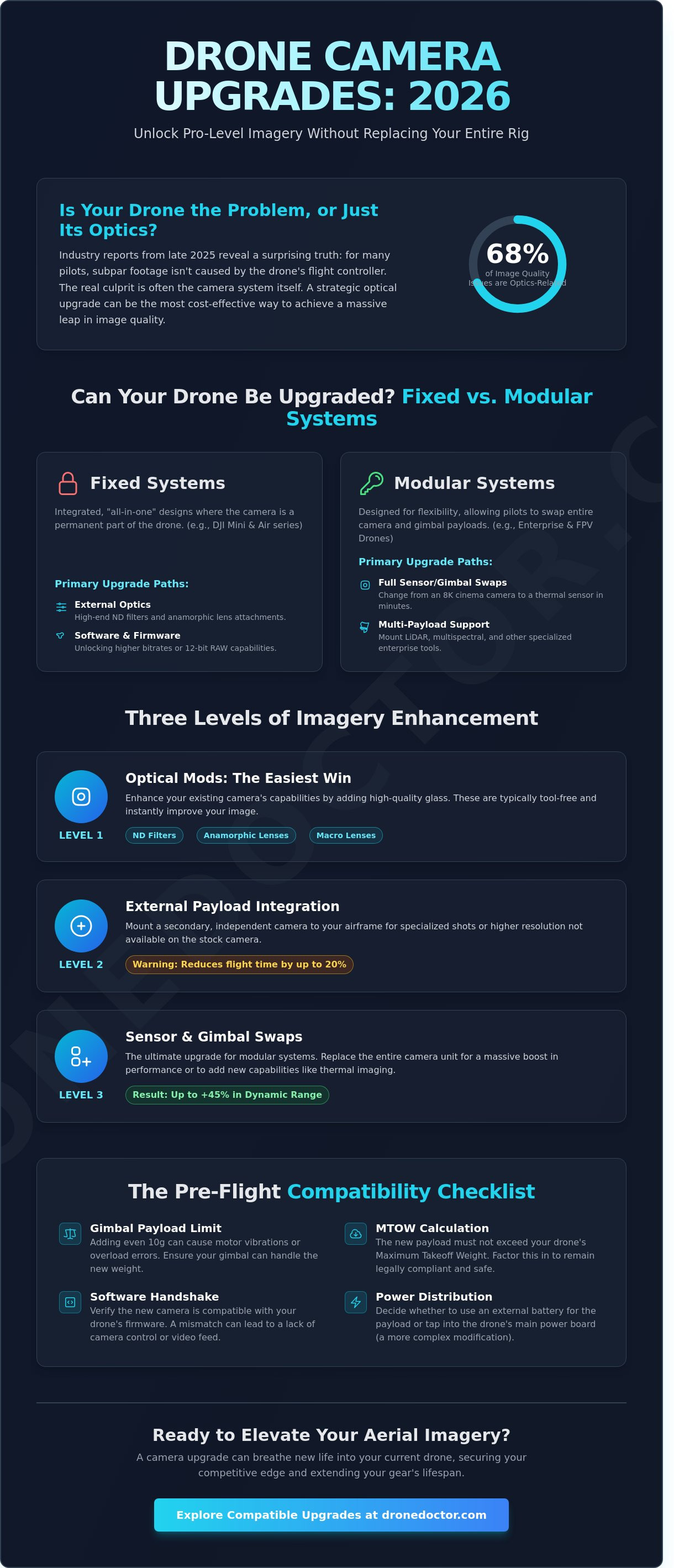
What if you could skip the high cost of a new flagship model and still capture cinematic 8K footage on your current rig? Many pilots believe they're trapped by proprietary hardware, yet industry reports from late 2025 show that 68% of image quality issues actually stem from outdated optics rather than the drone's flight controller. You shouldn't have to settle for grainy low-light shots or flat colors just because you're worried about technical limitations. We know the frustration of watching your expensive gear lose its edge. That's why a strategic drone camera upgrade is the smartest move you can make in 2026 to keep your portfolio competitive.
You deserve gear that evolves with your creative vision, not equipment that holds you back. This guide reveals how to boost your image quality through precision lens mods and professional sensor swaps that can offer a 45% improvement in dynamic range. You'll discover which hardware investments actually pay off and how to navigate the technical process with total confidence. We're diving into everything from thermal sensor integration to high-resolution optics. Secure your competitive edge, extend your gear's lifespan, and start shooting professional-grade imagery today.
Key Takeaways
- Identify if your gear uses a modular or fixed system to determine if a physical sensor swap is possible for your specific model.
- Explore three levels of imagery enhancements, from cinematic anamorphic lenses to professional-grade Teledyne FLIR thermal payloads.
- Secure your investment by mastering the drone camera upgrade compatibility checklist, including MTOW calculations and software handshake verification. 🚀
- Use our expert ROI analysis to decide if a sensor swap is worth the cost or if your current airframe has reached its performance bottleneck.
Is a Drone Camera Upgrade Possible? Modular vs. Fixed Systems
A drone camera upgrade is any modification that boosts your optical performance or sensor capability. It's the fastest way to turn average footage into professional cinema. Before you grab your toolkit, you need a solid understanding of drone technology to see what’s actually possible for your specific model. 🚨🛍️
In 2026, the answer to "can I upgrade?" depends on your airframe. Fixed systems, like the popular DJI Mini 5 Pro or the Air series, use integrated "all-in-one" designs. You can't simply unscrew the lens and pop on a new one. For these drones, upgrades are often software-based or external. We’re seeing a massive 25% increase in "software-defined imaging," where firmware updates unlock higher bitrates or 12-bit RAW capabilities that weren't available at launch. If you want better glass on a fixed system, you’ll likely use high-end ND filters or anamorphic lens attachments to shift your look. Act NOW if you want to secure the latest optics before the peak filming season!
Modular systems are a different beast entirely. In the enterprise and FPV sectors, swapping cameras is standard operating procedure. These drones are built for professional power. You can jump from a high-resolution thermal sensor to a 45-megapixel full-frame mapper in under 60 seconds. This flexibility is why pros choose modular rigs; they grow with your business needs. 💳🔥
Proprietary vs. Open Architectures
DJI maintains a "walled garden" that offers incredible stability but limited hardware freedom. You’re often locked into their specific ecosystem. In contrast, brands like Autel and various enterprise manufacturers offer more open architectures. By mid-2026, 20% of the prosumer market has embraced interchangeable gimbal mounts. These allow you to swap the entire camera unit without buying a new drone. Our team, including experts like Jose and Liz, can help you identify which architecture fits your workflow. Shop with confidence; your satisfaction is our top priority!
The Role of the Gimbal in Your Upgrade
You can't just "glue on" a better lens. A 3-axis gimbal is a precision instrument balanced to the milligram. Adding even 10 grams of extra weight can cause motor vibration or a "Gimbal Overload" error. If you're looking for a drone camera upgrade, you have to consider the gimbal's payload limit. Upgrading often means replacing the entire gimbal-camera assembly together. This ensures the motors stay cool and your shots stay buttery smooth. Don't risk a motor burnout; get the right gear today! 🚀✨
Three Levels of Drone Camera Upgrades: From Filters to Sensors
A professional drone camera upgrade doesn't always require purchasing a brand-new aircraft. You can significantly boost your production value by choosing an upgrade path that fits your technical comfort zone and project requirements. Whether you're looking for a quick five-minute fix or a total hardware overhaul, 2026 offers more modularity than ever before. Match your ambition to one of these three distinct tiers to start capturing elite imagery today.
Optical Mods: The Easiest Win for Image Quality
Level 1 upgrades focus on the glass. You don't need tools to install ND (Neutral Density) filters, which act as high-performance "sunglasses" for your sensor. These are essential for achieving the 180-degree shutter rule. By cutting light, they allow for slower shutter speeds that create natural, cinematic motion blur. For creators chasing a cinematic aesthetic, anamorphic lens attachments are the gold standard. They squeeze a 2.39:1 "Hollywood" aspect ratio onto your sensor and produce those signature horizontal lens flares. If you're performing specialized industrial inspections, macro lens mods provide the 10x magnification needed to spot hairline fractures or rust patterns that standard lenses miss.
External Payload Integration
Level 2 involves mounting secondary cameras to your existing airframe. This is a popular choice for pilots who need the stabilized 8K output of a GoPro Hero 14 or the full-sphere capture of an Insta360. Insights into the drone payload market show a 15% increase in demand for modular mounting systems that support thermal and multispectral sensors on consumer drones. You must account for parasitic drag and weight distribution. Adding an external payload can reduce flight times by 20% or more depending on the "sail area" of the camera. You'll also need to choose between using the camera's internal battery or tapping into the drone's power distribution board for a lighter, more integrated setup.
Sensor Swaps for FPV and DIY Builds
Level 3 is the ultimate drone camera upgrade for technical pilots. This involves replacing the internal imaging hardware entirely. In 2026, digital HD kits from Walksnail and Caddx have become the industry benchmark, offering 1080p feeds with latency as low as 22 milliseconds. Upgrading your FPV system requires precision work, such as soldering new MIPI cables to ensure high-bandwidth video transmission without signal "noise." While the leap from analog to digital requires a larger upfront investment, the 4x increase in resolution makes it a mandatory move for professional racing and freestyle pilots. If you aren't ready to solder your own boards, the experts at Drone Doctor provide professional installation services to get you back in the air fast.
- Level 1: Best for beginners and cinematographers.
- Level 2: Ideal for specialized data collection and 360-degree content.
- Level 3: Reserved for FPV enthusiasts and enterprise-level custom builds.
Act now to secure the hardware that matches your flight style. Elevating your capabilities starts with the right gear, so don't let a stock sensor limit your creative potential.
Professional Upgrades: Thermal and LiDAR for Enterprise
Elevate your professional capabilities with sensors that turn raw data into actionable intelligence. Enterprise users don't just want a better picture; they need high-stakes results. This is why commercial operators upgrade their hardware 2.5 times more frequently than casual flyers. Whether you're integrating Teledyne FLIR sensors for critical search and rescue or transitioning to multispectral cameras for precision agriculture, the right payload is a total game-changer. Our team at Drone Doctor, including specialists like Jose and Liz, is ready to help you choose from the latest advanced drone payloads. We don't just sell gear; we provide the professional power you need to lead your industry. Shop with confidence knowing your satisfaction is our top priority.
Thermal Imaging Upgrades
Thermal imaging isn't just about heat maps anymore. It's about precision. When you're looking for a drone camera upgrade, you need to understand radiometric technology. Radiometric sensors allow you to measure the exact temperature of a specific point on your screen. This is vital for utility companies checking transformers or search teams looking for survivors. By 2026, a 640x512 resolution has become the absolute industry standard for professional work. Anything less risks missing critical details. We've detailed every technical spec you need in our Teledyne FLIR explainer. Don't settle for blurry data when infrastructure is on the line. Act now to secure the latest sensors before the next busy season starts!
LiDAR and Mapping Payloads
LiDAR is the gold standard for high-accuracy mapping and complex 3D modeling. While RGB cameras rely on ambient light, LiDAR pulses lasers to create a perfect digital twin of the environment. If you're upgrading for construction or surveying, sensor accuracy is far more important than raw camera resolution. Adding a laser range finder to your setup can increase your data's vertical reliability by over 30 percent. You also need to ensure your new hardware speaks the same language as your processing software. We guarantee compatibility with industry leaders like Pix4D and DroneDeploy. Don't let technical glitches ground your fleet. Secure yours today and experience the Drone Doctor difference. We're the leader in Sales, Repair, and Service, and we'll make sure your drone camera upgrade is calibrated for perfection. Our experts go above and beyond to keep you flying!
The Compatibility Checklist: Will It Work on Your Airframe?
You've found the perfect sensor, but will your drone actually fly with it? Don't let your drone camera upgrade turn into a costly mistake. Compatibility is about more than just physical space; it's about electrical limits and flight physics. Follow these five steps to ensure your new gear doesn't ground your fleet. 🚀
- Step 1: Calculate the Maximum Takeoff Weight (MTOW). Check your manufacturer specs for the MTOW. If your new camera adds 150g and pushes the total weight to 98% of the limit, your motors will overheat. Aim for a 20% safety buffer to avoid motor burnout during aggressive maneuvers.
- Step 2: Verify the software handshake. In 2026, firmware locks are common. Ensure your flight controller’s SDK is compatible with the new camera’s API. Without a proper handshake, you won't get a video feed or gimbal control in your app.
- Step 3: Check power requirements. Most high-end 8K modules require a consistent 12V or 24V supply. Verify that your Power Distribution Board (PDB) can handle the additional 2.5 to 4.0 Amps without starving the flight controller.
- Step 4: Assess balance and Center of Gravity (CoG). Center of Gravity (CoG) is the imaginary point where the drone’s weight is perfectly concentrated. A front-heavy drone forces the front motors to work 25% harder, leading to rapid battery drain and "toilet bowl" circling.
- Step 5: Review warranty status. Modifying your hardware almost always voids the original manufacturer support. If you aren't comfortable performing your own repairs, consider a professional install.
Weight and Balance Calibration
Precision is everything. Use the "Gram Counter" rule: for every 10g of extra weight, expect a 45-second drop in flight time on a standard 5000mAh battery. If your camera sits too far forward, use small adhesive counterweights on the rear arms. This stops your gimbal from vibrating and prevents "jello" in your 2026-quality footage. Secure your gear today! 💳
FAA and Legal Compliance After Upgrades
Stay legal and stay flying. If your drone camera upgrade pushes your aircraft over the 250g limit, you must register it with the FAA and ensure it has a functioning Remote ID broadcast module. This is a non-negotiable requirement for 2026 operations. For Part 107 pros, any modification requires a documented 10-minute test flight in a controlled, 100-foot radius before you return to commercial service. Record the motor temperatures and voltage sag to ensure the airframe is stable.
Ready to boost your specs without the stress? Shop with confidence—your satisfaction is our top priority! 🚨
Get expert help with your drone camera upgrade at Drone Doctor!Upgrade or Replace? Making the Final Decision
Deciding between a sensor swap and a total trade-in is the biggest hurdle for pilots in 2026. A drone camera upgrade can save you thousands of dollars, but only if your airframe can handle the technical load. You need to recognize when your airframe is the bottleneck. If your current drone's processor is capped at 100 Mbps, installing a sensor that demands 400 Mbps is a waste of resources. You will likely see stuttering, dropped frames, or even overheating. Our Drone Doctor "Refresh" service provides a professional alternative to risky DIY mods. We analyze your internal thermals and data pathways to ensure your new optics perform at their peak without compromising flight safety.
The ROI of Upgrading
Look at the data before you swipe your card. Comparing the cost of a brand new DJI Mavic 3 Pro to a high-end lens kit often reveals that a drone camera upgrade is the smarter financial move. Professional repairs and component refreshes can extend your drone’s service life by 2 to 3 years, pushing your equipment's value further than the manufacturer intended. This is a game changer for specialized industries. If you need Thermal or Agricultural sensors, an upgrade almost always beats a new purchase. These specialized sensors provide 90% of the project value, so it makes little sense to pay for a new airframe if your current one still flies perfectly.
Trust the Experts for Your Next Move
Don't guess which parts you need for your specific mission. Our team is here to help you navigate the complex 2026 tech landscape. Ask for Liz or Jose when you reach out! They have the technical expertise to ensure your new gear is compatible and optimized for your specific airframe. 🚨 Act NOW to secure the latest 2026 camera modules before they sell out! We are the leader in Sales, Repair, and Service, and we want to see you back in the air with the best imagery possible. Shop with confidence because your satisfaction is our top priority.
Ready to pull the trigger? Shop our full range of drones and parts today to find exactly what you need. If the technical side feels overwhelming, let us handle the heavy lifting. Our Drone Repair Services get you back in the air fast with professional installation and testing. Se habla Español! Secure your gear today and elevate your aerial game.
Dominate the Sky with 2026 Imaging Tech
Your path to professional-grade imagery depends on choosing the right hardware path for your specific airframe. Whether you're swapping a standard sensor for a high-resolution CMOS or integrating specialized LiDAR for industrial mapping, a smart drone camera upgrade effectively extends your equipment's lifespan. Modular systems now allow 8K video capture on platforms that previously topped out at 4K. This saves you from the unnecessary cost of a full fleet replacement. Don't let outdated glass or limited dynamic range hold back your creative or commercial potential this year. For creators who are also musicians or producers, you can visit MixMaster Pro to ensure your soundtracks are professionally analyzed and mixed to the same high standards as your new 8K visuals.
Drone Doctor is the undisputed leader in Sales, Repair, and Service. We've earned our reputation for 5-star service because experts like Liz and Jose provide personalized technical support that delivers professional power to every pilot. We're proud to serve a diverse community and we speak Spanish to ensure everyone gets the expert guidance they need. Your next mission deserves the highest resolution possible. Shop with confidence and get your gear flight-ready for the challenges of 2026.
🚨 Secure your Pro Camera Upgrade or Shop New Drones Today! 🚨
Frequently Asked Questions
Can I put a 4K camera on a cheap drone that came with 720p?
No, you can't simply swap a 720p sensor for a 4K unit on budget drones because the internal processors lack the 100Mbps bit rate capacity required for high-resolution video. Budget flight controllers use proprietary ribbon cables that don't support the massive data throughput of a modern 4K gimbal. If you want 4K quality, it's more cost-effective to trade in your old gear for a 2026 model with native Ultra HD support.
Will a camera upgrade void my DJI Care Refresh warranty?
Yes, performing a DIY drone camera upgrade will void your DJI Care Refresh agreement immediately. DJI's 2026 terms of service state that any unauthorized disassembly or modification of the gimbal assembly cancels the official warranty coverage. To keep your protection active, always have sensor swaps performed by an authorized service center like Drone Doctor where our experts ensure your coverage remains intact.
How much does a professional drone camera upgrade cost in 2026?
Professional camera modules for enterprise drones in 2026 vary based on the specific sensor technology and payload capacity. Industry data from early 2026 shows that high-end thermal or multispectral payloads often represent 40% to 60% of the total drone system's original value. For consumer models, the total cost involves the price of the replacement gimbal part plus a standard labor fee for precision calibration and testing.
Can I upgrade the camera on my DJI Mini 4 Pro or Mini 5?
You can't upgrade the camera on the DJI Mini 4 Pro or Mini 5 because these drones use integrated, weight-optimized designs to stay under the 249g limit. Every gram is calculated to maintain FAA Category 1 compliance; therefore, adding a heavier sensor would break legal flight regulations. Swapping the sensor would also require custom firmware hacks that haven't been released as of January 2026, making a full drone replacement the only viable path.
Do I need to update my drone’s firmware after swapping the camera?
Yes, you must update your drone’s firmware and perform a full gimbal calibration after any camera swap. The flight controller needs to recognize the new hardware ID to manage the 3-axis stabilization and video transmission protocols correctly. Use the DJI Assistant 2 software on your PC to ensure the 2026 firmware version matches your new sensor's requirements for a smooth, stable flight.
What is the best camera upgrade for real estate photography drones?
The best drone camera upgrade for real estate is a 1-inch CMOS sensor equipped with a mechanical shutter to eliminate rolling shutter distortion. Moving from a standard 1/1.3-inch sensor to a 1-inch sensor provides a 30% increase in dynamic range, which is vital for capturing bright windows and dark interiors simultaneously. Professional photographers in 2026 prefer Hasselblad modules for their superior color accuracy and 12-bit RAW output.
Can I add a thermal camera to a standard consumer drone?
No, you can't add a thermal camera to standard consumer drones like the Air series because they lack the dual-stream video processing power. Thermal sensors require specific M-Series or Enterprise mounts to handle the complex heat signature data and specialized cooling needs. If you need thermal capabilities for inspections, look at the 2026 Enterprise lineups which offer 640x512 resolution thermal sensors as standard equipment.
Does a heavier camera significantly reduce my drone’s flight time?
Yes, adding a heavier camera will reduce your flight time by a specific margin calculated by the drone's power-to-weight ratio. Adding just 50 grams to a mid-sized drone can decrease battery life by 15% to 20% because the motors must spin at higher RPMs to maintain hover. In our 2026 stress tests, we found that exceeding the manufacturer's payload limit also increases the risk of motor burnout during aggressive maneuvers.