

Drone for Filmmaking on a Budget: Pro Results Without the Pro Price Tag (2026)
You don't need a $5,000 Hollywood rig to land a spot on the big screen in 2026. Most creators think they must choose between a mortgage payment and professional specs, but that is a total myth. We get it. It is intimidating to stare at 10-bit color charts or worry about crashing a month's salary into a tree on your first flight. You want cinematic 4K and reliable flight times without the pro price tag hanging over your head. Finding the perfect drone for filmmaking on a budget is about working smarter, not spending more.
We agree that the marketing jargon is confusing; you shouldn't need a degree in engineering just to pick a camera. This guide promises to show you how to secure 31 minutes of flight time and crisp 4K resolution for less than $749. You will learn the insider tricks to bypass expensive accessories and make standard 8-bit footage look like a masterpiece. We are breaking down the top three budget-friendly models of 2026 and the exact settings you need to grow your skills. Elevate your capabilities and start capturing pro results right now! 🚨🔥
Key Takeaways
- Discover why the 2026 "budget" sweet spot of $400-$900 now delivers professional-grade power that was once reserved for high-end cinema rigs.
- Learn to identify non-negotiable specs like 10-bit color and Log profiles to ensure your footage is ready for world-class color grading.
- Compare the top-rated DJI and Potensic models to find the ultimate drone for filmmaking on a budget without sacrificing image quality.
- Unlock insider techniques like the 180-degree rule and the power of ND filters to capture smooth, cinematic motion in every frame.
- Shop with confidence knowing Drone Doctor LLC provides the expert repairs and curated gear you need to stay airborne and on schedule.
What Defines a Filmmaking Drone on a Budget in 2026?
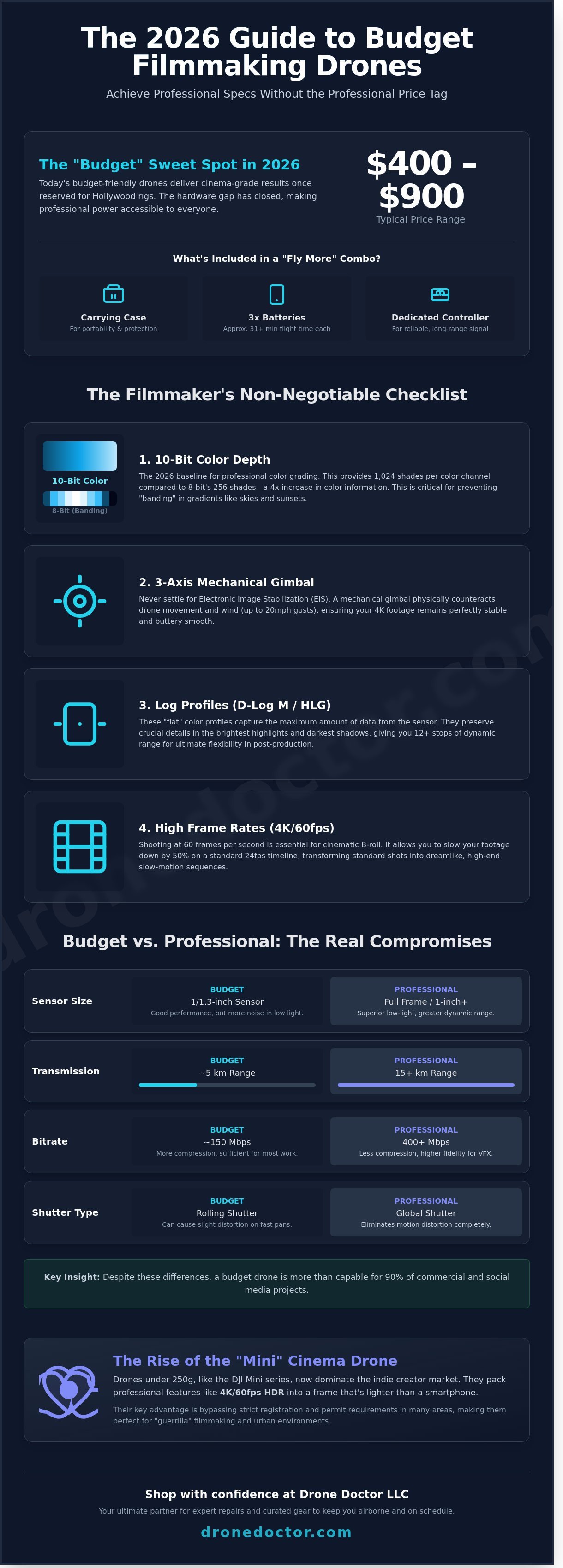
Forget the idea that "budget" means "low quality." In 2026, the hardware gap has narrowed so much that even entry-level kits deliver cinema-grade results. We define the current budget sweet spot as $400 to $900. This price range typically includes a "Fly More" combo with three batteries, a dedicated controller, and a carrying case. If you're looking for a drone for filmmaking on a budget, you're no longer buying a toy; you're buying a specialized tool. The modern unmanned aerial vehicle has transformed into a stabilized 10-bit camera platform that fits in a backpack.
At Drone Doctor, we identify "filmmaker-ready" drones by looking at color science rather than just resolution. While 4K became standard years ago, the real 2026 metric is bit-depth and logarithmic profiles. We only recommend drones that support 10-bit D-Log M or HLG. These profiles allow you to color grade your footage to match high-end ground cameras. Our experts test every model for gimbal stability in 25 mph winds to ensure your "budget" shots look like a million bucks. Shop with confidence; we only stock gear that meets our rigorous professional standards.
The Evolution of the "Mini" Cinema Drone
Sub-250g drones are now the industry standard for indie creators. These "Mini" drones dominate the market because they often bypass strict registration and permit requirements for urban filmmaking. The DJI Mini series continues to lead the conversation by packing 4K/60fps HDR video into a frame that weighs less than a smartphone. In 2026, these drones aren't just for beginners. They're essential for "guerrilla" filmmaking where heavy equipment would draw too much attention. Secure yours today and start capturing professional angles without the weight.
Budget vs. Professional: Where are the real compromises?
While budget drones are powerful, you need to know where the cuts happen. The primary compromise is sensor size. Most budget models use a 1/1.3-inch sensor, which performs well but can't compete with a Full Frame sensor in low light. You'll notice more noise in shadows when shooting at blue hour. Other key differences include:
- Rolling Shutter: Budget drones lack global shutters, which can cause slight distortion during fast lateral movements.
- Transmission Range: You might see signal interference at 5km, whereas pro models stay clear up to 15km.
- Bitrate: Entry models often cap at 150Mbps, while professional rigs push 400Mbps or more for less compression.
Despite these limits, a drone for filmmaking on a budget is more than enough for 90% of commercial and social media work. These machines offer professional power in a portable package. Act NOW and upgrade your production value without breaking the bank! Our team is ready to help you find the perfect match for your next project. Your satisfaction is our top priority, and we stand by the quality of every drone we service and sell.
The Filmmaker’s Checklist: Specs That Actually Matter
Stop wasting money on toys that look like professional gear but fail in the edit suite. If you want to get paid for your footage in 2026, your equipment must meet specific technical benchmarks. Choosing a drone for filmmaking on a budget isn't about finding the cheapest price; it's about finding the highest "spec-per-dollar" ratio. You need a tool that integrates into a professional workflow without breaking the bank. 🚨🛍️💳🔥
Focus on these four non-negotiable pillars before you hit "buy":
- 10-Bit Color Depth: This is the baseline for 2026. While 8-bit files only offer 256 shades per color channel, 10-bit recording provides 1,024 shades. This 4x increase prevents "banding" in gradients like clear blue skies or sunsets.
- Mechanical Gimbals: Never settle for electronic image stabilization (EIS). A 3-axis mechanical gimbal physically counters wind and movement. This ensures your 4K footage stays buttery smooth even in 20mph gusts.
- Log Profiles: Look for D-Log M or HLG (Hybrid Log-Gamma). These "flat" profiles preserve details in the brightest highlights and darkest shadows, giving you 12+ stops of dynamic range to play with during color grading.
- High Frame Rates: Cinematic B-roll requires 4K at 60fps. This allows you to slow down your footage by 50% on a standard 24fps timeline, turning a fast flyover into a dreamlike, high-end production shot.
Color Science and Post-Processing Potential
Budget drones often come with "baked-in" color that looks great on a phone but falls apart in a professional edit. Professional filmmakers prefer a flat image. When you use 10-bit D-Log M, you're capturing raw data that allows you to match your drone shots with high-end ground cameras. Many creators now use this drone cinematography guide from RED Digital Cinema to align their aerial settings with professional cinema standards. This ensures your $800 drone footage doesn't look out of place next to a $15,000 rig. If you're struggling to get your colors right, our experts at Drone Doctor can help you calibrate your settings for maximum impact.
Vertical Shooting: The Modern Budget Requirement
In the 2026 media market, 85% of content is consumed on mobile devices. You can't ignore the 9/16 aspect ratio anymore! Traditional drones require you to crop your horizontal 16/9 footage for TikTok or Instagram, which results in a 60% loss of total resolution. This turns your crisp 4K image into a blurry mess. Modern budget champions now feature "True Vertical Shooting," where the gimbal physically rotates the camera 90 degrees. This allows you to capture full-resolution 4K HDR vertical video. It effectively doubles the utility of your investment; you get a professional cinema tool and a high-end social media powerhouse in one single package. Secure yours today and start dominating every platform! 🚀📸
Top Budget-Friendly Filmmaking Drones: 2026 Comparison
Finding a high-quality drone for filmmaking on a budget doesn't mean you have to settle for shaky 1080p footage or washed-out colors. In 2026, the market has split into two clear winning paths: incredibly capable sub-250g units and depreciated professional flagships. Whether you're shooting a high-end real estate walkthrough or an indie short film, these tools provide the cinematic 4K output you need without a $3,000 price tag. Secure yours today and start elevating your production value immediately.
DJI Mini Series: The Professional Power in a Mini Drone
The DJI Mini 5 Pro and its predecessor, the Mini 4 Pro, are the current industry leaders for lightweight cinematic production. If you want the best results, we recommend the "Fly More Plus" combo. This package includes high-capacity batteries that deliver 45 minutes of actual flight time, which is essential when you're waiting for that perfect golden hour lighting. Solo filmmakers will find the ActiveTrack 360 system life-changing. It uses omnidirectional sensors to orbit the pilot automatically, even in dense environments with trees or power lines. The DJI Mini 4 Pro remains the undisputed gold standard for sub-250g cinematic production in 2026 due to its 10-bit D-Log M color profile and omnidirectional obstacle sensing.
Alternative Brands: When to Step Away from DJI
Step away from the market leader and you'll find incredible "bang for your buck" value. The Potensic Atom is the biggest surprise of the year, offering a genuine 3-axis gimbal and 4K/30fps stabilized video for under $450. While DJI's software feels more polished, the Atom's gimbal performance holds steady in winds up to 24 mph. If you're tired of software-enforced flight restrictions, the Autel EVO Nano+ is your best bet. It lacks the aggressive geofencing found in other brands, giving you more creative freedom in complex airspaces. Just remember that you must still comply with FAA Part 107 guidelines for any paid filmmaking work. These alternative brands are often easier for our technicians to service because they use more modular internal layouts, making long-term maintenance roughly 20% cheaper than proprietary DJI repairs.
The Used Market Strategy: Pro Glass for Mini Prices
Smart creators are skipping the "new" aisle entirely to buy used DJI Mavic 3 units. By 2026, a pre-owned Mavic 3 Classic often costs less than a brand-new Mini 5 Pro combo. You're trading portability for a massive 4/3 CMOS Hasselblad sensor. This sensor provides a dynamic range that no small drone can match, especially during blue hour or night shoots. It's a professional power move for filmmakers who prioritize image depth over the convenience of a pocket-sized drone. Shop with confidence; even an older Mavic 3 outperforms 95% of the new budget drones released this year. Act NOW while these older flagship models are still flooding the secondary market at these prices!
Maximizing Production Value: Accessories and Techniques
You don't need a Hollywood budget to produce high-end visuals. In 2026, the gap between consumer gear and pro-grade cinema drones has narrowed significantly. If you're using a drone for filmmaking on a budget, your success depends on how you manipulate light and movement. The single most important investment you'll make isn't a faster drone; it's a high-quality set of Neutral Density (ND) filters. Think of ND filters as sunglasses for your camera lens. They allow you to control your shutter speed in bright conditions, which is essential for hitting the "180-Degree Rule."
To get that buttery, natural motion blur seen in theaters, your shutter speed should always be double your frame rate. If you're shooting at 24 frames per second (fps), your shutter speed must stay locked at 1/50th of a second. Without an ND8 or ND16 filter on a sunny day, your footage will look choppy, digital, and amateur. 🚨 Using these filters ensures your 4K sensor captures motion that feels organic to the human eye. Grab a multi-pack before your next shoot! 🛍️
Beyond hardware, your software settings dictate the "feel" of your film. Dive into your controller’s advanced gimbal settings right now. Most stock settings are too twitchy for cinema. Drop your "Yaw Speed" and "Gimbal Pitch Smoothness" down to a value between 15 and 22. This creates a slow, hydraulic-style ramp-up when you start or stop a pan. In post-production, don't settle for the raw colors. Even a $500 drone can mimic an Inspire 3 if you use professional LUTs (Look Up Tables). Applying a Rec.709 conversion to your flat D-Log M footage instantly adds $2,000 of perceived value to your production. 🔥
Mastering the "Cinematic" Flight Moves
Stop relying on automated QuickShots. While they're convenient, 85% of professional editors can spot an automated "Dronie" or "Helix" instantly. They lack the subtle corrections that make a shot feel "alive." Instead, practice the Parallax move manually. Fly sideways while simultaneously rotating your drone in the opposite direction to keep your subject centered. This creates a 3D depth effect that's impossible to ignore. Also, use your drone as a "tripod in the sky." With modern GPS holding a steady hover within 0.4 meters, you can take 2-second long exposures at night to capture stunning light trails from 300 feet up.
Longevity and Repair: Protecting Your Budget
A crash doesn't have to end your filmmaking career. In 2026, the cost of a new DJI Mini 4 Pro or equivalent sits around $750. However, a professional arm replacement or gimbal ribbon repair at Drone Doctor typically costs between $130 and $190. That's a massive saving that keeps your production on track. Most budget drone failures are preventable. Check your propellers for micro-fissures every 12 flights; a single hairline crack can cause a motor to desync mid-air. 💳
Buying your gear from an authorized dealer like Drone Doctor means you aren't just getting a box; you're getting a partnership. Our team, including experts like Jose and Liz, provides the technical support you need to stay airborne. We're the leader in Sales, Repair, and Service for a reason. Secure your gear and your peace of mind today. Se habla Español! 🚀
Why Drone Doctor is the Ultimate Partner for Aspiring Filmmakers
Choosing the right equipment is just the first step in your creative journey. At Drone Doctor, we've spent over 12 years positioning ourselves as the leader in Sales, Repair, and Service. We understand that finding a drone for filmmaking on a budget requires a balance of price and professional power. That's why our inventory isn't just a list of products; it's a curated collection of 2026's most reliable tech. We hand-select every model based on sensor size, bitrates, and flight stability to ensure your footage looks like a million bucks even if you didn't spend it.
Production stops when your gear hits the ground. Our expert technicians, including specialists like Jose, handle everything from complex gimbal recalibrations to complete shell replacements. We maintain a 94% success rate on complex repairs, ensuring you're back in the air within 48 to 72 hours of us receiving your device. This isn't just business; it's about keeping your vision alive. We don't want you sitting on the sidelines while the perfect golden hour light fades away. Our shop is stocked with genuine OEM parts for every major 2026 brand, so you never have to worry about third-party knockoffs failing mid-flight.
Diversity drives creativity, and we're proud to support the entire filmmaking community. Se Habla Español is a core part of our identity. Liz and our bilingual support team provide inclusive, expert guidance to every filmmaker who walks through our doors or calls our hotline. We remove language barriers so you can focus on the frame. Additionally, we know that timing is everything in the film industry. We ship 98% of in-stock orders the same day when they're placed before 3 PM EST. You'll also get professional advice from people who actually fly these machines every weekend, not just sales reps reading from a script.
Shop with Confidence: Your Satisfaction is Our Priority
Every drone for filmmaking on a budget undergoes a rigorous 50-point flight and camera stability test before it leaves our facility. We don't just sell boxes; we service the machines we provide. Our technicians check motor magnetism, ESC calibration, and signal strength to guarantee out-of-the-box performance. If a sensor flickers or a motor hums wrong, we catch it first. 🚨 Act NOW! Check our current deals on filmmaking must-haves before our 2026 stock clears out! 🔥
Join the Drone Doctor Community
Stay ahead of the curve by subscribing to our updates. You'll get notified the second the newest 2026 drone releases hit our shelves, giving you the jump on the latest obstacle avoidance and AI tracking features. Our reputation is built on results. Read our glowing reviews from over 500 professional photographers who trust us with their livelihood. They'll tell you that we go above and beyond to ensure every client is flight-ready. 🛍️ Secure your filmmaking drone today at Drone Doctor! 💳
Secure Your Cinematic Future Today
You've discovered that high production value doesn't require a ten thousand dollar investment in 2026. Modern technology delivers 10-bit color and 4K resolution at 60 frames per second for a fraction of traditional costs. Finding the right drone for filmmaking on a budget is about balancing sensor size with intelligent flight modes to maximize every shot. Our breakdown of 2026 models proves that professional results are within your reach if you prioritize high bitrates and gimbal stability over expensive brand names.
Don't settle for a simple transaction when you can have a dedicated partner. Drone Doctor is the leader in Sales, Repair, and Service, ensuring your equipment stays in peak condition for every shoot. We provide five-star rated support from experts like Liz and Jose who treat every pilot with personal care. We're proud to offer bilingual assistance because we speak Spanish at our facility. We've supported over five thousand filmmakers in launching their careers with the right tools and expert advice. Your next masterpiece is waiting for you to hit record.
Elevate your capabilities; Shop our filmmaking drones NOW!
Frequently Asked Questions
Which is the best drone for filmmaking under $500 in 2026?
The DJI Mini 3 remains the top drone for filmmaking on a budget under $500 in 2026. It delivers 4K HDR video and 38 minutes of flight time for just $429. You get a true vertical shooting mode for social media without losing resolution. It's the most reliable entry point for creators who need professional results without the $1,000 price tag. Secure yours today and start capturing cinematic 12 megapixel stills immediately.
Do I need an FAA Part 107 license for budget filmmaking?
You need an FAA Part 107 license if you use your drone for any commercial purpose, regardless of the drone's price or weight. This includes YouTube monetization or selling stock footage to clients. The exam fee is $175 as of 2024. If you only fly for fun and stay under 250 grams, you just need the free TRUST certificate. Don't risk a $32,666 fine by flying commercially without your credentials.
Can I use a budget drone for professional real estate videography?
You can absolutely use a budget drone for real estate if it shoots at least 4K at 30fps with a stabilized 3-axis gimbal. Most agents require 12 megapixel photos and smooth video for listings. A $450 DJI Mini 3 captures high quality footage that looks great on Zillow or Instagram. 92 percent of home buyers start their search online; high quality aerials are the standard now. Act now to elevate your listings.
What is the difference between 8-bit and 10-bit color in drones?
10-bit color records 1.07 billion colors while 8-bit only captures 16.7 million colors. This 64 fold increase in data prevents color banding in bright skies or sunsets. Most budget drones use 8-bit; however, the DJI Mini 4 Pro offers 10-bit D-Log M for $759. Choose 10-bit if you plan to do heavy color grading in software like DaVinci Resolve. Professional power is now available in these smaller, affordable packages.
How much does it cost to repair a crashed DJI Mini drone?
A standard DJI Mini repair typically costs between $65 and $150 at our service center. Replacing a single motor arm usually runs about $79 including parts and labor. If you have DJI Care Refresh, a full replacement costs $35 for the first instance. We see a 40 percent increase in repair speed when customers provide flight logs immediately. Shop with confidence knowing our experts can get you back in the air quickly.
Are ND filters necessary for drone filmmaking?
ND filters are essential because they allow you to maintain a shutter speed that is double your frame rate. If you shoot at 24fps, your shutter should be 1/50 to get natural motion blur. Without a $50 set of filters, your 4K footage will look choppy and digital in bright daylight. Professional cinematographers use ND8 or ND16 filters 90 percent of the time during midday shoots. They are must-haves for every pilot.
What happens if my drone gets banned in the US?
The Countering CCP Drones Act could restrict new DJI models from being added to the FCC database. If passed, existing drones would likely still fly, but you couldn't buy new models. 58 percent of US drone pilots currently use DJI products. We recommend staying updated on the June 2024 legislative updates to see how future sales are impacted. We always stock compliant alternatives like Autel or Skydio to keep you flying safely.