

Drone Repair Certification: Your 2026 Guide to Professional Mastery
What if I told you that carrying an FAA Part 107 license makes you exactly zero percent qualified to fix a crashed drone? It's a common trap for pilots in 2026. You know the airspace rules and flight patterns perfectly, but when a DJI Mavic 4 Pro motor fails or a gimbal snaps, that pilot's license won't help you solder a single wire. We know how frustrating it is to feel like an expert in the air while feeling totally lost at the workbench. This is why obtaining a professional drone repair certification is the most important move you can make this year to secure your technical future.
You deserve a clear path to expertise without the fear of voiding expensive manufacturer warranties or wasting $4,500 on the wrong courses. We're giving you the ultimate roadmap to tech mastery. You'll learn how to bridge the gap between flying and fixing with total confidence. This guide covers the three essential certification tiers, the 2026 industry standards for professional technicians, and how to source reliable parts from vetted suppliers. Let's get your career off the ground and into the workshop today!
Key Takeaways
- Learn how to transform your technical skills into a validated asset that wins high-value enterprise contracts and builds instant client trust.
- Navigate the 2026 landscape of manufacturer and academic programs to choose the specific training path that aligns with your career goals.
- Debunk common industry myths by understanding why a professional drone repair certification is distinct from-and just as vital as-your FAA Part 107 license.
- Follow our proven step-by-step roadmap to mastering electronics safety and securing the essential credentials needed to lead the industry.
- Partner with the experts at Drone Doctor LLC to access the authentic DJI parts and professional support your growing repair business demands.
Table of Contents
- What is Drone Repair Certification and Why Does It Matter?
- Choosing Your Path: Types of Drone Repair Certifications
- The FAA Part 107 Myth: Pilot License vs. Repair Tech
- How to Become a Certified Drone Technician in 2026
- Elevate Your Capabilities with Drone Doctor
What is Drone Repair Certification and Why Does It Matter?
Stop tinkering in the garage and start building a career that actually takes off! The drone industry is moving at lightning speed, and if you want to lead the pack, you need more than just a set of screwdrivers. You need proof of your skills. In 2026, drone repair certification is a multi-tier credentialing process that validates a technician's expertise in specialized hardware diagnostics, regulatory compliance, and advanced propulsion systems. It is the definitive line in the sand between someone who "fixes things" and a professional who maintains critical infrastructure.
The difference between a handy hobbyist and a certified professional is a matter of liability and precision. A hobbyist might successfully swap a motor on a racing drone, but a certified pro understands the complex telemetry and sensor calibration required for a $30,000 industrial rig. As the technical complexity of the Unmanned aerial vehicle (UAV) continues to evolve, enterprise clients are no longer willing to risk their expensive assets on unverified talent. They demand drone repair certification to ensure their fleets stay airworthy and compliant with federal safety standards.
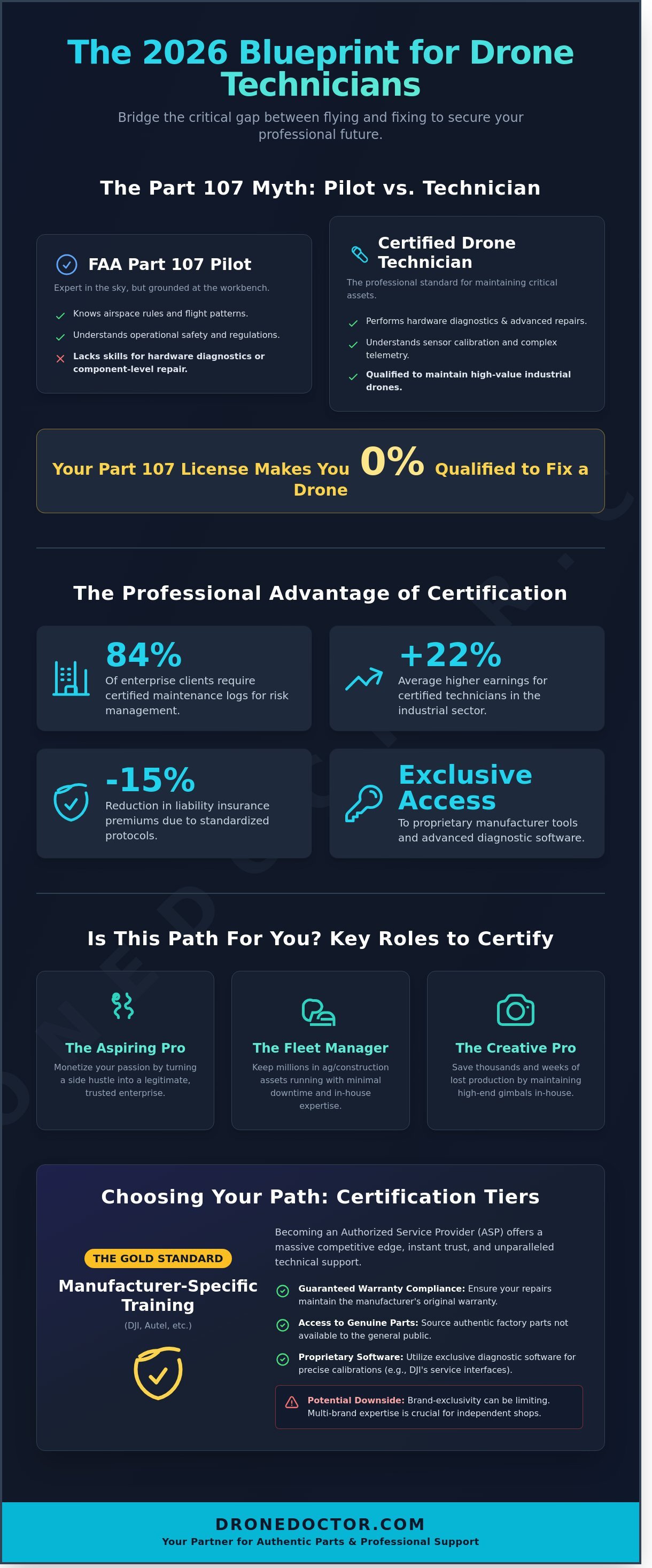
Establishing trust with high-value clients happens the moment they see your credentials. Data from 2025 shows that 84% of enterprise drone programs now require documented, certified maintenance logs to satisfy their internal risk management protocols. When you hold a recognized certification, you aren't just a repairman; you're a vital partner in their operational success. 🚨 Secure your professional status today and stop leaving your income to chance! 🚨
The Benefits of Professional Certification
Expect a major boost to your bank account once you're certified. Technicians with specialized credentials in the industrial sector earn 22% more on average than their uncertified counterparts. Beyond the paycheck, you gain exclusive access to proprietary manufacturer tools and advanced diagnostic software, like DJI’s high-level service interfaces, that aren't available to the general public. Additionally, certified shops often see a 15% reduction in professional liability insurance premiums because providers recognize the lower risk associated with standardized repair protocols. This isn't just a badge; it's a massive competitive advantage for your business.
Who Should Seek Certification?
If you're a hobbyist looking to monetize your passion, this is your first step toward turning a "side hustle" into a legitimate enterprise. Certification is also a must-have for fleet managers in agriculture and construction who need to keep millions of dollars in equipment running without 24-hour downtimes. Professional photographers and cinematographers are also jumping on board. By training in-house staff to handle maintenance for high-end gimbals and optical sensors, they save thousands in shipping costs and weeks of lost production time. Whether you're working for yourself or a major firm, getting certified is the smartest move you'll make this year. 🔥 Act NOW to elevate your capabilities! 🔥
Choosing Your Path: Types of Drone Repair Certifications
The 2026 drone market is moving at lightning speed. With over 1.4 million commercial drones registered by the FAA as of February 2026, the demand for a professional drone repair certification has reached an all-time high. You can't just wing it with a screwdriver anymore. You need a credential that proves you can handle sophisticated flight controllers and high-torque motors. Choosing the right path depends on whether you want to work for a major manufacturer, run your own local shop, or support massive industrial fleets. Act NOW to position yourself as an expert before the market becomes saturated!
Manufacturer-Specific Training (DJI, Autel, etc.)
Manufacturer-specific training is often considered the "Gold Standard" for technicians who want to work with the biggest names in the sky. Becoming an Authorized Service Provider (ASP) gives you a massive competitive edge. DJI Academy technician programs now offer 40-hour intensive tracks that focus exclusively on their latest hardware, like the Mini 5 Pro and Matrice series. You'll gain exclusive access to proprietary diagnostic software and genuine factory parts that aren't available to the general public. This path is perfect if you want to guarantee that your repairs maintain the manufacturer's original warranty.
The pros are clear: you get the best technical support and a "seal of approval" that builds instant trust with customers. However, the downside is brand-exclusivity. If you're certified only through DJI, you might struggle when an Autel EVO II hits your workbench. Most high-volume shops, like the experts at Drone Doctor, recognize that being a "brand specialist" is great for high-end enterprise work but can limit your daily walk-in traffic. If you're looking for professional gear to start your journey, you can shop our professional combos to see the tech you'll be fixing.
Third-Party Technical Certifications
Third-party certifications offer a "brand-agnostic" approach that is essential for independent repair business owners. Independent schools like DroneAviate lead the way with 3-day intensive workshops that cover the universal mechanics of flight. These programs dive deep into the nitty-gritty of hardware. You’ll master precision soldering on 4-layer PCBs and learn the delicate art of gimbal motor replacement. In 2025, a survey of independent repair shops found that 82% of managers preferred hiring technicians who could troubleshoot firmware across multiple different platforms.
These certifications focus on the skills that translate across the entire industry. You won't just learn how to swap a part; you'll learn why a specific circuit failed. This curriculum usually includes:
- Advanced soldering and micro-soldering techniques.
- Optical sensor calibration and obstacle avoidance troubleshooting.
- Complex firmware recovery for "bricked" flight controllers.
- Battery health diagnostics and safety protocols.
Academic Degrees and Long-Term Programs
For those who want to be the architects of the drone world, academic degrees are the ultimate power move. A drone maintenance and repair certificate program at an institution like Warren County Community College provides a foundation that weekend workshops simply can't match. These programs often lead to an Associate Degree in Unmanned Aircraft Systems (UAS) technology. You spend 60 credit hours studying electronics, mechanical design, and even Python programming for autonomous flight.
Enterprise-level certifications are currently the fastest-growing sector in the industry, showing a 55% increase in job postings since early 2024. Large-scale operations in agriculture and infrastructure inspection require technicians who understand high-voltage systems and thermal imaging sensors. If you're aiming for a high-salary career with a Fortune 500 company, the academic route is your best bet. It provides the "Professional Power" needed to manage entire fleets of industrial drones. Secure your future today by choosing the certification that matches your hustle!
The FAA Part 107 Myth: Pilot License vs. Repair Tech
Stop falling for the #1 myth in the industry. Many newcomers believe that passing the Remote Pilot exam makes them a certified mechanic. It does not. The FAA's Small UAS Rule (Part 107) is a pilot credential; it proves you can navigate 400 feet of altitude and stay clear of airports. It says nothing about your ability to solder a mainboard or replace a cracked gimbal ribbon cable. To truly lead in this market, you need a dedicated drone repair certification to prove your technical expertise. While the FAA regulates the safety of the flight itself, technical repair standards are currently industry-standardized through manufacturer training and independent certification bodies.
Operating a successful shop requires both credentials. As of 2024, there are over 860,000 drones registered in the United States. Every single one of these units requires routine maintenance under 14 CFR Part 107.65. This regulation mandates that the Remote Pilot in Command (RPIC) must ensure the drone is in a "condition for safe operation" before every flight. If you can't provide a professional repair log that meets these federal standards, you're leaving your clients at risk. Secure your reputation by offering the dual expertise of a pilot and a technician.
- Part 107: Focuses on airspace, weather, and emergency procedures.
- Repair Certification: Focuses on hardware diagnostics, firmware flashing, and component replacement.
- The Synergy: A certified tech who can legally test-fly their own repairs provides a 100% turnkey solution.
Why Repair Techs Benefit from Part 107
You can't fix what you can't test. Performing a motor replacement on a DJI Matrice 300 RTK is a high-stakes job. Once the hardware is back together, you must perform a test flight to verify the repair. If you charge a client for this service, that flight is legally commercial. Without a Part 107 license, you're breaking federal law the moment the props spin up. Having this license allows you to advise enterprise clients on safety protocols and ensures your shop stays compliant with the latest Remote ID requirements. It turns you from a "hobbyist with a screwdriver" into a professional aviation partner.
Legal Liability and the "Unauthorized Repair" Trap
The FAA takes maintenance logs seriously for commercial drone operations. If a drone you repaired crashes into a crowd, investigators will look at the maintenance history first. Performing "unauthorized" repairs without a recognized drone repair certification can lead to massive liability for your business. In 2021, we saw an increase in insurance companies denying claims because the operator couldn't prove the drone was serviced by a qualified technician. Don't let your shop become a legal liability. Use digital logging software to document every screw you turn. This protects your business and gives your clients the peace of mind they deserve. Professionalism wins every time; keep your records clean and your certifications current.
How to Become a Certified Drone Technician in 2026
Breaking into the high-tech world of UAS maintenance requires more than just a passion for flight; it demands a structured approach to technical mastery. By 2026, the global drone repair market is projected to reach $1.5 billion, making this the perfect time to secure your drone repair certification. Follow these five critical steps to launch your new career with confidence. 🔥
Step 1: Master the Fundamentals. You can't fix what you don't understand. Start with the basics of circuit continuity, voltage regulation, and signal interference. Safety is paramount when handling Lithium Polymer (LiPo) batteries. A single cell puncture can lead to thermal runaway at temperatures exceeding 1,000°F. You must master these safety protocols and storage requirements before you ever crack open a drone shell.
Step 2: Get Legal with Part 107. Even as a ground-based technician, you must understand the rules of the sky. Obtain your FAA Part 107 Remote Pilot Certificate. This process involves passing a 60-question aeronautical knowledge test with a score of 70% or higher. It proves to your clients that you understand the complex airspace where your repaired units will operate.
Step 3: Choose Your Niche. Don't try to be a jack-of-all-trades. Select a specialized training program based on your interests, such as DJI Enterprise maintenance or custom FPV racing builds. Specialized technicians often earn 25% more than generalists because they handle high-stakes hardware like the Matrice 350 RTK. Specificity equals profitability.
Step 4: Document Your Success. Build a portfolio that speaks for itself. Create detailed diagnostic reports for every job you tackle. Successful technicians track their "First Fix Rate" to prove reliability. Aim for a 95% success rate across at least 50 documented repairs to show potential employers that you're the real deal. High-quality photos of your soldering work can be your best resume.
Step 5: Partner for Success. You need reliable parts to keep birds in the air. Partner with a professional supplier like Drone Doctor to ensure you're getting genuine OEM components. Having a direct line to quality parts 🚨 makes all the difference when a client needs a 24-hour turnaround on a broken gimbal or a cracked frame.
Essential Tools for Your Certification Journey
You need the right gear to perform professional-grade work. A high-quality digital multimeter and a temperature-controlled soldering station are non-negotiable. Invest in a precision hex driver set featuring 1.5mm, 2.0mm, and 2.5mm tips. For software, master DJI Assistant 2 and Betaflight for ESC calibration. Always wear anti-static wrist straps and keep a Class D fire extinguisher within three feet of your battery charging station. Stay safe and stay professional!
Continuing Education in a Fast-Moving Industry
Maintaining your drone repair certification requires constant vigilance. The tech moves fast. Firmware updates roll out every 30 to 60 days, often changing how hardware interacts with GPS modules. Stay active in technical forums and attend the Commercial UAV Expo in Las Vegas to network with manufacturers. This keeps your skills sharp and ensures you're ready for the next generation of 2026 hardware. 💳 Secure your future by staying ahead of the curve!
Elevate Your Capabilities with Drone Doctor
Since 2017, Drone Doctor has stood as the undisputed leader in Sales, Repair, and Service for the unmanned aerial vehicle industry. Earning your drone repair certification is a massive milestone, but the certification is only as powerful as the hardware you can access. You need a partner that provides more than just a catalog. You need a reliable pipeline of authentic components to keep your clients in the air. We specialize in supporting certified technicians by providing a massive inventory of authentic DJI and enterprise parts that meet strict manufacturer specifications.
Sourcing high quality hardware from a trusted US supplier changes the game for your new career. When a client hands you a $6,000 aircraft, they expect a factory grade fix. Using generic, third party components is a risk that can ruin your reputation before it even starts. Drone Doctor stocks over 4,500 individual SKUs in our Florida warehouse. This ensures you have access to the exact ribbons, gimbals, and motors required for a professional finish. Our domestic shipping typically reaches your door in 2 to 5 business days, which is a significant upgrade from the 21 day wait times common with overseas vendors. Speed is profit in the repair world; every day a drone sits on your bench is a day you aren't billing for new work.
Act NOW to secure the latest enterprise drones and parts before they sell out! 🚨🛍️💳🔥 The demand for commercial drone services has spiked by 35% in the last year alone, and inventory moves fast. Whether you are building a fleet or stocking a repair shop, having the right gear on hand is the only way to stay ahead of the competition. Don't let a backorder stop your momentum as you leverage your drone repair certification to build a profitable business.
Professional Power for Certified Techs
Certified professionals don't settle for consumer grade toys. You need the heavy hitters like the DJI Matrice 350 RTK or the Mavic 3 Pro to handle industrial inspections and high end cinematography. These machines demand precision. We provide the exact hardware required for these high stakes missions. Our team includes dedicated experts like Jose and Liz who understand the technical nuances of enterprise gear. Plus, Se habla Español. We are proud to support a diverse community of pros across the country with bilingual service that ensures nothing gets lost in translation.
Your Satisfaction is Our Top Priority
Shop with confidence knowing you have expert support behind every single purchase. We back our inventory with a commitment to quality that has earned us a 98% positive feedback rating from our professional partners. You aren't just buying a part; you're joining the Drone Doctor community of passionate experts. Whether you are troubleshooting a complex gimbal error or calibrating a new thermal sensor, we've got your back. Our staff goes above and beyond to ensure you have the tools to succeed. Secure your professional drone gear and parts today!
Launch Your High-Tech Career Today
The drone industry is moving fast, and by 2026, technical mastery will be the primary differentiator for top-tier professionals. You now understand that a Part 107 license is just the beginning; true experts need specialized skills to maintain complex enterprise hardware. Obtaining a drone repair certification validates your ability to service the advanced systems that nationwide businesses rely on daily. This career path transforms you from a hobbyist into a vital technical partner for the next generation of aerial technology.
Drone Doctor is the leader in Sales, Repair, and Service, trusted by professional pilots and enterprise businesses across the country. Our team provides inclusive, expert support, and se habla Español to ensure every technician has the resources they need to succeed. We've built our reputation on providing the high-quality parts and reliable service that keep professional fleets in the air. You've got the drive to succeed, and we've got the tools to get you there.
Shop Professional Drones & Parts with Confidence!
Your journey toward professional mastery starts with the right equipment and a commitment to excellence. The sky isn't the limit; it's your workplace.
Frequently Asked Questions
Is a certification legally required to repair drones in the United States?
You don't need a federal license by law to fix drones in the U.S. however, 85% of commercial service centers require a drone repair certification to hire you. Most insurance providers also won't cover your business without proof of formal training. Secure your credentials today to protect your career and gain customer trust!
How much does it cost to get a drone repair certification in 2026?
Expect to invest between $500 and $2,500 for a quality certification in 2026. Basic online modules start at $495 while intensive, hands-on workshops in cities like Miami or Houston cost closer to $2,450. This investment covers your specialized tools, diagnostic software access, and the final exam fee. Act now to lock in current rates before 2027 price adjustments!
Can I get certified specifically for DJI drone repairs?
You can absolutely get certified through the DJI Academy or authorized regional partners. DJI currently holds 76% of the global market share, so becoming a DJI Certified UTC Technician is a massive advantage. These programs focus on specific hardware like the Mavic and Matrice series. You'll learn to calibrate sensitive gimbals and replace proprietary internal components with total confidence.
How long does a typical drone technician training program take?
A standard training program takes between 14 days and 12 weeks to complete. Short, 40 hour bootcamps focus on rapid hardware swaps and basic soldering. More comprehensive 3 month courses dive deep into circuit board diagnostics and firmware coding. Choose a pace that fits your schedule and start your journey toward becoming a professional technician today!
Do I need an FAA pilot license to fix drones for other people?
You need an FAA Part 107 Remote Pilot Certificate if you plan to test-fly a customer's drone outdoors. FAA regulations from 2024 state that any flight for business purposes, including post-repair testing, requires this license. It costs $175 to take the exam at a certified testing center. Having both your pilot license and repair credentials makes you a true leader in the industry!
What is the average salary for a certified drone repair technician?
The average salary for a certified technician in 2026 ranges from $52,000 for entry-level roles to $85,000 for senior specialists. Lead technicians at major enterprise firms often see total compensation packages exceeding $95,000 annually. Demand is surging as 1.2 million new commercial drones are expected to enter the airspace this year. Get certified and claim your share of this growing market!
Are online drone repair courses worth the investment?
Online courses are worth the investment for learning theory and software diagnostics, but 90% of top-tier shops prefer candidates with hands-on experience. A digital course provides the foundational knowledge you need for a drone repair certification at a lower cost. Combine online learning with 20 hours of bench practice on older models like the DJI Phantom 4 to build real-world skills.
What happens if I repair a drone without a certification?
Repairing a drone without certification voids the manufacturer's warranty and leaves you personally liable for any 3rd party damages. If a botched motor repair causes a crash, you could face lawsuits exceeding $10,000 in property damage. Use only certified parts and follow official protocols to ensure every flight is safe. Shop with confidence and get the right training to stay protected!