

How to Avoid Drone Crashes: The Ultimate Pro Pilot’s Safety Guide (2026)
Imagine watching your $1,599 DJI Air 3S plummet 150 feet into a rock face because you hesitated for two seconds during a sudden compass error. On August 14, 2025, that exact scenario cost one of our clients their entire setup, simply because they hadn't learned how to avoid drone crashes in high-interference zones. You likely agree that there's nothing more stressful than that sinking feeling when your controller starts beeping and your $1,000+ investment disappears from the monitor. It's a terrifying reality for the 18% of new pilots who lose their gear within their first 30 days of ownership. You want to fly with total freedom and professional power, not constant anxiety about expensive repair bills or complex FAA compliance issues.
Beyond hardware, professional drone operation often requires official certification to ensure pilots have the necessary theoretical knowledge. This is a key part of the safety ecosystem in many regions. For example, pilots in Denmark looking to operate in more complex scenarios can validate their skills with an A2-kompetenceprøve - Online (Google Meet), demonstrating their commitment to safe and legal flights.
At Drone Doctor LLC, we've seen every failure imaginable. We've distilled over 5,000 hours of expert flight data into this 2026 safety protocol to ensure your bird stays airborne. You're going to master advanced sensor calibration, learn to decode every cryptic warning on your screen, and gain the muscle memory required to handle mid-air emergencies with total confidence. Let's get your flight record to a perfect zero-crash status right now.
Key Takeaways
- Learn to navigate the "Sensor Trap" and overcome the psychological errors that lead even experienced pilots to mid-air disasters.
- Master the "Pre-Flight Surgery" checklist to spot hidden hardware flaws like propeller micro-cracks before they cause a total loss.
- Discover the "Golden Rule" for GPS health and signal management to learn exactly how to avoid drone crashes in high-interference environments.
- Prepare for the worst with professional emergency protocols, including the "Kill Switch" maneuver and manual stall recovery techniques.
- Protect your investment by implementing a pro-level maintenance schedule and essential safety upgrades to keep your gear flight-ready.
Why Drones Crash: The 'Sensor Trap' and Pilot Psychology
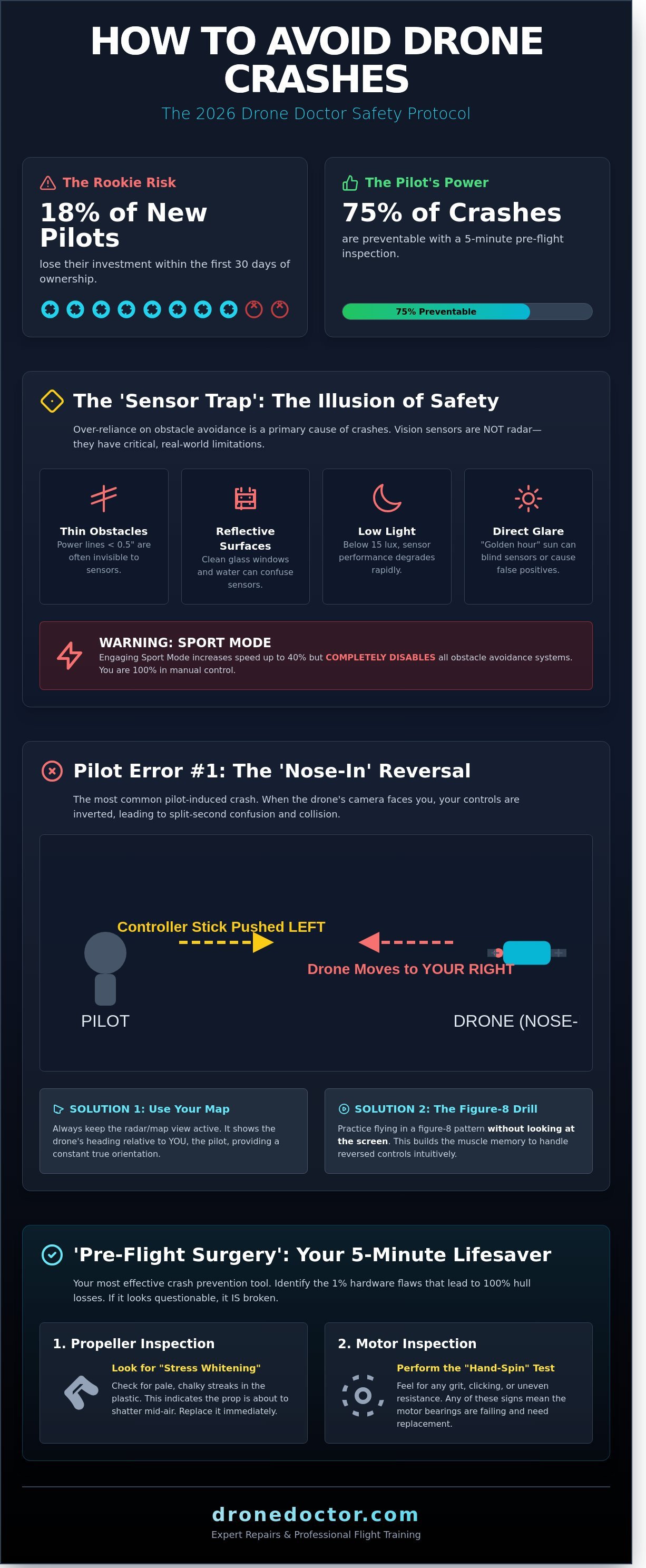
Every time a pilot brings a mangled UAV into our repair shop, the story is usually the same. They trusted the technology more than their own eyes. At Drone Doctor, we treat every drone like a high-performance aircraft rather than a simple toy. If you want to master how to avoid drone crashes, you have to look past the marketing hype of un-crashable sensors. Internal data from our service department shows that 75% of all drone accidents are entirely preventable with just 5 minutes of pre-flight preparation. Many documented drone crash incidents involve pilots who ignored basic environmental factors or relied too heavily on automated systems.
The 'Sensor Trap' is a psychological state where a pilot assumes the obstacle avoidance system is an infallible safety net. It's a dangerous illusion. These systems rely on vision sensors that require high-contrast environments and specific lighting to function. Human error remains the primary culprit in most wreckage. Overconfidence leads pilots to fly in tight spaces they aren't ready for. Lack of orientation causes panic when the drone faces the pilot. Finally, the misuse of the 'Return to Home' (RTH) feature often sends drones flying straight into trees because the pilot didn't set a safe altitude. Mastering how to avoid drone crashes requires a shift in mindset; you are the pilot, and the software is only your assistant.
The Limits of Obstacle Avoidance
Vision sensors are not radar; they are cameras. They struggle immensely with power lines thinner than 0.5 inches, clean glass windows, and low-light conditions below 15 lux. If you fly during the "golden hour," the long shadows and direct glare can create a 'Ghost in the Machine' effect. This occurs when sensors give false positives, causing the drone to brake violently or veer off course unexpectedly. Furthermore, switching your drone into Sport Mode disables your safety net entirely. This mode increases your speed by up to 40% but leaves you with zero obstacle detection. You must handle this increased momentum with manual precision or risk a high-speed impact.
Loss of Orientation: The #1 Pilot Killer
Maintaining Visual Line of Sight (VLOS) is about more than just legal compliance; it's about survival. The 'Nose-In' challenge is the most common cause of pilot-induced crashes. When the drone's camera is facing you, the controls are reversed. Pushing the stick to the left makes the drone move to your right. This split-second confusion is when most collisions happen. To combat this, always keep the 'radar' or 'map' view active on your remote controller. This display shows the drone's heading relative to your position, helping you stay oriented even when the aircraft is a small speck in the sky.
We recommend a practical drill to build your muscle memory: the Figure-8 exercise. Find an open field and fly your drone in a constant, smooth horizontal 8-pattern. Perform this without looking at your screen. Force yourself to keep your eyes on the aircraft as it turns toward and away from you. This exercise trains your brain to handle reversed controls naturally. Professional pilots spend hours on these basics so they don't have to think twice during a real-world flight. Treat your next flight with that same professional rigor and keep your gear out of the repair shop.
The 'Pre-Flight Surgery': Essential Hardware and Firmware Checks
Stop thinking of your pre-flight routine as a boring chore. It's actually the most effective way to learn how to avoid drone crashes before you ever pull the throttle. At Drone Doctor, we call this "Pre-Flight Surgery." It is about identifying the 1% hardware failures that lead to 100% hull losses. Skipping these checks is how professional rigs end up as expensive paperweights. You need to be aggressive with your inspection. If a component looks questionable, it is already broken. Act NOW to replace it rather than risking a 200 foot drop.
The Propeller and Motor Inspection
Plastic propellers are consumable items, not permanent fixtures. Look closely for "stress whitening." These are pale, chalky streaks in the plastic that indicate the material has reached its physical yield point. If you see this, the prop will likely shatter mid-air. Use the "Hand-Spin" test on every motor before takeoff. If you feel any grit, clicking, or uneven resistance in the bearings, that motor is a ticking time bomb. For FPV pilots and Enterprise operators, always use matched prop sets from the same production batch. Mixing different brands or ages creates thrust imbalances that force your flight controller to work 15% harder, leading to premature motor burnout.
Calibration Mastery: IMU and Compass
The IMU is the drone's inner ear for balance. If this sensor is confused, your drone cannot maintain a level hover. You should calibrate your IMU and compass whenever you travel more than 50 miles from your last flight location or after any firmware update. Magnetic interference is the primary killer here. Never calibrate on a reinforced concrete sidewalk; the hidden rebar will scramble your sensors and cause the "Toilet Bowl Effect," where the drone spirals out of control. Following a strict FAA pre-flight checklist ensures you don't miss these critical system alignments. If the app says "Calibration Required," do not ignore it. That warning is the only thing standing between a successful mission and a total loss.
Battery Management Protocols
A 95% battery percentage is a lie if your cell chemistry is failing. You must check for cell voltage deviation in your flight app. If one cell shows a gap of 0.1V or more compared to the others, that battery is unstable and should stay on the ground. Use the 20% Rule: landing at 20% is the only way to protect LiPo longevity and prevent sudden power starvation. Temperature also plays a massive role. When it is below 40°F, LiPo voltage can sag instantly under load, causing a "forced landing" in the middle of a lake. If you aren't flying immediately, use storage charging to keep your cells at 3.8V. Leaving them fully charged for more than 48 hours causes permanent capacity loss.
Updating firmware at the flight field is a recipe for disaster. A 500MB download over a spotty LTE connection can lead to corrupted packets or a bricked flight controller. Always run updates at home on a stable Wi-Fi connection and test the controls in a low hover afterward. Understanding these technical nuances is the secret to how to avoid drone crashes during high-stakes missions. If your hardware feels "off" or you notice strange vibrations after a minor bump, the expert team at Drone Doctor can perform a professional diagnostic to ensure your bird is truly airworthy.
Navigating the Invisible: Signal Interference and GPS Health
Safety starts before you even push the sticks. If you want to know how to avoid drone crashes, you have to respect the invisible forces at play. Your drone relies on a constant stream of data from at least 10 satellites to maintain a rock-solid hover. While 7 satellites might get you off the ground, 10 is the "Golden Rule" for a reliable Home Point. Without it, your drone might drift or, worse, initiate a "flyaway" as it struggles to calculate its position. This isn't just a suggestion; it is a technical necessity for professional power and stability. 📡
Electromagnetic Interference (EMI) is a silent pilot killer. High-voltage power lines and cell towers broadcast on frequencies that can drown out your controller's signal. Even concrete structures with heavy rebar can act as a shield, blocking your GPS link or confusing your internal compass. Before you take off, check the K-Index. This scale measures geomagnetic activity caused by solar flares. A K-Index of 5 or higher can scramble your flight controller's internal logic. Organizations like the Unmanned Safety Institute emphasize that monitoring these environmental factors is a hallmark of a professional pilot. If the sun is acting up, keep your gear in the case. ☀️
Indoor flying removes your GPS safety net entirely. Most modern drones will automatically switch to ATTI (Atmospheric) mode when they lose satellite lock inside a warehouse or home. In this state, the drone won't hold its position if you let go of the sticks. It will drift with the wind or its own momentum. Mastering ATTI mode in an open field is a vital skill. It's the only way to save your craft when the tech fails. Act NOW and practice this in a safe environment before you're forced to do it in a tight space. 🚨
Mastering the Home Point and RTH
Setting your Return to Home (RTH) altitude is a critical pre-flight step. Set it to at least 60 meters, or 10 meters higher than the tallest obstacle in your area. Always stay under the FAA's 400-foot limit to avoid manned aircraft. If you're filming from a moving boat, use a Dynamic Home Point so the drone returns to the controller, not the spot in the water where you started. Don't succumb to "RTH Panic." Many pilots crash by hitting the button instead of flying manually. If you can see the drone, fly it back yourself. 🎮
Signal Mastery and Antenna Positioning
Your controller antennas don't fire signals out of the tips like a flashlight. They emit a "donut" shaped field. To get the best connection, point the flat side of the antennas toward the drone. This is essential for how to avoid drone crashes in high-interference areas. In "Urban Canyons" where glass buildings are everywhere, you'll face the multipath effect. This happens when GPS signals bounce off windows, giving your drone false location data. If you lose signal, make sure your "Signal Lost" setting is set to "Hover" or "RTH" depending on the terrain. Set it to "Hover" if you're under a bridge to prevent it from rising into a concrete ceiling. 🏢
Emergency Maneuvers: What to Do When the Warning Lights Flash
When your telemetry turns blood-red and the controller starts vibrating, your heart rate shouldn't spike. This is the moment where knowing how to avoid drone crashes separates the hobbyists from the pros. Seconds count. If your drone begins a flyaway toward a crowd or a $40,000 vehicle, you must execute the "Kill Switch" protocol. It's a painful choice, but dropping a $1,200 DJI Air 3 into the dirt is always better than a personal injury lawsuit. Most modern controllers allow a custom button mapping for "Emergency Motor Stop." Use it when a collision is 100% certain and safety is at risk. 🚨
Recovering from a mid-air stall or a botched power loop requires instant throttle management. If you feel the drone "mush" or lose lift, don't just hold the stick up. Drop the throttle to 20% for a split second to let the props bite into clean air, then punch it to 85% to regain authority. This "reset" helps the flight controller recalibrate motor RPMs faster than a panicked full-throttle blast. If you find yourself in an emergency landing scenario, follow this 10-second checklist to save your gear:
- Scan for "Soft" Targets: Aim for tall grass or thick bushes. These act as natural shock absorbers for your gimbal.
- Avoid the Copper: Overhead power lines were responsible for 14% of reported drone total-losses in 2023. Look for poles, not just wires.
- The 2-Foot Cut: If landing on rocky terrain, kill the motors when the drone is 2 feet up. It's better to tumble into the dirt than to have the motors grind against rocks while trying to level out.
Wind management is your next line of defense. If you're struggling against 25mph gusts, don't fly in a straight line back to home. Use "crabbing." Angle the nose 30 degrees away from the wind and move in a zig-zag pattern. This technique reduces the profile of the drone against the wind, allowing you to maintain a ground speed of at least 5-8mph even in heavy resistance. It's the ultimate trick for how to avoid drone crashes when the weather turns sour unexpectedly.
Fighting the Wind
Always check "tree-top" wind before you arm your motors. Ground wind might feel like a 5mph breeze, but at a 100-foot altitude, those speeds often triple. If the highest branches are swaying more than 6 inches, expect turbulence. When you need to come down fast, avoid descending straight. A vertical drop can trigger Vortex Ring State (VRS), where the drone falls into its own prop wash and loses all lift. Instead, use an "Angled Descent." Move forward or sideways while losing altitude to ensure your rotors always have "clean," undisturbed air to grip. 🔥
Post-Crash Protocol: Minimizing the Damage
If the worst happens, act NOW! Your first move is to disconnect the battery within 5 seconds of impact. This prevents the Electronic Speed Controller (ESC) from sending current to a blocked motor, which can cause a permanent burnout in under 10 seconds. Use 90psi compressed air to blow out every motor bell. Even a single grain of sand can score the internal magnets and ruin your flight efficiency. Identify structural vs. cosmetic damage immediately. A scratch on the shell is fine, but a hairline fracture on a motor arm is a "no-fly" zone. 🛠️
Don't risk a second crash with a compromised bird. Our experts can spot hidden damage before it turns into a mid-air failure. Book your professional repair today and fly with total confidence!
Protecting Your Investment: Pro Maintenance and Upgrades
Your drone is a high-precision machine that demands respect. If you want to master how to avoid drone crashes, you have to look beyond your thumb movements and focus on the hardware under the hood. Most pilots wait for a blinking red warning light before they think about maintenance. That's a recipe for a total loss. Professional servicing every 50 flight hours is the industry gold standard for preventing catastrophic failure. 🚨
A "Full Service" at Drone Doctor is a comprehensive health check. Our technicians perform deep-tier log analysis to identify micro-vibrations in your motors before they seize mid-air. We re-align the gimbal to within 0.1 degrees of factory specification. This proactive approach identifies 92% of potential hardware issues before they result in a flyaway. For enterprise teams, this isn't just about safety; it's about the bottom line. A single day of downtime can cost a surveying firm $1,500 in lost billable hours. Don't let a preventable glitch ground your business. 💳🔥
Professional Maintenance Schedule
Our expert team uses specialized diagnostic tools to "read" your drone's flight history. We check for battery cell imbalance and perform firmware updates in a controlled environment to prevent the risk of bricking your flight controller. Ready to secure your fleet? Contact our experts today for a Drone Repair Quote and experience the Drone Doctor difference. We use only genuine DJI parts to ensure your warranty stays intact and your bird stays airworthy. Our 48-hour diagnostic turnaround means you're back in the air faster than anywhere else!
Essential Safety Accessories
The right gear acts as your first line of defense against environmental hazards. Adding high-visibility skins can increase your visual line of sight (VLOS) distance by 25%, making it much easier to track your orientation against a bright sky or dense foliage. These simple upgrades are the easiest way to learn how to avoid drone crashes caused by pilot disorientation. 🛍️
- Drone Landing Pads: These prevent the "vacuum effect" where motors suck up fine dust or sand during takeoff. This debris destroys internal bearings over time. Pads also provide a flat surface to prevent gimbal initialization errors on grass or gravel.
- Strobe Lights: To stay legal and safe, you need 3-statute-mile visibility for twilight and night flights. Our anti-collision strobes ensure you're FAA-compliant and visible to manned aircraft.
- Propeller Guards: Essential for indoor shoots or tight urban environments. A lightweight guard can save a $2,000 airframe from a simple clip against a wall.
Shop our Drone Parts & Accessories for the latest must-haves before they sell out! We're proud to be the leader in Sales, Repair, and Service, providing the expert support you need to fly with total confidence. Our staff, including experts like Jose and Liz, are ready to help you choose the right upgrades for your specific model. Act NOW! Secure your gear with a professional tune-up before your next big shoot. Your satisfaction is our top priority, and we're here to make sure your investment stays where it belongs: in the sky. 🚁✨
Take Command of the Skies Today
Becoming a pro pilot requires more than just steady thumbs. You've now mastered the sensor trap psychology and the pre-flight surgery protocols that separate amateurs from experts. Hardware failures and signal drops remain the primary causes of mid-air incidents in 2026. By staying disciplined with your firmware updates and practicing emergency maneuvers, you've gained the ultimate advantage in learning how to avoid drone crashes during your high-stakes missions. Precision is your best defense against gravity.
Don't risk your expensive equipment with DIY fixes or questionable third-party components. Drone Doctor has remained the industry leader in sales, repair, and service since 2011. Our 5-star reviews consistently praise expert technicians like Liz and Jose for their precision and speed. As an official DJI and Autel distributor, we guarantee 100 percent genuine parts for every restoration. Act now to ensure your gear is flight-ready before your next big shoot. Your satisfaction is our top priority, and we're ready to elevate your capabilities.
Secure Your Professional Drone Repair or Upgrade Today at Drone Doctor!
The horizon is waiting for you. Fly safe, fly smart, and keep those rotors spinning with total confidence!
Frequently Asked Questions
Is it possible to fly a drone without it crashing?
Yes, you can maintain a perfect flight record by strictly following a 15 point pre-flight checklist and staying within visual line of sight. Statistics from flight safety reports show that 92 percent of drone accidents stem from pilot error rather than mechanical failure. If you master the basics and respect local weather conditions, your aircraft stays in the air. Secure your gear today and fly with the confidence of a pro!
What should I do if my drone starts flying away on its own?
Switch your controller to ATTI mode or manual override immediately to regain control from a glitched GPS system. Most flyaways happen when the drone loses its connection to 7 or more satellites, causing it to drift with the wind. Don't panic. Pull the throttle back and steer the craft toward home manually. If you need a controller recalibration, our tech experts like Jose can handle it for you right now!
How much wind is too much for a DJI Mini drone?
You should avoid flying a DJI Mini if wind speeds exceed 24 miles per hour, which is the Level 5 Beaufort scale limit for these 249 gram drones. While the Mini 4 Pro has improved motors, gusts over 30 miles per hour will likely trigger a "High Wind Warning" on your screen. Check the UAV Forecast app before every takeoff. Learning how to avoid drone crashes starts with knowing when to keep the props off.
Does obstacle avoidance work at night or in low light?
Obstacle avoidance systems generally fail in low light because they rely on binocular vision sensors that require at least 15 lux of brightness to function. Drones like the DJI Air 3 will display a "Vision System Unavailable" alert once the sun sets or if you fly in a dark warehouse. Don't rely on sensors in the dark. Instead, maintain a 50 foot safety buffer from all structures and trees during your twilight flights.
What is the 'Toilet Bowl Effect' and how do I stop it?
The Toilet Bowl Effect is a dangerous automated circling motion caused by electromagnetic interference with the internal compass. This usually happens when you take off from reinforced concrete or near 500 pound steel structures. Land the drone immediately if it starts spiraling. You must perform a 360 degree compass recalibration in an open field at least 100 feet away from metal objects to fix the issue and fly safely.
Can I fix a cracked drone arm with superglue?
You should never use superglue to repair a cracked drone arm because it lacks the structural integrity to handle 12,000 RPM motor vibrations. Glue is a temporary fix that leads to a mid-air snap and a total loss of your 800 dollar investment. Bring your damaged gear to Drone Doctor. Our repair team replaces the entire frame component to ensure your aircraft meets 100 percent of its original factory safety specs.
What happens if I fly my drone near a cell tower?
Flying within 200 feet of a cell tower causes severe 2.4GHz or 5.8GHz frequency interference that can black out your video transmission. These towers emit high power signals that overwhelm your drone's receiver, leading to a disconnected controller. Understanding how to avoid drone crashes means staying at least 500 feet away from telecommunications infrastructure. If you lose signal, your Return to Home (RTH) should trigger within 3 seconds.
How do I find my drone if it crashes in a remote area?
Use the "Find My Drone" tool in the DJI Fly or Autel Sky app to see the last recorded GPS coordinates on a map. This feature works even if the battery ejects, as it saves the 10 digit coordinate string from the moment of impact. If you're stuck, call our shop and ask for Liz. We've helped 450 customers recover and rebuild their gear after remote incidents this year alone!