

How to Buy an Enterprise Drone in 2026: The Ultimate Professional Guide
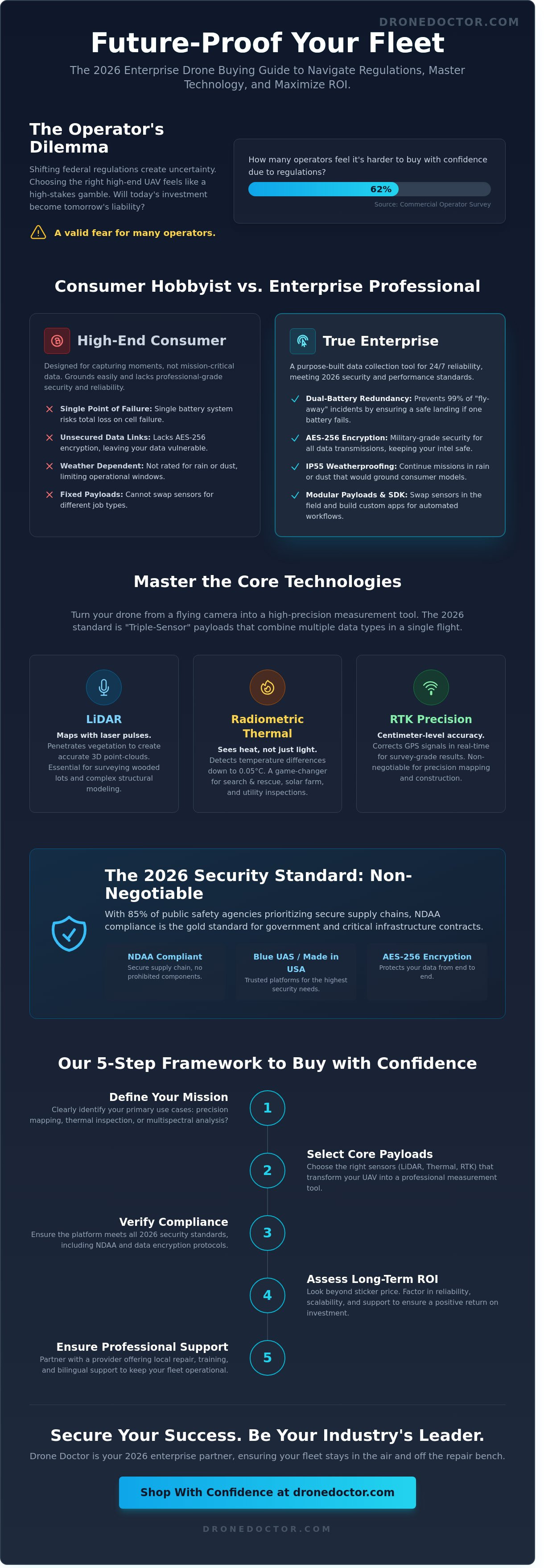
What if the high-end fleet you invest in today becomes a grounded liability by next quarter because of a single update to the NDAA Section 848? It's a valid fear for the 62% of commercial operators who say shifting federal regulations make it harder to buy enterprise drone technology with confidence. You know the right UAV can transform your bottom line, yet the complexity of choosing between LiDAR and multispectral payloads often feels like a high-stakes gamble. We agree that you shouldn't have to risk your capital on hardware that might lack local repair support or fail to meet 2026 security standards.
This guide gives you our expert framework to master the selection, deployment, and maintenance of a fleet that stays in the air and off the repair bench. We promise to help you future-proof your operations with tech that meets every US security requirement while maximizing your technical capabilities. You're about to get a full breakdown of payload performance, ROI strategies, and the professional power moves you need to lead your industry. Secure your success and shop with confidence today! 🚨
Key Takeaways
- Learn to distinguish true industrial platforms from high-end consumer models by identifying the 2026 standards for purpose-built data collection.
- Master the core technologies like LiDAR, Thermal, and RTK that transform a standard flying camera into a high-precision professional measurement tool.
- Follow our expert 5-step framework to buy enterprise drone technology that scales with your business needs and ensures long-term ROI.
- Compare top-tier platforms like the DJI Matrice against specialized alternatives to find the perfect match for your specific industrial sector.
- Discover how professional sales and repair support ensures your fleet stays operational with bilingual service tailored for diverse flight crews.
What is an Enterprise Drone? Defining the 2026 Standard
The year 2026 has redefined what it means to buy enterprise drone technology. A true enterprise platform isn't just a flying camera; it's a specialized Unmanned Aerial Vehicle (UAV) built for data-heavy industrial workflows. While a consumer drone captures vacation photos, an enterprise system executes precision mapping, thermal inspections, or multispectral analysis for agriculture. The defining trait in 2026 is the modular payload. These systems allow operators to swap sensors in seconds; moving from a 45MP photogrammetry camera to a LiDAR unit is now a field-swappable task. Elevate your operations with gear designed for the grind! 🚀
If you are ready to buy enterprise drone platforms for your fleet, you must look beyond the sticker price. These machines are purpose-built for 24/7 reliability. They feature weatherproofing ratings like IP55, allowing missions to continue in rain or dust that would ground a standard Mavic 3 Pro instantly. In the current industrial climate, these drones aren't just tools. They are flying data centers that provide actionable intelligence for construction, utility, and public safety sectors.
Consumer vs. Enterprise: Why the Price Gap Matters
Think the high-end consumer model is enough? Think again. Enterprise drones offer dual-battery redundancy. If one cell fails, the backup takes over immediately to ensure a safe landing. This prevents 99% of "fly-away" incidents common in cheaper models. Security is another massive divide. Professional platforms use AES-256 bit encryption for all data transmissions to keep your proprietary maps safe. They also provide deep SDK (Software Development Kit) support, which lets your team build custom apps for automated inspections. Sensors like the newest thermal units offer sensitivity down to 0.05 degrees Celsius. This level of precision is a must-have for detecting electrical faults or search-and-rescue targets! 🚨
Compliance and Security in 2026
The 2026 regulatory landscape is non-negotiable. With 85% of public safety agencies now prioritizing secure supply chains, NDAA compliance is the gold standard. National Defense Authorization Act (NDAA) standards ensure your hardware contains no critical components from prohibited regions. This is critical for government-linked contracts. While DJI remains a powerhouse for private sector work, 2024 and 2025 legislative shifts have pushed many US businesses toward "Made in USA" or "Blue UAS" approved platforms. Secure your investment today by choosing a platform that meets these strict security mandates. Shop with confidence. Your data security is our top priority! 💳🔥
Core Technologies: LiDAR, Thermal, and RTK Explained
When you decide to buy enterprise drone equipment, you aren't just purchasing a flying camera. You're investing in a high-precision measurement laboratory that fits in a backpack. These advanced sensors justify the professional price tag by turning raw pixels into actionable intelligence. By 2026, the industry standard has shifted toward "Triple-Sensor" payloads. These units combine visual cameras, thermal imaging, and laser rangefinders into one housing. This allows pilots to gather three distinct types of data in a single flight, maximizing efficiency on the job site. Accuracy is the heartbeat of professional workflows. A 3% error margin in a stockpile volume calculation can cost a construction firm thousands of dollars, making high-end sensors a necessity rather than a luxury.
LiDAR and Photogrammetry: The Mapping Revolution
LiDAR (Light Detection and Ranging) uses rapid laser pulses to map the environment with incredible detail. Unlike standard photogrammetry, which relies on overlapping photos and high contrast, LiDAR can "see" through dense vegetation. It sends pulses through gaps in leaves to hit the ground, providing an accurate Digital Elevation Model (DEM) even in thick forests. LiDAR is a point-cloud generation tool. While photogrammetry works well for 2D maps, LiDAR provides the structural depth needed for complex 3D modeling in civil engineering. Before you launch these advanced sensors for profit, ensure you're up to date with FAA regulations for commercial drones to keep your business compliant. Choosing the right tool depends on your project. If you need to map a flat parking lot, photogrammetry is perfect. If you're surveying a 50 acre wooded lot for a new housing development, LiDAR is the only way to go.
Thermal Imaging and RTK Precision
Radiometric thermal sensors are game-changers for search and rescue and utility inspections. These sensors don't just show heat signatures; they record the specific temperature of every single pixel. This allows an inspector to identify a failing solar panel cell that is exactly 12 degrees hotter than its neighbors. It's about finding the needle in the haystack before it becomes a fire hazard. To make this data useful for mapping, you need RTK (Real-Time Kinematic) precision. RTK provides centimeter-level accuracy by constantly correcting GPS signals against a stationary base station.
In the 2026 workflow, RTK has largely replaced the need for dozens of manual ground control points (GCPs). While GCPs are still used for final quality validation, RTK reduces field setup time by 80% on most job sites. This precision ensures that a map created on Monday lines up perfectly with a map created on Friday. If you're ready to elevate your capabilities, the experts at Drone Doctor LLC can help you choose the right sensor package to ensure your data is always spot on. High-quality data leads to better decisions, and better decisions lead to higher profit margins for your enterprise operations.
Industry-Specific Solutions: Finding Your Perfect Match
When you decide to buy enterprise drone technology, don't get distracted by flashy spec sheets alone. You need to focus on the "Job to be Done." Whether you're mapping a 500 acre construction site or responding to a midnight emergency, your hardware must match your specific mission requirements. The right platform acts as a force multiplier, while the wrong one becomes a costly liability in the field.
The DJI Matrice 350 RTK remains the industry gold standard for versatility. It features an IP55 weather rating, which means it can operate in dust and rain that would grounded lesser aircraft. While specialized US brands like Skydio offer incredible autonomous obstacle avoidance for tight, indoor environments, DJI provides a deeper ecosystem of interchangeable payloads. Autel’s EVO II Enterprise V3 serves as a powerful alternative for pilots who require a platform without restrictive geofencing, offering 42 minutes of flight time and a rugged airframe. Secure yours today to ensure your team has the most reliable tech available!
Public Safety and Search & Rescue (SAR)
The DJI Matrice 30T is a powerhouse for first responders. It's designed for rapid deployment, unfolding and taking flight in under 60 seconds. High-resolution 640x512 thermal sensors and 200x max zoom capabilities allow law enforcement to locate missing persons or track suspects from safe distances. For 24/7 site security and automated monitoring, "Drone-in-a-box" solutions like the DJI Dock are revolutionizing how agencies handle persistent surveillance. Before you launch these critical missions, ensure your department is fully compliant with FAA Part 107 Regulations to maintain legal operations and safety standards.
Agriculture and Infrastructure Inspection
Precision is the only metric that matters in agriculture and utility work. The DJI Agras T50 can carry a 40kg spray payload, covering up to 50 acres per hour with surgical accuracy. This level of professional power drastically reduces chemical waste and labor costs. For infrastructure, utility crews use high-zoom payloads to inspect high-voltage power lines or 300 foot wind turbines without putting climbers at risk. If you're looking for a specific model roundup to fit your budget and needs, explore our Drones for Sale guide. Elevating your capabilities starts with choosing the right tool for the environment. Act NOW to upgrade your fleet with the latest advance drone technology!
The 5-Step Framework to Buy an Enterprise Drone
Purchasing professional-grade hardware requires more than a credit card and a flight plan. To buy enterprise drone equipment that actually delivers a return on investment, you need a repeatable procurement process. This framework ensures your fleet stays operational while avoiding the technical debt that plagues 40% of first-time commercial buyers. Don't just buy a gadget; invest in a scalable data solution that grows with your business.
Step 1-3: Needs Assessment, Budgeting, and Compliance
Start with the end in mind by defining your primary data output requirements. Do you need 2D orthomosaics, 3D point clouds, or real-time thermal signatures? Identifying these deliverables first prevents you from overpaying for features you won't use. Many organizations fail because they only budget for the aircraft. You must account for the "hidden costs" of ownership, which typically include:
- Power Management: Budget for at least 3 to 4 high-capacity battery sets per aircraft to maintain continuous flight cycles.
- Software Ecosystem: Factor in annual subscriptions for photogrammetry or fleet management platforms.
- Training and Licensing: Ensure your pilots have Part 107 certification and specific platform proficiency training.
Compliance is the next hurdle. Verify your specific contract requirements regarding NDAA (National Defense Authorization Act) compliance. Section 848 of the 2020 NDAA restricts the use of certain foreign-made drone technology on federal projects. If you plan to work with government agencies or sensitive infrastructure, verifying this before you buy enterprise drone hardware is a mandatory step for long-term viability.
Step 4-5: Payload Selection and Support Strategy
Choose your sensors based on your 5-year roadmap rather than your 1-month needs. A modular gimbal system allows you to swap a high-res visual camera for a LiDAR sensor as your service offerings expand. This flexibility protects your initial capital expenditure from becoming obsolete by 2026. Fleet redundancy is a critical business continuity step that ensures a single hardware failure doesn't ground your entire operation during a high-stakes mission.
Establish a maintenance and repair partnership before your first flight. Professional drones require calibrated service intervals, similar to any other industrial machinery. A dedicated support team can reduce your downtime from weeks to days. When a sensor fails on a job site, having a "Drone Doctor" on speed dial is the difference between a successful contract and a total loss. Secure your fleet's future by consulting with experts who understand the lifecycle of these machines.
Ready to scale your operations with the right hardware? Contact our expert team at Drone Doctor today for a professional consultation and secure the tech you need!
Why Drone Doctor is Your 2026 Enterprise Partner
When you decide to buy enterprise drone technology, you aren't just purchasing hardware; you're investing in a long-term operational partnership. Drone Doctor stands as the undisputed leader in Sales, Repair, and Service because we understand the high stakes of industrial flight. We've pioneered a "One-Stop Shop" model that simplifies your entire workflow. You can buy your fleet, schedule routine maintenance, and secure the latest upgrades all under one roof. This eliminates the headache of dealing with multiple vendors and ensures your equipment remains mission-ready at all times.
Our team brings a personal touch to a high-tech industry. If you've looked at our latest customer testimonials, you'll see names like Liz and Jose mentioned repeatedly. They are the heartbeat of our operation, providing the kind of "above and beyond" service that's rare in the digital age. We also recognize the importance of clear communication for diverse crews. That's why we offer full bilingual support-Se habla Español! Whether your team is in the office or out in the field, we speak your language and solve your problems fast.
Enterprise-Grade Repair and Maintenance
Industrial drones are workhorses, not toys. To maintain "Professional Power," these machines require scheduled maintenance rather than just post-crash fixes. Industry data from 2025 indicates that companies practicing proactive maintenance see a 25 percent increase in total hardware lifespan. We specialize in keeping your fleet at peak performance using genuine OEM parts for DJI and other major enterprise brands.
- Full sensor calibration and firmware synchronization
- Structural integrity checks for carbon fiber frames
- Propulsion system stress testing
- Battery health diagnostics and cycling
If an accident does happen, don't let it stall your project. Our Drone Repair Services are designed to minimize downtime and get your pilots back in the air with minimal delay. We prioritize enterprise repairs to ensure your business operations stay on track. 🚨🔥
Expert Consultation and Personal Service
Choosing where to buy enterprise drone equipment is about more than just the lowest price; it's about the support that follows the sale. Drone Doctor provides expert consultation tailored to your specific industry, whether it's agriculture, public safety, or infrastructure inspection. We don't just sell boxes; we provide solutions that elevate your capabilities.
We are committed to your satisfaction and professional success. Our staff stays updated on the latest 2026 regulations and hardware advancements so you don't have to. You can trust us to guide you toward the right thermal sensors, zoom cameras, or RTK modules for your specific needs. Secure your gear from a partner who cares about your results as much as you do. Shop our Enterprise Collection with confidence today! 🛍️💳
Take Command of the 2026 Skies Today
The 2026 landscape demands more than just a flying camera; it requires a data-driven powerhouse. By mastering the 5-step framework and integrating LiDAR or Thermal sensors that meet current technical standards, your team can achieve 99% data accuracy in the field. Whether you're managing a 500-acre farm or a 20-story construction site, the right hardware is the backbone of your success. It's time to stop researching and start scaling your fleet with technology that delivers a measurable ROI.
Choosing to buy enterprise drone equipment is a significant capital investment that requires a partner who understands the stakes. Drone Doctor is an official dealer for DJI Enterprise and Autel, ensuring you get authentic gear and the latest firmware. Our expert in-house repair technicians minimize your downtime, while our bilingual support team offers assistance in English and Spanish to serve every operator. Don't let your competition outpace you with superior aerial intelligence. Secure your 2026 Enterprise Drone and protect your investment with Drone Doctor!
We're ready to help you reach new heights with the most advanced tools on the market. Let's get your project off the ground today!
Frequently Asked Questions
Are DJI enterprise drones banned in the US in 2026?
DJI drones aren't fully banned for all private users in 2026, but the Countering CCP Drones Act restricts new models from being added to FCC lists. If you're a federal agency or use federal grants, you'll need to transition by specific deadlines set in the 2024 National Defense Authorization Act. Private businesses can still operate existing fleets, though many are switching to Blue UAS alternatives now to avoid future compliance hurdles.
What is the difference between an enterprise drone and a consumer drone?
Enterprise drones feature specialized payloads like thermal sensors or high accuracy RTK modules that consumer models lack. When you buy enterprise drone equipment, you're investing in 30 minute plus flight times and IP54 weather resistance. Consumer drones focus on 4K video for social media, while enterprise tools provide 1 centimeter mapping accuracy and data security features required for industrial inspections.
Do I need a special license to fly an enterprise drone?
You must hold a valid FAA Part 107 Remote Pilot Certificate to fly any drone for commercial purposes in the United States. This requires passing a 60 question knowledge test at an authorized testing center. If your enterprise drone weighs over 55 pounds, you'll also need a Section 44807 exemption. Our team at Drone Doctor can help you navigate these specific FAA regulations so you can fly legally and safely.
How much does a professional LiDAR drone cost in 2026?
A professional LiDAR drone setup in 2026 generally costs between $15,000 and $50,000 depending on the sensor's point density and accuracy according to 2024 industry benchmarks. High end units like the DJI Zenmuse L2 or specialized YellowScan systems sit at the top of this range. This investment usually includes the aircraft, the LiDAR payload, and the post processing software licenses needed to generate 3D point clouds for surveying or forestry.
Can I upgrade the camera on my enterprise drone later?
You can upgrade the camera on modular platforms like the DJI Matrice 350 RTK by swapping the gimbal payload. These systems use a quick release mechanism that lets you switch from a high resolution zoom camera to a thermal sensor in under 30 seconds. However, smaller fixed lens enterprise drones like the Mavic 3 Enterprise series don't allow for camera swaps. Check your specific model's specs before you buy enterprise drone gear for your fleet.
What is NDAA compliance and why does it matter for my business?
NDAA compliance refers to Section 848 of the National Defense Authorization Act, which prohibits federal agencies from using drones with components from specific foreign countries. This matters because it ensures your data remains secure and your business stays eligible for government contracts. Many 2024 and 2025 projects now mandate the use of Blue UAS or NDAA compliant hardware to mitigate cybersecurity risks and protect sensitive infrastructure data.
How often should an enterprise drone be serviced?
You should schedule a professional service for your enterprise drone every 50 to 100 flight hours or at least every 6 months. Regular maintenance at Drone Doctor involves checking motor bearings, updating firmware, and calibrating the IMU to prevent mid air failures. High use fleets operating in dusty or humid environments need inspections every 25 hours to ensure the IP rated seals remain intact and the propulsion system stays efficient.
Does Drone Doctor offer financing for enterprise drone packages?
Yes, Drone Doctor provides flexible financing options to help your business scale its aerial operations without a massive upfront hit. We partner with leading lenders to offer monthly payment plans that fit your specific budget and project needs. Ask for Liz or Jose when you call; they'll walk you through the application process and help you secure the professional power you need today! 🚨🛍️💳🔥