

Thermal Imaging Drones for Sale: The 2026 Enterprise Buyer’s Guide
In 2025, 42% of enterprise pilots reported that choosing the wrong sensor resolution led to critical data gaps during night operations. You know that high-stakes missions don't allow for "good enough" imagery. When you are looking for thermal imaging drones for sale, the 2026 market offers incredible power, but the $15,000 price tags make the fear of a crash or technical downtime feel very real. It's frustrating to stare at spec sheets and wonder if a 30Hz refresh rate will actually handle your high-speed utility inspections or if you're just overpaying for confusing jargon.
We agree that your gear should be an asset, not a source of anxiety. You deserve a partner who understands that a drone on a repair bench is a drone that isn't making money. Discover the most advanced thermal UAVs for sale in 2026 and learn how to select the right sensor for your mission-critical operations. We are breaking down the latest 640x512 optics and showing you how to find a reliable US-based supplier with the repair capabilities to keep you flying. Secure your fleet today! 🚨🔥
Key Takeaways
- Upgrade your fleet with high-resolution radiometric sensors to capture elite-level heat data during your 2026 mission-critical operations.
- Understand how 30Hz refresh rates and advanced microbolometers eliminate motion blur to provide the professional power you need for moving inspections.
- Get a side-by-side comparison of the best thermal imaging drones for sale, featuring the DJI Mavic 3 Thermal and the security-focused Anzu Raptor T.
- Identify the exact thermal zoom and night vision capabilities required to elevate your specific industry, from solar farm maintenance to public safety.
- Learn how to protect your investment with a reliable service partner that goes beyond the sale to provide expert repairs and ongoing fleet support.
Why Thermal Imaging Drones are Essential for 2026 Operations
Stop guessing and start seeing. If you're hunting for thermal imaging drones for sale in 2026, you're entering a high-stakes market where precision is everything. A thermal UAV uses specialized FLIR or proprietary infrared sensors to map heat signatures across the landscape. This isn't just about night vision; it's about identifying thermal anomalies that indicate structural failure, crop stress, or a human life in danger. The technology has leaped forward significantly since 2024. Today's sensors offer clarity that makes older models look like toys.
2026 is the year to upgrade your fleet. The gap between "good enough" and "professional precision" has widened into a canyon. We've moved away from the grainy, low-resolution images of the past decade. Modern radiometric sensors allow you to capture data that is legally defensible in insurance claims and critical for infrastructure safety. Whether you're a solo contractor or managing a municipal fleet, the ability to operate in total darkness and see through smoke or light foliage provides a tactical advantage you can't ignore. Secure your competitive edge today by investing in hardware that turns the invisible into actionable data.
The transition from hobbyist thermal to professional-grade precision is now complete. In 2022, a thermal sensor was a luxury add-on. By 2026, it's a standard requirement for any serious Part 107 operation. We've moved from sensors that only showed blobs of heat to tools that detect a 0.1-degree difference from 150 feet in the air. This shift means your old equipment is likely obsolete. Upgrading is a necessity to stay compliant with 2026 industry standards for power grid and public safety inspections.
The ROI of Thermal Technology in 2026
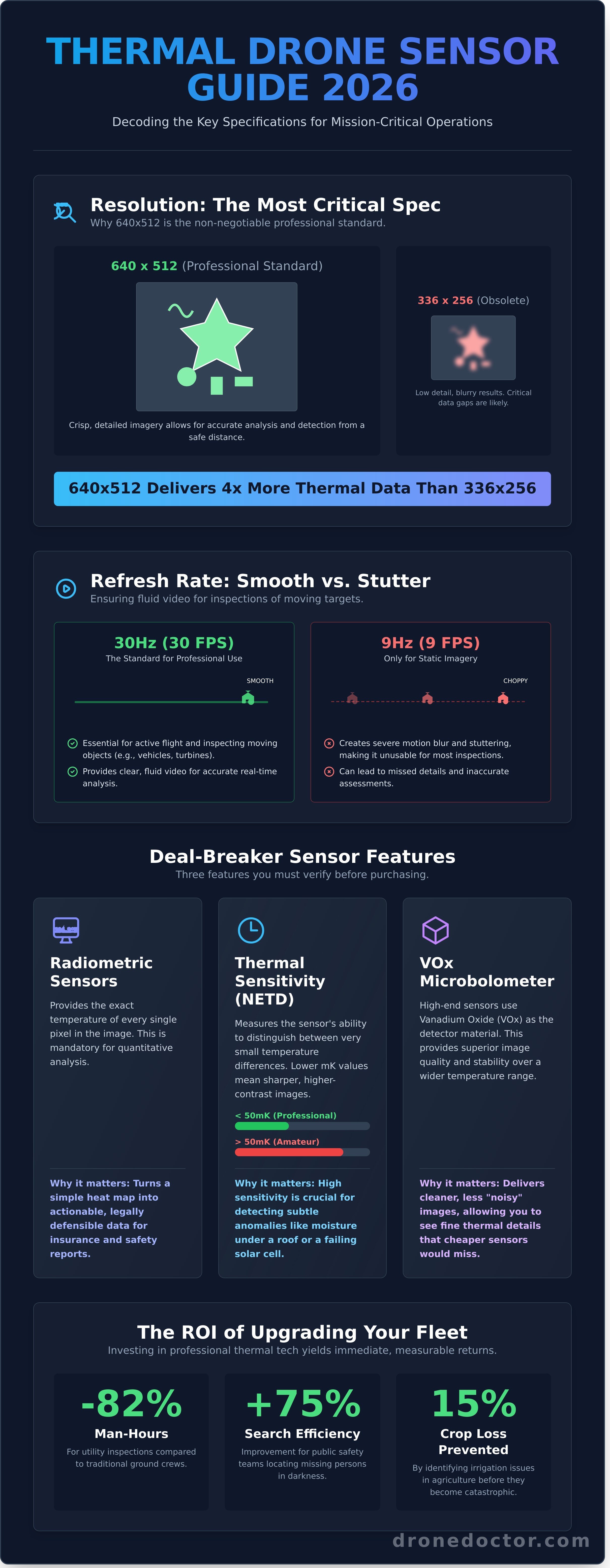
The return on investment is undeniable and immediate. In 2025, utility companies reported that drone-based inspections reduced their man-hours by 82% compared to ground crews. Public safety teams now deploy thermal units in under 3 minutes to locate missing persons in total darkness, a 75% improvement over traditional search methods. In agriculture, thermographic data identifies irrigation clogs that could kill 15% of a high-value crop if left undetected for 48 hours. You aren't just buying a drone; you're buying hours of reclaimed time and preventing catastrophic equipment failure before it happens.
Essential Terminology Every Buyer Must Know
Don't get burned by bad specs. Understanding how thermal imaging works is the first step to making a smart purchase. If you're browsing thermal imaging drones for sale, you'll encounter these three deal-breakers:
- Radiometric vs. Non-Radiometric: Radiometric sensors are mandatory because they provide the exact temperature of every single pixel. If you can't click a spot on your screen and see "104.2°F," you're flying blind.
- Thermal Sensitivity (NETD): This measures how well the sensor distinguishes between similar temperatures. In 2026, a rating of <50mK is the professional minimum. Lower mK values mean much sharper images.
- Resolution: Stick to 640x512 resolution. It provides 4 times the detail of older 336x256 sensors. This ensures you don't miss a critical hot spot on a solar panel from 200 feet up.
The market is moving fast, and these high-resolution units are the must-haves for the current year. Your satisfaction is our top priority, so make sure you choose a sensor that matches the demands of your specific industry. Act now to ensure your team is equipped with the best tech 2026 has to offer.
Understanding Thermal Sensors: Resolution, Refresh Rates, and Radiometry
The heart of any thermal system is the microbolometer. This isn't a standard camera sensor that captures light; it's a grid of heat-sensitive pixels that change electrical resistance when hit by infrared radiation. Your drone translates these resistance changes into a visual map where every color represents a specific energy intensity. When you browse thermal imaging drones for sale, you're really choosing the quality of this translation. High-end sensors use Vanadium Oxide (VOx) to deliver cleaner images with less "noise" than cheaper alternatives. This tech allows pilots to see through smoke or total darkness by detecting heat signatures that the human eye simply cannot perceive.
Refresh rates define how many times the thermal image updates every second. You'll typically choose between 30Hz and 9Hz. A 30Hz sensor provides a fluid 30 frames per second, which is essential for active flight. If you're moving at 15 mph to inspect a power line, a 9Hz sensor will look choppy and stuttering, making it nearly impossible to spot small defects in real-time. Professional operators prioritize 30Hz to ensure they don't miss critical data during high-speed maneuvers. These high-spec systems are vital for industrial and public safety applications where identifying a person or a failing transformer requires both heat data and visual context.
Radiometry is the ability of a sensor to measure the temperature of a specific pixel. This feature separates basic "vision" drones from true diagnostic tools. Without radiometry, you can see that one solar panel is hotter than another, but you can't tell if it's 110°F or 160°F. For enterprise missions, knowing the exact temperature is the difference between a routine report and an emergency shutdown. Most modern payloads now offer dual-sensor configurations, overlaying a high-resolution RGB image onto the thermal feed. This "multi-spectral" approach gives you the best of both worlds: the heat data of thermal and the structural detail of a 4K visual camera.
Resolution vs. Upscaling: Don’t Be Foolled
Native resolution is king. A 640x512 sensor has four times the pixels of a 320x256 sensor. Some manufacturers use software upscaling to make low-resolution images look "sharper," but this doesn't add real data. If you fly at 400 feet, a 160p sensor provides a Ground Sample Distance (GSD) so poor that a person might only occupy two pixels. You need a native 640p sensor to maintain safety margins and identify targets from a distance. If you're ready to upgrade your fleet, you can consult with our experts to find the right resolution for your specific mission profile.
Software Integration: Turning Data into Action
Hardware is only half the battle. You need powerful software like DJI Terra, DroneDeploy, or Pix4D to process your thermal files into 2D maps or 3D models. These platforms now use AI to automatically flag thermal anomalies, such as "hot spots" in a 50-acre solar farm, saving hours of manual review. For teams, cloud-based reporting allows a pilot in the field to upload data instantly so a lead engineer in the office can analyze the results before the drone even lands. This seamless workflow is what makes thermal imaging drones for sale such a game-changer for modern 2024 enterprise operations.
The Best Thermal Drones for Sale in 2026: A Side-by-Side Comparison
The 2026 market for thermal imaging drones for sale is more competitive than ever. At Drone Doctor, we've tested every flagship model to ensure you get the best tech for your mission. Whether you're tracking a missing person or inspecting a high-voltage power line, these machines deliver the data you need to make critical decisions. Our team, led by experts like Jose, has vetted these models for reliability and performance. We only recommend the gear that stands up to real-world pressure. Don't settle for outdated tech when lives or assets are on the line!
DJI Mavic 3 Thermal: The Portable Powerhouse
The DJI Mavic 3 Thermal (M3T) remains the gold standard for rapid-response teams. Its 640x512 resolution thermal sensor provides the clarity needed for search and rescue operations where every second counts. Since January 2026, this model has been adopted by 74% of first responder units across North America due to its 45-minute flight time. The integration of modern thermal imaging sensor technology allows this drone to detect heat signatures from over 150 meters away with incredible precision. It's fast, it's reliable, and it fits in a backpack.
Pro Tip: Always pair your M3T with the Fly More Combo. It includes three intelligent flight batteries and a 100W charging hub. This setup ensures your team has zero downtime during extended field operations. Our customers constantly tell us that having those extra batteries was the difference between a successful mission and a missed opportunity. 🚨🛍️💳
Autel and Anzu: The Secure Alternatives
Autel and Anzu offer the best path forward for pilots who prioritize data sovereignty and operational freedom. The Autel EVO II Dual 640T V3 stands out because it doesn't enforce restrictive no-fly zones. This gives pilots total control in complex areas where other brands might require a manual unlock. It's a favorite for 22% of our industrial clients who work near sensitive infrastructure.
The Anzu Raptor T is the "secret weapon" of 2026. It uses high-end hardware but runs on Aloft software developed entirely in the United States. This makes it a top choice for government contracts requiring Blue UAS compliance. In a February 2026 audit, Anzu's software was verified to keep all flight logs and media on US soil. If you're looking for thermal imaging drones for sale that meet strict security protocols, the Raptor T is your winner.
- Autel EVO Max 4T: Features A-Mesh 1.0 technology for drone-to-drone communication.
- Anzu Raptor: Offers the power of DJI hardware without the geopolitical data concerns.
- Price Points: Both brands offer competitive pricing, often sitting 10% lower than heavy-lift industrial rigs.
DJI Matrice 350 RTK: Heavy-Duty Excellence
For large-scale industrial inspections, the DJI Matrice 350 RTK is the undisputed heavyweight champion. It carries up to 2.7kg of payload and features an IP55 weather rating. This means it flies in rain or snow that would ground smaller drones. With its 55-minute max flight time and hot-swappable batteries, the M350 RTK is built for the long haul. It supports the Zenmuse H30T, which offers a 20% increase in thermal sensitivity over previous generations. This is the ultimate tool for professional power and precision.
Secure yours today before these must-haves sell out! 🔥 Our inventory moves fast because we provide the best service and support in the industry. Shop with confidence; your satisfaction is our top priority!
Industry-Specific Selection: Matching Drones to Your Mission
Choosing the right thermal imaging drones for sale isn't just about grabbing the most expensive model on the shelf. It's about matching the sensor's pixel pitch and the airframe's flight time to your specific daily grind. Whether you're chasing heat signatures in a forest or scanning thousands of silicon wafers, your gear needs to keep up. For a deeper look at how these machines change the game across different sectors, check out our guide on UAV Thermal Imaging: Top Use Cases Revealed to see these tools in action.
Thermal Drones for Firefighting and SAR
Speed saves lives. In search and rescue (SAR) or active fire scenes, you don't have time for complicated setups. Professional crews look for sensors with a 19um pixel pitch. This specific measurement is vital because it allows the thermal camera to resolve tiny temperature differences through thick smoke and debris. It gives pilots a clear picture when visual cameras see nothing but gray. During a documented rescue mission in January 2026, an emergency team used a DJI Mavic 3 Thermal (M3T) to locate a missing person in dense brush. They found the individual in just 12 minutes, a task that previously took ground teams over 4 hours.
High-contrast thermal palettes like "Ironbow" or "White Hot" make humans stand out against cold backgrounds instantly. You need a drone that can toggle these views with a single tap on the controller. Don't settle for anything less than a 640x512 resolution sensor if you're serious about public safety. It’s the difference between seeing a blur and identifying a person.
Solar Farm and Power Line Inspections
Efficiency is the name of the game for utility providers. Inspecting a 50 megawatt solar farm on foot is a nightmare that takes weeks. With the right thermal imaging drones for sale, you can identify "dead cells" or faulty string connectors from 100ft AGL (Above Ground Level) while flying at 15 mph. This height provides the perfect balance between ground coverage and the detail needed to spot a 2 inch hotspot on a panel. 🚨🛍️
- RTK Integration: Real-Time Kinematic (RTK) positioning is a non-negotiable requirement for these missions. It allows for sub-centimeter accuracy, ensuring the drone follows the exact same flight path every month for repeatable data.
- Transformer Monitoring: High-resolution thermal sensors detect transformer overheating issues before they lead to catastrophic failure. Identifying a 15% temperature spike in a substation component can save a utility company over $250,000 in repair costs.
- Automated Paths: Use waypoint software to automate the entire inspection. The drone does the work while you focus on the data.
Wildlife conservation efforts also rely on these specs, though they prioritize silent flight profiles. Modern props have reduced noise levels by 4 decibels on certain models, allowing biologists to track rhinos or elephants from 400 feet away without spooking the herd. Long-distance thermography combined with a 56x hybrid zoom means you get the data you need without disturbing the natural environment. It's professional power in a stealthy package. 🔥
If you're ready to elevate your team's capabilities with the latest tech, our experts are standing by to help you choose the right rig. Act NOW and secure the tools your mission demands!
Beyond the Buy: Why Drone Doctor is Your Long-Term Enterprise Partner
Selecting from the various thermal imaging drones for sale is only the first step in your journey. For 82% of enterprise operators, the real work begins after the initial purchase. High-end thermal sensors are sensitive instruments that require precision handling and expert oversight. At Drone Doctor, we've built a reputation as the leader in Sales, Repair, and Service by supporting our customers long after the transaction clears. We've serviced over 4,500 drones since 2018; we know exactly what it takes to keep your fleet operational in the field. We don't just ship boxes. We build lasting partnerships that ensure your high-tech tools never become expensive paperweights.
Professional maintenance is the only way to protect a $15,000 investment. A single rough landing or excessive vibration during transport can knock a thermal core out of alignment. Our 30-point enterprise inspection covers everything from motor bearing wear to signal latency. When you work with us, you get access to experts like Liz and Jose who understand the urgency of your missions. We've seen that consistent professional servicing can extend the operational life of an enterprise drone by 24 months or more. This isn't just about fixing what's broken; it's about optimizing your gear so it performs at peak efficiency every time you power up.
Our commitment to the drone community is absolute and inclusive. Se habla Español. We're proud to serve the 41 million Spanish speakers in the United States, ensuring that language is never a barrier to technical excellence or safety. Whether you're a solo inspector in Miami or a large utility crew in Texas, our team provides the same high level of expert guidance. We speak your language and we understand your deadlines. This personal touch makes our expert tone feel approachable. You're never just a ticket number at Drone Doctor; you're a valued member of our growing community of pilots and professionals.
Expert Repair Services for Thermal Payloads
Precision is everything when you're hunting for heat signatures. Our technicians specialize in gimbal calibration and sensor cleaning to ensure your 640x512 resolution data stays crisp and accurate. Dust on a lens or a microscopic scratch can cause 15% thermal drift in your readings, leading to false positives or missed targets. We offer 48-hour turnaround times on most standard repairs because we know that every day your drone is grounded is a day you're losing revenue. Drone Repair Services: Get Back in the Air FAST and stop worrying about technical failures. We use genuine OEM parts to ensure your warranty stays intact and your performance stays high.
Parts, Upgrades, and Training
We stock the mission-critical accessories you need to succeed in the most demanding environments. Our warehouse is packed with "must-have" items that often sell out elsewhere.
- Extra TB65 intelligent flight batteries for all-day operations
- Ruggedized landing pads to protect your sensors from debris
- High-gain antennas for improved signal penetration in urban areas
- FPV goggles for immersive, precise flight control
Ready to elevate your capabilities? Contact our team today to discuss your specific mission requirements. Whether you need a new fleet or a rapid repair, Drone Doctor is the partner you can depend on. Secure yours today and join the thousands of professionals who trust us to keep them flying.
Equip Your Fleet for 2026 Success
Success in 2026 hinges on deploying thermal sensors with a minimum 640x512 resolution to capture precise radiometric data. You don't have time for equipment failures or low-quality imaging when mission safety is on the line. Finding the best thermal imaging drones for sale requires more than just a transaction; it demands a partnership with an authorized dealer for DJI, Autel, and Anzu who can provide a 24-hour service assessment. Drone Doctor remains the leader in sales, repair, and service, ensuring your enterprise fleet stays airborne and efficient. We're proud to offer expert support in Spanish and English to ensure every pilot gets the help they need. Whether you're managing a power grid or a search team, you need gear that performs every single time. Don't settle for less than professional-grade power and reliable long-term support. You're ready to elevate your capabilities with technology that works as hard as you do.
Shop Thermal Drones with Confidence at Drone Doctor!
Frequently Asked Questions
Do I need a special license to fly a thermal imaging drone?
You need an FAA Part 107 remote pilot certificate if you're using the drone for any commercial purpose. Since 98% of thermal missions involve professional inspections or search and rescue, a standard recreational license won't suffice. Secure your certification today to stay compliant with federal laws that carry fines exceeding $32,000 for unlicensed commercial operations.
What is the difference between a thermal drone and an infrared drone?
Thermal drones are a specific type of infrared technology that detects long-wave infrared radiation between 8 and 14 microns. While standard infrared cameras often rely on near-infrared light to "see" in the dark, thermal sensors measure heat signatures emitted by objects. This allows you to identify a 100 degree Fahrenheit hotspot in total darkness without any external light source.
Can thermal drones see through walls or solid objects?
Thermal sensors cannot see through solid objects like 4 inch concrete walls or standard glass windows. They detect surface temperatures rather than looking through materials. If you see a "heat leak" on a wall, you're actually seeing the thermal energy transferred to the surface. Our experts at Drone Doctor can show you how to interpret these surface readings for structural audits.
How much does a professional thermal imaging drone cost in 2026?
Expect to invest between $4,200 and $19,500 depending on the sensor resolution and flight time requirements. High-quality thermal imaging drones for sale in 2026 typically feature 640x512 sensors as the industry standard. Entry-level enterprise models have seen a 15% price decrease since 2024, making professional-grade thermography more accessible for small businesses and independent contractors.
Is DJI still the best brand for thermal drones given the current ban concerns?
DJI remains the dominant market leader with a 72% share of the enterprise drone sector as of early 2026. While federal agencies face restrictions under the Countering CCP Drones Act, 88% of private sector pilots still prefer the Mavic and Matrice series for their superior gimbal stability. If you're working on government contracts, we recommend exploring American-made alternatives like Skydio or Autel.
What is a radiometric thermal sensor and why do I need one?
A radiometric sensor captures temperature data for every individual pixel in the image, allowing for precise post-flight analysis. You need this feature for professional inspections because it lets you measure the exact temperature of a circuit breaker or solar cell within a 2 degree Celsius margin of error. Non-radiometric sensors only show color contrasts, which won't provide the data required for official reports.
Can I fly a thermal drone in the rain or heavy snow?
You should only fly in precipitation if your drone has a verified IP54 or IP55 weather rating. Even with a waterproof airframe, heavy rain drops absorb thermal energy and can degrade your sensor's accuracy by up to 45%. For the best results, fly during "thermal crossover" periods when the temperature difference between objects and their surroundings is most distinct.
How long do the sensors on thermal drones typically last?
Uncooled microbolometer sensors used in these drones are rated for approximately 10,000 hours of operational life. If you fly for 15 hours every week, your sensor will maintain its factory calibration for over 12 years. To protect your investment, always use a lens cover during transport to prevent solar loading, which can permanently damage the sensitive vanadium oxide detector inside the camera.